
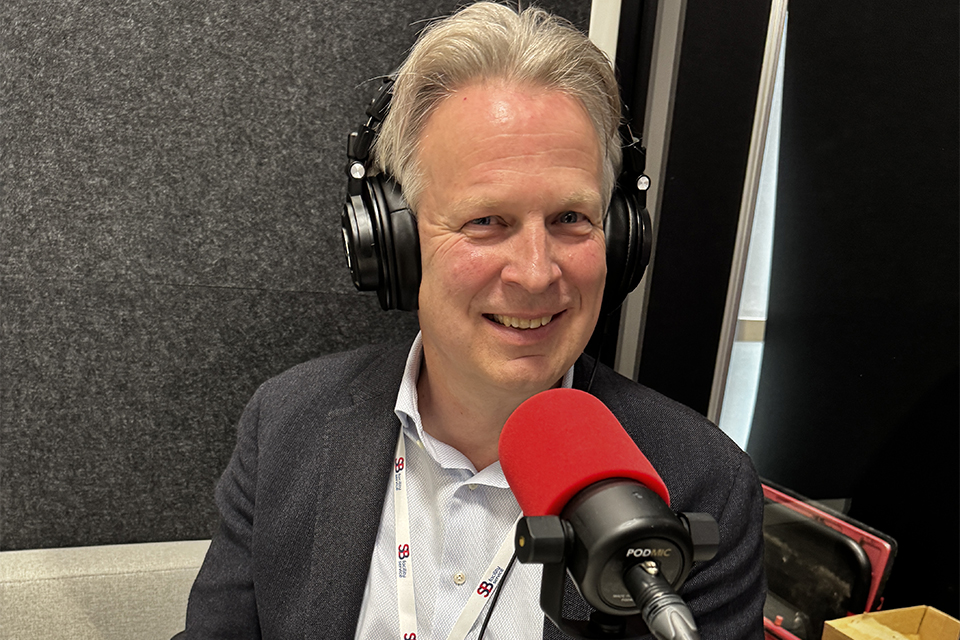
Jerry Helmers: Lightspeed Restaurant, the leading platform for the world’s top hospitality entrepreneurs. Thank you for listening to Hotelvak, the podcast. Produced by Louwers Mediagroep in Weert. This episode is part of a series in which we speak to industry experts and examine a current hotel dilemma. At any rate, it’s a dilemma or issue that every hotel owner, general manager or entrepreneur in the sector will recognise. And today I’m joined in the studio by Jeroen Coesmans, Managing Director of Vingcard. Linked to ASSA ABLOY, or should we just say Vingcard?
Jeroen Coesmans: Both are fine.
Jerry Helmers: Both are fine, yes, exactly. A very warm welcome, Jeroen – please come a little closer to the microphone. We’re going to be chatting for 30 minutes and we’ll try to discuss the dilemma of safety versus hospitality in the hospitality industry. Before we introduce you in more detail to the few people in the hotel industry who might not yet know who you are, I’d like to ask you: who should listen to this podcast and why? Or could you perhaps even make a promise that listeners will take home with them afterwards?
Jeroen Coesmans: That’s a very good question, Jerry, and thank you. Of course, this podcast is really aimed at anyone who works in a hotel, but with a particular focus on general managers, hotel owners, IT managers and security managers. But we might also have something of interest for the head of housekeeping and the head of rooms. So it’s quite a broad audience. And why will this be a fascinating podcast? Because I think there’s a lot happening across the industry in all sorts of areas, and that naturally presents all sorts of challenges, but also a great many opportunities.
Jerry Helmers: We’re going to be discussing those challenges in detail, because there’s certainly a lot going on in the hotel industry. I think we can put together a great story about that and perhaps eventually arrive at the solutions you’ve come up with, or the ones you might personally like to suggest. But first of all: who are you? We’ve heard your name, we know where you work. What sort of work do you do there? Tell us something that we should always remember about you.
[02:22] Jeroen Coesmans and Vingcard join ASSA ABLOY
Jeroen Coesmans: As director, I lead the Vingcard division. Vingcard is a well-known brand in the hospitality industry. It is part of ASSA ABLOY, a very large group that is the market leader in access control. And we focus primarily – or almost exclusively – on hotels. So it’s a very specialised division within ASSA ABLOY.
Jerry Helmers: What’s so great about working in the hotel industry?
Jeroen Coesmans: What I really enjoy is that you get to visit the most beautiful places – the sort of places people sometimes dream of spending a weekend at. That’s where I work almost every day. What I love is that the hotels are, of course, extremely hospitable and service-minded. And they expect the same from their suppliers. So expectations are often high. And we’ve been doing our very best, for almost 50 years now in the Netherlands, to meet those expectations. And perhaps even to try and exceed them from time to time.
Jerry Helmers: When you’re staying at a hotel yourself, whether in the Netherlands or abroad. Do you already have a sort of professional bias in that regard? Or are you the sort of workaholic who immediately looks around thinking: ‘This could be done differently?’ Or: ‘This could be better?’ You don’t need to mention the names of the hotels you’ve stayed in.
Jeroen Coesmans: No, fortunately it’s not that bad. In my experience, there are few, if any, bad hotels. I don’t come across them either, perhaps because I’m a bit biased by my profession and know where I want to stay, so I book there. But of course, my children do find it a bit odd from time to time. When I walk in, the first thing I look at is: what sort of lock is on the door?
Jerry Helmers: Is it really that bad? Yes, is it really that bad?
Jeroen Coesmans: Yes.
Jerry Helmers: They’re like: ‘Here we go again. Dad with his lock.’.
Jeroen Coesmans: Something like that. Yes, it’s even worse if I then try to bring it up with someone at reception. Or ask them about it.
Jerry Helmers: Oh, you’d do that anyway. So what sort of question might you ask an innocent young receptionist like that?
Jeroen Coesmans: It’s very simple. I’m staying overnight, just as I am now, because we’re here at the trade fair.
Jerry Helmers: We’re currently at the Independent Hotel Show Amsterdam, where we’re recording this podcast.
Jeroen Coesmans: Exactly. And my team and I are staying just round the corner with a very loyal customer who’s actually been with us right from the start – since we opened. Then I’ll ask the girl at reception, have a look at our keycard encoder and say: ‘Is it working to your satisfaction?’ And they’re often very surprised by that. Why would he ask that? I say: ‘We’re the supplier.’ We’re the supplier of your keycards and your access control system. When I do that with my daughters there, they’re really not happy. They find it very embarrassing.
Jerry Helmers: Yes, but those daughters are, of course, absolutely delighted that Dad’s earning a decent living too. Which means the daughters can do fun things as well, don’t they?
Jeroen Coesmans: That’s right. Yes, that’s right. It’s just that my youngest daughter is, I think, a bit – how shall I put it? – spoilt in that respect. I do joke about it every now and then. If she ever goes on holiday with her friends herself one day, I’m really curious to see what she makes of the experience. Because, well, I do try to show her the lovely…
Jerry Helmers: I’ve been thinking that perhaps we should invite your daughter onto this podcast one day.
Jeroen Coesmans: It can be quite entertaining.
Jerry Helmers: It could be quite entertaining. It might even turn out to be quite a surprise.
[05:47] Statements on safety, hospitality and technology
Jerry Helmers: Security versus hospitality – that’s pretty much the central theme. You could call it a dilemma, which is what we’re going to be discussing. I’ve got a few points I’d like to put to you. You can agree or disagree. Here’s the first one. Digital access control is now just as important as a good reception.
Jeroen Coesmans: I agree.
Jerry Helmers: A long, deep sigh. Did you have to do that? Yes, you had to give it a moment’s thought.
Jeroen Coesmans: Yes.
Jerry Helmers: But they have increased it.
Jeroen Coesmans: My answer is yes, but I did have my doubts. Fortunately, you’re asking: ‘Is it just as important as?’ You’re not asking: ‘Is it more important or the most important?’ So that actually makes it easy for me to answer. And I do think that both are indeed important.
Jerry Helmers: Smart technology does not make a hotel less personal; on the contrary, it makes it more efficient and welcoming.
Jeroen Coesmans: I completely agree.
Jerry Helmers: So what’s that all about? Could you explain that straight away?.
Jeroen Coesmans: That’s the point, and I’m not the only one who thinks so. There are, of course, other specialists in the market who share and express that view. People often think: well, if we digitise that, it’ll become more impersonal. It’s actually the other way round. What you often see at a hotel check-in, for example, is that everyone has to queue at reception because we somehow assume that guests really want a moment of personal contact, this can often just cause frustration for the guest who wants to check in very quickly because they still need to catch their Teams call in their hotel room. And they’re left waiting there because someone ahead of them wants a water bowl for their dog and wants to ask for a nice little Italian restaurant. Or whether they can hire bikes. Et cetera, et cetera. So the moment you offer guests a choice – such as the option to have a digital key on their phone – they can walk in and head straight to their room to make sure they catch that Teams call on time. Or they can check in at a kiosk and collect their key card there.
Jerry Helmers: Everyone’s happy.
Jeroen Coesmans: Yes, what happens then is that it’s actually the people working at the front desk, but even now you’re seeing a trend where people are saying: perhaps we no longer want to be behind the front desk, but rather in front of it, to welcome guests and guide them on their journey – that’s the fancy term we use for it these days.
Jerry Helmers: But do you really mean literally at the front desk?
Jeroen Coesmans: Or, as we’re seeing, some hotels don’t have a reception desk at all.
Jerry Helmers: No more receptions.
Jeroen Coesmans: No. And then perhaps you could sit down next to the guest with an iPad and say: ‘Did you have a good journey? Would you like a drink? I’ve got it here in the system, yes. Let’s check you in – and you’ll need to pay.’ Make the payment and you’ll have your keycard, then you can go to your room. Or would you like to receive it on your phone? Then we’ll send you a digital key.
Jerry Helmers: I’m not going to name names, but a major bank in the Netherlands – I think it was about 10 or 15 years ago – actually did away with reception desks or counters altogether, and instead a hostess would come over to you – and I believe that’s still the case today. That’s a completely different approach to the customer or guest experience. Would you say that this breaks down a kind of barrier? And by ‘barrier’, I mean literally that physical reception desk?
[08:59] The changing role of the front desk
Jeroen Coesmans: Yes, if you don’t set it up properly, a reception desk can, quite literally, be a barrier. We’ve all heard people say: ‘You really need to connect with the guest.’ But the person behind the desk is mostly staring at a screen, typing things in and looking things up. And the guest thinks: ‘There’s no real connection at all; there’s no eye contact at that moment.’ It’s a sort of procedure you go through, and it can indeed come across as rather distant. I won’t name names, mind you, but we recently fitted a large hotel in Amsterdam with a new access control system in collaboration with a number of partners. It has a very large reception area, with an entrance featuring islands, kiosks and real trees, where guests can check in themselves and collect their keycards. There are hostesses walking around to welcome and guide people, and there’s also a very small reception desk tucked away somewhere at the back. That’s where someone sits who’s there to help those who really need it, because something has gone completely wrong. Perhaps someone who’s only just made a booking for tomorrow, meaning that booking isn’t visible in the system.
Jerry Helmers: Yes, a reception desk just for the difficult cases.
Jeroen Coesmans: For example. Or if you really want to hand something over. But that’s just a mini reception desk. Where, of course, there used to be a reception desk metres wide. And the real action actually takes place in front of that reception desk, in the reception area where a very friendly and welcoming check-in experience has been created.
Jerry Helmers: But the reception desk is disappearing.
Jeroen Coesmans: That’s up to the hotelier.
Jerry Helmers: Yes, but such a general interpretation?
Jeroen Coesmans: I can well imagine that reception desks might disappear in the future. Perhaps not in all hotels, but for a large number of them, that could indeed be the future.
Jerry Helmers: There’s another point to be made. Hoteliers need to focus less on isolated solutions and more on a single, smart ecosystem.
Jeroen Coesmans: I agree.
Jerry Helmers: I suspected you might say something like that. One final point. The greatest gains for hotels in the coming years will lie not only in higher turnover, but precisely in greater control over hidden costs.
Jeroen Coesmans: I agree.
Jerry Helmers: I’m sure you’ve got a solution for that. But I’ll no doubt come back to that later. Let’s take a step back for a moment and look at the bigger picture. Let’s take a look at the industry as a whole, at the hotel sector. What are the major challenges – or could you name two or three challenges – facing the hotel sector?
[11:31] Staffing: a challenge for the hotel sector
Jeroen Coesmans: It’s a challenge – and perhaps a bit of a no-brainer, as it’s likely been mentioned before, perhaps in other podcasts or conversations – but it’s staffing.
Jerry Helmers: Staff, yes. Explain that to us – I have to admit, we’ve heard this mentioned in several recordings. So we’re gradually coming to the conclusion that you’ve got a point. But could you elaborate on that – what exactly is the challenge here?
Jeroen Coesmans: I think – as we’ve seen – there is a post- and a pre-COVID situation.
Jerry Helmers: Ah yes, that’s how you organise it. Yes, carry on.
Jeroen Coesmans: What we’ve seen is that, following COVID, people were naturally forced – because everything came to a standstill, particularly the hospitality sector – so the hospitality sector itself was, of course, hit very hard and started to think: how do we move forward from here? The staff did the same. And what we often see is that the people right at the forefront of operations really enjoy it. It’s in their blood – the hotel trade. They love interacting with guests and get a huge amount of drive and enjoyment from it. Anyway, within a hotel you naturally have the front of house and the back of house. And in the back of the house, there are people working in HR departments, in housekeeping, in IT, and in technical services. They rarely come into contact with guests, or perhaps don’t even consider that the most important part of their job.
Jerry Helmers: Boring work? What are you on about?
Jeroen Coesmans: Sometimes. Sometimes it can be repetitive and boring work.
Jerry Helmers: But why, then, do you describe this as a challenge for the hotel sector?
Jeroen Coesmans: Because those people have a choice. They don’t necessarily have to work in a hotel. They could also say: ‘I’m going to work at the university of applied sciences.’ Or for the City of Amsterdam.
Jerry Helmers: Or I’ll go and work in a hospital. Yes, because they literally don’t have any contact with the patients.
Jeroen Coesmans: That’s right, it’s further removed from the hospitality industry in general.
Jerry Helmers: Exactly.
Jeroen Coesmans: Whether you’re maintaining IT systems in a hotel, a hospital or a university of applied sciences, it doesn’t make that much of a difference. So how do you keep it interesting for those people so that they still want to continue working at the hotel or come and work there? But can you give an example of that? Yes, that’s the question: can you give an example of that? We’ve seen that during COVID, people weren’t so much being made redundant because there was no more work. But they were stuck at home and started thinking: ‘Am I still in the right place here? Should I perhaps have a look around elsewhere? Even if it’s just for a shorter commute.’ Or let’s be honest: the hospitality industry runs 24/7, so that includes Sundays, public holidays, evenings and weekends. When I was young, that wasn’t a problem. Now I have a family with children. Yes, I might want to work somewhere where the hours are a bit more regular.
Jerry Helmers: But then you’re mainly talking about people who carry out all those boring, repetitive tasks. And when you talk about retaining staff – which is a challenge – surely you’re also talking about keeping the work enjoyable for your employees.
Jeroen Coesmans: That’s right, so how do you keep the job interesting? So that people enjoy working in a hotel and want to carry on doing so.
Jerry Helmers: And that’s where we’ve got a brilliant solution. But could you give an example of that? Name a function, just to bring it to life.
[14:59] Reducing linen management and repetitive tasks
Jeroen Coesmans: Here at the trade fair, we showcase what we do much more fully. People often only know Vingcard for its locks – the card-operated locks on doors. These days, we offer much more, including linen management.
Jerry Helmers: Ah, that’s the direction you want to go in. That’s right.
Jeroen Coesmans: And we’ve seen that a great many people aren’t even aware that it exists. So what can we do? How does it work in a regular hotel? Well, it’s actually a bit old-school. Although it’s been that way for decades. Linen is sent off to the laundry every day and comes back every day. And that linen is then counted, by hand. Then a trolley comes in, and everything’s all jumbled up. It contains towels, napkins, fitted sheets and duvet covers. But with king-size, queen-size and twin beds – to name but a few – how can you quickly work out which is which? And then those lists are entered into the computer. And that’s how they try to keep track of: what linen do I have in my hotel? And how much has been washed, and how much do I have to pay the laundry for that? It’s, of course, very repetitive, quite meticulous work, but also quite time-consuming and tedious. We’ve come up with a solution for that.
Jerry Helmers: Let’s get straight to the solution, because there’ll be another challenge coming up that you’ll recognise. But what, then, is the solution to make that work more enjoyable?
Jeroen Coesmans: We have a solution. You place a large cabinet in your hotel where linen is brought in or taken out. We wheel a whole linen trolley into it in one go, close the door and it is scanned, because we have fitted the linen with a tag – a chip – which is programmed. And it doesn’t have to be towels with towels; they can be mixed right up together. We scan all the linen properly in one go. And we scan it out again when it’s sent away dirty. That way, of course, you can see at any given moment how many towels there are in your hotel. Because if you’ve ever started with a thousand towels and every day you get two or three fewer back, by the end of the year you’ll have run out of towels. At a certain point, we can also see how many wash cycles those towels have been through, when you’ll need to replace them, and how long it will take to programme the system – how long it takes before you have new towels.
Jerry Helmers: Anyway, what you’re saying is: you make the job more interesting for your employee in that respect, because they no longer have to do the tedious task of counting those towels every day.
Jeroen Coesmans: That’s right. And at some point they’ll probably just make an estimate, or they’ll simply forget about it. And I’ve seen examples of people who have to enter those count lists into the computer but don’t always have time to do so. Then it gets left undone, and you might as well stop counting altogether, because it’s completely pointless. Because the whole data set is basically corrupted. And if you could say to someone in housekeeping: ‘Lads, what you’ve been doing all these years, you don’t need to do anymore. We’ve come up with a solution and you’re free from that boring, repetitive counting. I can think of more enjoyable things to do.’.
Jerry Helmers: Exactly.
Jeroen Coesmans: Yes. Exactly.
[17:36] Cost control and profitability in hotels
Jerry Helmers: The second challenge facing the hotel sector. Because we’ve just been talking about staff. How do you retain staff? How do you keep the work interesting for your staff? Are there any other challenges facing the hotel sector?
Jeroen Coesmans: Certainly. And that’s a bit of a bridge, too. The second challenge is, of course, cost-efficiency.
Jerry Helmers: Oh, so we’re talking about returns.
Jeroen Coesmans: Yes, at the end of the day, we’re still business owners, aren’t we? And that’s quite a challenge. Just imagine what we hoteliers have to deal with here in Amsterdam – other cities have, of course, been only too happy to follow suit with an increase in tourist tax.
Jerry Helmers: Yes, city tax.
Jeroen Coesmans: On top of that, a VAT increase from 9 to 21 per cent is, of course, quite substantial. And then you’ll just have to see how it goes. A: You can’t always pass that on. What impact does that have on your bottom-line returns, your occupancy rates and the margin on your rooms? Then you might have to look for cost savings to see how you can somehow end up with a profit at the end of the day.
Jerry Helmers: So perhaps there’s a bit of a link there with what you just said about linen management. If you manage it more efficiently – that is, literally allocate fewer FTEs to it, so you can perhaps deploy those FTEs elsewhere – you’ll at least save on staff costs in that area.
Jeroen Coesmans: The savings lie elsewhere, and they can be realised much more quickly. It gets a bit technical, but there are two models within a hotel. Hotels either own their linen or hire it, leasing it through a linen company. In the case of ownership: if the towels go missing, they’re your own towels. But at some point, you also want to know what you’re paying for and exactly how much has been washed. So that’s an immediate, very quick first saving if you can get that under control. Another thing you’d see in hotels is that if, on one occasion, someone ran out of towels during a peak period, the general manager wouldn’t be happy. Then, of course, everyone gets a telling-off: that won’t happen to us again; we’re going to make sure we’re covered. They’ll build up extra stocks to prevent running out again. As a result, you often end up buying far too much linen, holding it in stock and having to keep it there, which takes up space. So if you have good control over that, you can also manage your linen more efficiently.
Jerry Helmers: That’s clear once again. Could you give another example of an aspect of business operations where you can cut costs, which will ultimately boost your returns?
[20:01] Energy savings with smart room sensors
Jeroen Coesmans: Certainly. Everyone is probably familiar with what we call the card reader on the wall – the one you see when you walk into a hotel room.
Jerry Helmers: Yes, you’re already in the dark, trying to work out: where on earth is he? Because the door’s already slammed shut behind you. That and that.
Jeroen Coesmans: Yes, and what’s the idea? It’s actually very simple: if a guest leaves the room and takes the card with them, then – bang – the lights go out, and the air conditioning or heating switches off. That’s a very simple, basic way of saving energy. But what do we see in practice? People are worried: ‘Well, if I go to breakfast, my laptop won’t charge.’ So you see that people start to get round the system. They’ll pop in cards from the DIY store or come up with other daft ideas.
Jerry Helmers: Do they actually do it, then?
Jeroen Coesmans: Some do.
Jerry Helmers: I’ve had this happen before – I find it a bit odd, actually – when the receptionist gives me a second key card. She says: ‘Yes, just in case you leave the room.’.
Jeroen Coesmans: Yes, you sometimes get them for other reasons as well. Anyway, that could be the case here too. But it’s true, most of them just work because they contain a very simple flip-switch. It simply responds to a card.
Jerry Helmers: That’s right, yes.
Jeroen Coesmans: The smarter ones don’t react, because they read the tag on your keycard and can tell whether you’re actually a hotel keycard or a Kwantum loyalty card. So, but what else happens? People pop that keycard in, and your air conditioning switches on. They set the air conditioning to 18 degrees, whilst it’s 26 degrees outside. It’s nice to leave the window open, though – you open the curtains and windows, and then the heat comes in and the air con just keeps roaring away. Conversely: in winter it’s cold, so we turn the heating up, open the window – it’s 6 degrees outside – cold air comes in, and the heating carries on running. We can make that work smarter in no time at all by adding sensors and getting rid of that card reader altogether. Because even if someone comes in with a mobile key: well, how am I supposed to cram my phone into that little box? That’s a bit of a nuisance too. So what did we notice? The chambermaids: ‘Oh, they’ve got a mobile key, so I’ll pop a card in there in advance.’ Because otherwise, when that man or woman comes in, they won’t be able to switch on the lights. That’s obviously a bit of a workaround. We can very quickly convert that to a system with sensors. So it checks whether anyone is in the room. The moment someone leaves the room, there’s a door sensor in the door. The door opens, and the system checks: ‘OK, is there still movement in the room?’ If so, I stay on. The moment there’s no more movement, I switch everything off. But even if someone says, ‘I’ll set the air conditioning to 18 and open the window,’ the air conditioning switches off. Or the heating. That way, you make significant savings very quickly, and with current energy prices, that adds up to real money very quickly. But you’re also doing your bit for sustainability and the planet.
[22:40] Hotel guests’ sense of security
Jerry Helmers: How would you sort out the following? Well, I think I’m actually a really bad example of a troublesome guest in a hotel. Ultimately, I always think about safety as well. And you sometimes see on Instagram and all those social media platforms tips on how you can still get into a hotel room when the guest isn’t there. How you can still open a lock from the outside or how everything can be tampered with. So what do I do? I hang the ‘Do Not Disturb’ sign on the door when I go out for breakfast or into town, or whatever. But, well, it’s a bit of a risk, but I always leave the TV on as well. So if some dodgy character is standing outside the room door and hears the television inside, I reckon that sort of dodgy character with bad intentions would think: ‘I’m not going into this room, because the guest is probably lying comfortably on their bed watching the telly.’ Is there anything you can do about that? Because, of course, the hotel owners aren’t happy about this either, because the TV’s on. Well, it uses energy, it uses electricity. And I’m not there. And of course there are also hotels where, if you do take the keycard out, the TV eventually switches off after 10 minutes, straight away, or whatever. But I’ve experienced it before where the TV just stays on. I’m a bad person.
Jeroen Coesmans: No, you might just be a bit anxious. So I’d say, first and foremost, you shouldn’t have to worry that, when you’re not in that room, someone could gain unauthorised access to it. And that, of course, starts with proper access control. But ultimately, it’s all in the guest’s mind. You seem to be the sort of person who does worry about that sort of thing.
Jerry Helmers: I’m exceptional.
Jeroen Coesmans: I don’t know, perhaps more people feel that way.
Jerry Helmers: Yes, you do think: if you’re on a long trip, for example, you obviously don’t want to lose your stuff because some bloke walks into your hotel room. I have to say, though, it’s never happened to me. And I also have to say that I…
Jeroen Coesmans: Well, perhaps it’s because of that television over there.
Jerry Helmers: Yes, I mean, I let myself be influenced too much by all those dodgy Instagram videos. But I have to say: when I check into a hotel and I see that your keycard is the only way to get the lift working, that in itself gives me a nice feeling somehow.
Jeroen Coesmans: Yes, we can expand that further so that you can also go directly to the floor where your room is.
Jerry Helmers: Exactly.
Jeroen Coesmans: However you set it up, you don’t end up in the wrong corridors.
Jerry Helmers: So there are plenty of opportunities for hoteliers to make those savings and, as a result, ultimately need fewer staff, thereby creating that sense of security and maintaining a high standard of hospitality.
Jeroen Coesmans: And another thing we make – this might sound a bit like a sales pitch, of course – but naturally we also supply the safes for hotel rooms. So when you leave your room, you can store your laptop, your wallet and your car keys in your safe. And if, say, housekeeping comes into your room, for example, you can rest assured that all the 99% safes are trustworthy. If you’re not entirely comfortable with that, you can at least store your valuables in a safe beforehand.
Jerry Helmers: On the other hand, if I’m walking down the corridor in a hotel, I’d also like to grab one of those little bottles of shampoo from one of those trolleys standing there in the corridor.
Jeroen Coesmans: Alarm systems are needed.
Jerry Helmers: You had me for a tenth of a second there. I thought: oh my god. I have to say, it’s really bad, but I have helped myself to a bit of shampoo once or twice. Then I think: I’ll just take it. And I walked ten metres further and turned round, just to check if there were any cameras in the corridor.
Jeroen Coesmans: Often, yes.
Jerry Helmers: A guilty conscience. I really am giving myself a bad name. But I’m sure you’ll come up with technical solutions for this as well. Well, looking ahead to the hotel sector: would you dare to make a prediction or offer your take on what the whole hotel industry will look like in ten years’ time? And, of course, based partly on your own area of expertise. When you talk about digitalisation, AI could well be factored in here, and security remains a top priority. Just pretend for a moment that you’re a trend watcher.
[26:30] AI, digitalisation and the hotel room of the future
Jeroen Coesmans: Good one. And yes, of course, it’s the magic buzzword. I think this podcast is too short to go on about that for hours. What exactly is AI? Just as with greenwashing, a lot of things are labelled as AI that make you wonder: well, is that really ‘artificial intelligence’? But yes, of course we can see that AI can support hotel processes. We’re already seeing some very good examples of this. They don’t necessarily have to be particularly complex. So I think that trend will certainly continue, especially for hoteliers. Once again, the question is: firstly, how can we improve the user experience – the guest experience – with AI? How can we support operations? And how can we make work more enjoyable for our staff? Particularly in that regard, I see it as a…
Jerry Helmers: But will a hotel room still look the same in ten years’ time?
Jeroen Coesmans: I think, well, you know, people have, of course, been sleeping in beds for a very long time. We no longer sit upright like we did in the Middle Ages. So I think that, you know, at some point, you’ll see televisions in hotel rooms being used less and less, but streaming services will take their place. So you can just watch your own Netflix series and things like that.
Jerry Helmers: Exactly.
Jeroen Coesmans: So I don’t expect the room itself to change all that much in terms of how a guest experiences it. What I do see happening is that the technology behind that room is changing. And that could be in many areas. As I just mentioned, this could make such a room a bit smarter, enabling you to save energy, but also enhancing the guest experience straight away.
Jerry Helmers: But are you also talking about those lovely displays you sometimes see in hotel rooms, where, as a guest, you can actually customise your room to some extent?
Jeroen Coesmans: That’s right, and we supply those kinds of systems too. You need to distinguish between energy management – that is, the management aspect – and, of course, it’s often mainly about climate control and lighting. Then there’s guestroom management. That’s more about the guest experience in terms of your lighting scenes. You could call it that – a nice English word. But in any case, it’s about your lighting arrangements for the evening, to create a cosy atmosphere.
Jerry Helmers: Yes, that’s it. But seriously, I sometimes find myself in hotel rooms wondering: which switch controls which light? You press one, or click a button, and suddenly everything’s off and everything’s on full. And then you want that one little lamp by your bed on, and you end up trying the buttons 26 times. Surely there must be a better way, especially now? Can you come up with a proper solution for that?
Jeroen Coesmans: We’ve already got those. And you’ve described it perfectly. What you often see is that these kinds of systems are, yes, even installed in office buildings or very luxurious homes. If you’ve got one in your home, at some point you’ll know which button controls which light. Often, though, the buttons are quite small, so you need to be fairly tech-savvy and know what you’re doing to be able to operate it at all. We offer a system with very large, intuitive buttons featuring pictograms – which you can choose from – for the lighting, and they’re self-explanatory. And if people wish, we can also engrave labels in any language above them, for example ‘curtains’ or ‘lighting’.
Jerry Helmers: After this podcast recording, I’ll give you the name of that hotel where you’ll need to sort that out. Yes, I’ll go along then. It’s either the light’s on or it’s completely off – but really, absolutely everything in that hotel room. It’s dreadful. But I’m not going to name names; I’ll just give you the tip afterwards. And yes, just before we move on to your ‘60 seconds of fame’, could you give the listeners three useful tips – things they can get started on straight away when they finish this podcast and head back to the office tomorrow morning?
[30:33] Practical tips for hoteliers
Jeroen Coesmans: Yes, what I’m actually referring to is that we don’t need to make it too complicated, because then people often never get started. And it doesn’t always have to cost a lot of money either. What I’d call, in plain English: the quick wins. Just look at what you can implement quite easily – things that will also deliver savings fairly quickly. Because spending money is fun, but saving money is even more fun.
Jerry Helmers: So just go for the low-hanging fruit.
Jeroen Coesmans: Exactly that.
Jerry Helmers: Right, how easy is that? Do you have a second tip?
Jeroen Coesmans: Well, I wanted to give an example of that.
Jerry Helmers: Oh, you want to go even further?
Jeroen Coesmans: It’s exactly what I was just saying. For example: just have a quick look around your hotel room. How’s my energy management, and can I manage it in a smart way? You can often convert a room in an hour or an hour and a half, which means you don’t even have to block that room off and it doesn’t come at the expense of your room revenue. And in no time at all, you’ve created a smart room that saves money straight away. And that’s not just about saving the planet, but also saving your wallet.
Jerry Helmers: Right, can I ask for the second tip now?
Jeroen Coesmans: Absolutely. My second tip would be: see what technology can do – in line with what we said earlier – to ensure your hotel is and remains modern, not only for the guest experience but also, and certainly, for the staff. That ensures that working in your hotel is, and remains, a pleasure.
Jerry Helmers: Are guests looking for a modern hotel? Or are guests disappointed if the hotel isn’t modern enough?
Jeroen Coesmans: I don’t really think so. You can also exceed expectations. So, what does a guest expect from a hotel experience? If they think: ‘Wow, I’ve never thought of that before. That’s really cool, that’s really brilliant.’ Here’s an example I like to give: Vingcard was the first to launch wallet keys on the market. And yes, you can see your hotel key digitally in your wallet. Because via your phone – these days, guests arrive by plane, and their boarding pass is already in the wallet. They book an Uber via their phone. So then, if you can say: ‘You’ve already got your keycard on your phone too, so you can simply continue your entire guest journey at the hotel by just letting the phone handle everything.’ Then I think that at some point they’ll realise: ‘Gosh, I didn’t expect that.’ I think that’s really brilliant.
Jerry Helmers: And of course, that’s a real plus for a hotel manager.
Jeroen Coesmans: Yeah, that’s really cool, you know. Wow, I’m just opening the door here with my phone.
Jerry Helmers: One more tip – the third and final one – for listeners who are thinking: ‘I want to get started on that tomorrow.’.
Jeroen Coesmans: A third and final tip…
Jerry Helmers: There’s someone standing at the window, waving.
Jeroen Coesmans: Everything’s going really well.
Jerry Helmers: Or does that come as a bit of a surprise to you?
Jeroen Coesmans: A bit.
Jerry Helmers: Well, have another think about that. Maybe you’ll have one more at the end of this podcast. Then you can add it in. It’s finally time for your 60 seconds of fame. I always call it the ‘Loekie de Leeuw moment’. Your 60 seconds – one minute of commercial speaking time. You’re free to use it however you like. I’ll set the timer. So my question to you is: are you ready?
[34:00] Vingcard’s 60 seconds of fame
Jeroen Coesmans: Right, Vingcard is known in the Netherlands, but also worldwide, for its card-operated locks. We were the inventors of the hotel room door lock, but these days we do much more than just that. We also supply Wi-Fi networks. We supply the energy management and guest room management systems mentioned earlier. We supply systems for linen management. We can also provide asset tracking solutions for hotels. We can supply staff safety solutions. What’s more, we can enable all these systems to communicate with one another, allowing you to build an intelligent tech stack within a hotel. So yes, do get in touch with us for the best access control for your hotel, but also for all those other solutions you might not have immediately expected or sought from us.
Jerry Helmers: That was a lovely minute of fame, sixty seconds of fame, a neat pitch. We’ve come to the end of this podcast. Yes, I asked you earlier – and perhaps I asked too much of you – do you have three tips? You’ve given two, and you found the third one a bit tricky to come up with. You’ve had a little time to think about it, and you’ve presented your pitch in the meantime. Do you have that third tip for our listeners now?
[35:29] The hotel as a meeting place – more than just a place to stay
Jeroen Coesmans: Yes, you’ve certainly got me thinking and challenged me a bit, Jerry. And of course, I think I’ve got another good one that might come from a slightly more unexpected angle. But hotels are often just so fantastic when you check in for the night. And that makes you feel good. I’d like to say to hotels – and some are already doing this – but I think there’s still room for improvement. By not just focusing on the guest who’s coming to stay the night.
Jerry Helmers: Ah, I see what you mean.
Jeroen Coesmans: Yes, but also saying: why not just pop back next time for lunch with your friends? Or come here to hold a business meeting. And you can hire a meeting room from us or book a table with a lunch package. Which means, of course, that the hotel has much more to offer than just a place to sleep.
Jerry Helmers: Yes, a hotel is more than just the sum of its rooms and beds.
Jeroen Coesmans: That’s right, and of course it also serves the neighbourhood, as we know, which naturally makes you an asset to the area. But the neighbourhood does need to know that you’re welcoming, that you’re a great place to pop in for a beer at the bar, and that the door is always open to everyone.
Jerry Helmers: Jeroen, I’d like to thank you for coming to the studio in this beautiful boat where we’ve set up our studio. Because we’re currently at the Independent Hotel Show at the Amsterdam RAI. That’s where we recorded this podcast. I really enjoyed recording this podcast. Any more tips for me? Did I put you under too much pressure?
Jeroen Coesmans: Certainly not, certainly not.
Jerry Helmers: Are we ever going to do that again?
Jeroen Coesmans: Yes, I’d love to. And yes, I thought it was really entertaining – time just flew by.
[37:08] Final episode of Hotelvak, the podcast
Jerry Helmers: Right, well, we’re going to ask our listeners if they could indeed post their comments on this podcast on Spotify. Then we’ll see, Jeroen, whether we’ve actually produced an entertaining podcast. So that’s going to be exciting for us now. Jeroen, thank you once again for coming here to the studio and for the time you’ve invested in this. And of course, I’d like to thank all our listeners for tuning in. My name is Jerry Helmers. I was, and still am, the presenter of Hotelvak, the podcast. The project manager is Daniel Bundel. And this whole project has, of course, been made possible by Louwers Mediagroep in Weert. Thank you for listening, and see you in the next episode.


 Nederlands
  English (UK)