hotelvak.eu
EN

Platform on hotelmanagement, interiordesign and design in the Netherlands

Koninklijke Horeca Nederland (KHN) is calling on the government to set a cap on the tourist tax. A comparison carried out by the trade association of popular European cities shows that Amsterdam has the highest tourist tax in Europe. Many other Dutch local authorities are also increasing their rates.
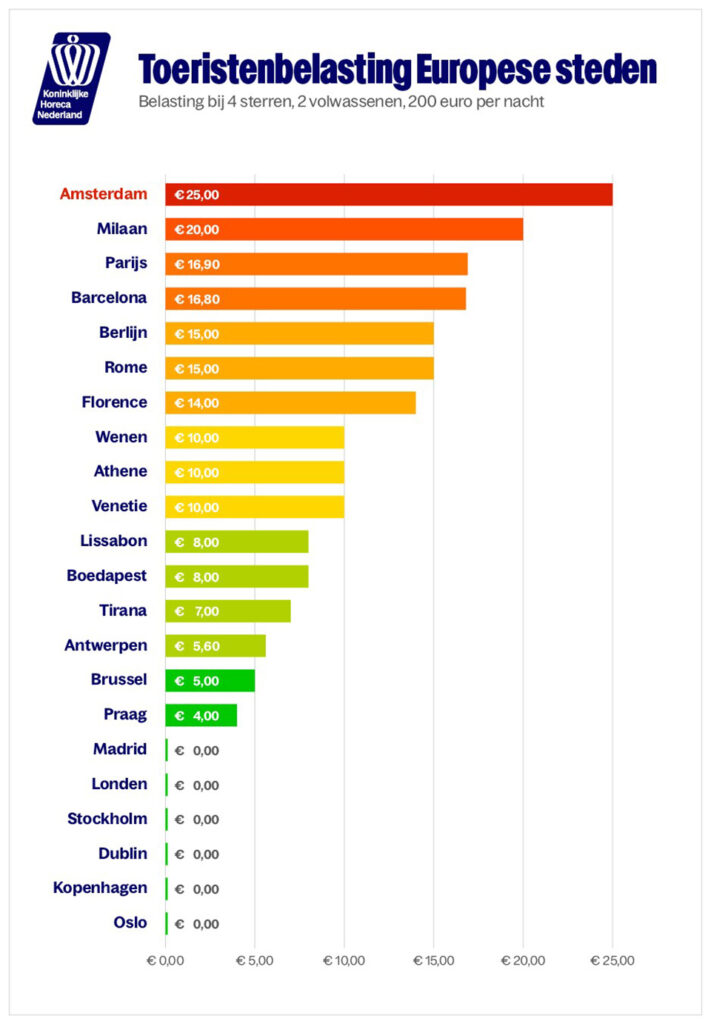
The trend in tourist tax, both in general and in Amsterdam in particular, makes it abundantly clear that local authorities will not, of their own accord, stop constantly increasing tourist tax. Recently research The Bungalow Park Overview shows how the local tourist tax has risen. According to the KHN, a (statutory) cap is necessary.
The current tourist tax in Amsterdam is 12.5% of the room rate (excluding VAT) and will rise to 16% from January 2027. If the new coalition’s plans in Amsterdam are implemented, the tourist tax will rise to 20% in 2030. Add VAT to that, and tourists in Amsterdam will be paying 41% in tax by 2030. This puts Amsterdam well ahead of cities such as Barcelona, Paris, Rome and Berlin. According to KHN, this threatens to make the Netherlands increasingly less competitive internationally as a tourist destination.
KHN had already raised the issue in April that hotels that keep you awake. These concerns are reinforced by recent figures from Rabobank, which shows that the number of overnight stays in the Netherlands has fallen for the first time in 10 years. Reasons for this include the increase in VAT on accommodation from 9 to 21% and the tourist tax, which was raised by an average of 10% across Dutch municipalities in 2026. According to KHN, the government should instead focus on promoting attractive tourism, as this benefits not only the hospitality sector, but also shops, cultural institutions, transport operators and, ultimately, the government itself.
Local authorities set the rate of the tourist tax themselves. There is no statutory upper limit. KHN recognises that local authorities incur costs in providing tourist facilities and maintaining the quality of life in the town. However, the trade association notes that the tourist tax is increasingly being used to plug gaps in the local authority budget or to fund other policy objectives. According to KHN, this is not what this tax is intended for.
Neem dan rechtstreeks contact op met Royal Dutch Catering Association.
 Contact opnemen
Largest trade organisation Royal Catering Netherlands (KHN) is the largest catering trade organisation in the country, with over 20,000 catering entrepreneurs and thus some 255,000 catering employees we represent. We are committed to the industry, give advice and keep an eye on all the news surrounding the hospitality industry. We also regularly launch our own campaigns to ensure [...]
View Company profile Nederlands Nederlands
  English (UK)