[00:00] Introducing Hotelvak, the podcast
Lightspeed Restaurant, the leading platform for top hospitality entrepreneurs worldwide.
Welcome to Hotelvak, the podcast. The podcast about running a business in the hospitality sector.
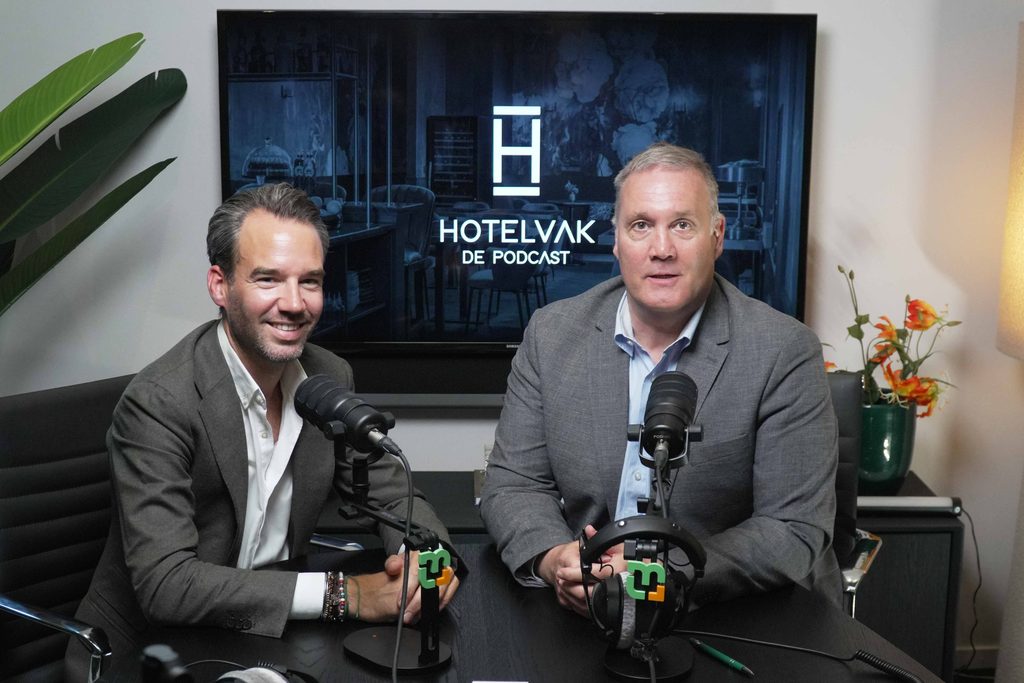
Jerry Helmers: You’re listening to Hotelvak, the podcast for professionals working in the hotel sector in the Netherlands. My name is Jerry Helmers and I’m the presenter of this episode. And we’re going to have another really enjoyable – or so I hope, at least; I’ll certainly do my best – interview. Because I have none other than Ruben Schuuring as my guest here in the studio today. He’s made a long drive today to get to the studio in Weert. I understand you’ve come all the way from Dronten today to have a chat with me. Ruben, we’ll be introducing you in a bit more detail in a moment – who you are, where you’re from. But what made you decide to accept our invitation to come here for this profile interview?
[01:02] Reasons for taking part in the interview
Ruben Schuuring: First of all, thank you for the invitation. It’s really lovely. It’s a chance to tell people more about our profession. The way in which someone develops in this field or ends up here isn’t the same for everyone. That’s true for me too, so I enjoy sharing that as well. Perhaps it might inspire others a little, too.
Jerry Helmers: Because what do you think people can learn from you? That might already be a teaser for the end of this podcast.
Ruben Schuuring: I think what people can learn is that once you’ve decided to do something for yourself in the future – in other words, if you want to achieve something – you should stand by that decision and keep at it. Even if other things come your way that aren’t always easy.
Jerry Helmers: But if you work in the hotel sector or in the hotel industry, that’s obviously an extra challenge: having that perseverance, staying true to your passion and continuing to believe in yourself. Because, of course, you never work normal hours, do you?
Ruben Schuuring: No, and that’s one of the very first things you learn, of course. You have to be flexible. You have to be able to work in the evenings, on days when others aren’t working. That has its advantages, and it has its disadvantages too. But that’s what you choose. So I was already aware of that. But staying on course and ensuring you’re heading somewhere – that also requires discipline. Saying goodbye to the people who aren’t contributing to that, but also having the courage to let people go.
Jerry Helmers: Then you’ve got to be able to make a decision.
Ruben Schuuring: Yes, certainly. And I think it’s important that, when you make a decision, you take the time to think through the consequences for yourself before you act. Some people in the industry are still sometimes caught off guard, even though these are fairly straightforward matters that you could have anticipated.
[03:08] Young people in Amersfoort, Nunspeet and Dronten
Jerry Helmers: We’re going to go through it all with you, so that we’ll know a bit more about you by the end of this podcast. But first, Ruben, the basic question: who are you and where are you from?
Ruben Schuuring: I’m originally from Amersfoort; I was born in hospital there. I was the third of five children. An incredibly warm, loving family. Both my parents are from the city, but at some point they came together after both had been through a divorce. [unclear] way of starting a family, and we then said goodbye to the city. We moved to the Veluwe.
Jerry Helmers: What do you mean by ‘forming a family in your own way’?
Ruben Schuuring: They both came from families where they’d eventually realised: this isn’t how we’d want things to be. So that was a good thing. Both situations called for a different kind of attention, and my parents, when they got together, ultimately decided: we want to do things differently. One example was this: one family had three children, the other two. The fact that my parents aspired to have a large family was, in itself, a bit of a head-scratcher: ‘Well, why would you want to do that?’ It’s a slightly different way of thinking. And that’s what they did; they left the city behind, though having grown up with that city mindset, to settle in a little village in the Veluwe, in Nunspeet. And that’s where I lived until I was ten.
Jerry Helmers: How old are you now?
Ruben Schuuring: 39. And after that we moved to the polder, to Dronten. For the simple reason that you get more house for your money. It was more convenient in terms of work. As far as schools were concerned, it was a bit more innovative, a bit more forward-thinking. Some of the family were already living there.
Jerry Helmers: Nunspeet is, of course, very conservative. Dronten perhaps a little less so?
Ruben Schuuring: Fewer, yes. It’s a pioneer village, founded and built by people from various provinces who were given the opportunity to farm or set up businesses there. Everything had to be started from scratch there.
Jerry Helmers: Yes, of course, it was all water to begin with.
Ruben Schuuring: Yes, exactly.
Jerry Helmers: But if I’ve understood correctly, you were about ten years old when you moved to Dronten.
Ruben Schuuring: Yes, so that was already quite well developed.
Jerry Helmers: Anyway, when you’re ten, I think that’s when a sort of awareness starts to develop in your life – one that you’ll still remember later on. Anything that happens before you turn ten – perhaps the odd little thing here and there – but for the most part, you don’t really remember it anymore.
Ruben Schuuring: Not really any more, no.
Jerry Helmers: What stands out most in your memory from when you first wandered around there as a young boy?
Ruben Schuuring: Great.
Jerry Helmers: Big?
Ruben Schuuring: Great. It was an indoor shopping centre, which was actually quite innovative and interesting even back then. As a ten-year-old boy. When I look at my eldest son now, who’s that age, it’s quite special to experience that too, because you realise: oh yes, I was at that stage back then, and I remember that time. Really looking around you, being curious. There was more going on.
Jerry Helmers: More happened than in Nunspeet.
Ruben Schuuring: Yes. And as for the rest, you complete the last two years of primary school there. And that was innovative too. We were living in a new housing estate at the time, and the teachers had to come with us to the new school. Otherwise, we wouldn’t have had enough staff to run Year 8 at the new school. So that’s how new and how recent it all was. Looking back, I do see it as a special time.
[06:44] Curiosity and discovering things for oneself
Jerry Helmers: Have you taken anything from that experience into your life today? Anything that makes you think: ‘Those final years at primary school – that’s something that has partly shaped who I am’?
Ruben Schuuring: We had to figure out a lot more things as we went along, because it wasn’t there yet.
Jerry Helmers: Because everything was new in the newly reclaimed polder.
Ruben Schuuring: Yes. So Years 6, 7 and 8 – that was, so to speak, fifteen pupils. So just add that all up. My little brother was also in my class, and that occasionally worked in my favour at the new school. So perhaps that shaped the rest of it a bit.
Jerry Helmers: Now I’m thinking: you’re an entrepreneur – we’ll be discussing that in detail later on with RBS Hotels. You might not have thought of it quite like that as a boy of ten, eleven or twelve, but perhaps that’s where the foundations for entrepreneurship and discovering things for yourself were laid, enabling you to take all these steps now that you’re an adult.
Ruben Schuuring: Yes, that’s when my curiosity really started to grow. The advantage of a new-build estate is that people come to live right next to one another. They haven’t met each other yet. They get to know one another; you share the garden. So a sense of community and a nice atmosphere with the neighbours develops quite quickly. And there was a hotelier living on that street. A man who, well, his driveway was always empty, so there was never anyone there. Coincidentally, he also had a large family. We used to play with the children in the street a lot. And that’s how you end up getting to know that man. He became friends with my parents too. And that’s when he took me to the lobby of the Hilton on Apollolaan for the very first time.
[08:31] First taste of the hotel industry
Jerry Helmers: But how old were you when you were left there in that lobby?
Ruben Schuuring: I was still at secondary school back then. So I was about fifteen or sixteen.
Jerry Helmers: Right. Because that means we’re actually taking a bit of a leap now, from Year 8 straight into the middle of your teenage years. Someone who owned a hotel or was involved in the hotel business lived on your street, but they weren’t there. But eventually, through that boyfriend, you literally found yourself in the lobby of a hotel on Apollolaan in Amsterdam and came into contact with the hotel industry.
Ruben Schuuring: Yes. And I went to school in Harderwijk, because there was only one secondary school in Dronten, so after that you had two options. And if you didn’t fit in there – as was the case for me – you soon had to head to Harderwijk. Or to Lelystad. So that meant catching the bus early on, again outside Dronten. So that shaped you a bit as well. And there you are, all on your own on the bus with other children. That really does make you get creative. And then I was able to choose the ‘consumer services’ course quite early on. That was a VMBO course: cooking and serving. And I realised quite quickly that I wanted to work in the kitchen, and later that turned into service, [unclear].
Jerry Helmers: But what was the trigger that made you think: ‘This is the right fit for me’, rather than, say, being a bus driver or train driver, a locomotive driver or a pilot – you name it? So what was that trigger?
Ruben Schuuring: Well, it’s definitely… It’s a bit like a stage. You get to do something for others – so interact with people – but also do something that’s just really fun. Ideally, everyone comes for a reason. That’s good food and drink. A basic need, you could say. And also, to some extent, a bit of pressure from school. You can do this, and you can do that. Initially, the options were construction, hospitality and care. And then you choose – in my case – hospitality, because that seemed the most fun to me.
Jerry Helmers: Of course, you don’t know that for sure yet either.
Ruben Schuuring: No, so you’re still finding your feet a bit. But I did know this was the thing that suited me best right now. I think I quite like it. And I’d actually gone along with my uncle once when I was a young lad. He ran a little catering business on the side. And he let me serve once, just for fun. So I’d had a bit of a taste of it. It seemed like fun to me. That’s actually how it all started.
[11:04] Impressed by luxury hotels
Jerry Helmers: So there you were, sitting in that hotel lobby on Apollolaan. The turning point in your life.
Ruben Schuuring: Yes, literally, I don’t know. You could call it that. I did decide at the time: this is it. There were managers, and I thought of a hotel manager, staff, [unclear]. But I was incredibly impressed. He simply took me along with him. He said: ‘Why don’t you come along? I’ve got to go to the office on Saturday. Fancy coming with me? You can sit in the lobby and wait until I’m done.’ So that’s what I did. And I remember it very well: everything was in print, so I picked up every leaflet I could find about the Hilton. That same year, I did the same at all the five-star hotels in Amsterdam. Because I thought the luxury and the buzz surrounding a hotel like that, and the people and the way they were dressed, were absolutely amazing.
Jerry Helmers: Hang on a moment. So you were just sitting there in the lobby as a lad of about fifteen or sixteen. You were allowed to go along with that neighbour. And so, for you, this was really just a journey of discovery into the world.
Ruben Schuuring: Yes. I’d been to Amsterdam once, of course, but not as part of my upbringing. We used to go to campsites and spent a lot of time at home. A really lovely, cosy life, but we didn’t have the luxury of staying in hotels or going on city breaks and that sort of thing. So I wasn’t at all familiar with that sort of thing. I was incredibly impressed.
Jerry Helmers: But did people in the lobby – guests or hotel staff – ever speak to you? A fifteen-year-old boy all on his own.
Ruben Schuuring: Look, the neighbour in question was ultimately responsible for the hotel, so people knew: that gentleman had brought his nosy neighbour along.
Jerry Helmers: Exactly.
Ruben Schuuring: So that was actually quite nice.
Jerry Helmers: Surely they did have a chat with you from time to time?
Ruben Schuuring: Of course. You’ve ended up in a sort of village where everyone ends up there in different ways.
Jerry Helmers: So were they the people you met there? I’m just thinking of the chambermaids, the receptionists, the bar staff at the hotel bar – the ones who might have popped round to bring you a Coke every now and then?
Ruben Schuuring: No, that wasn’t on the agenda.
Jerry Helmers: What wasn’t on the agenda?
Ruben Schuuring: No, because when I’m in a lobby like that, I look round and then I set off exploring. I want to see everything. That’s curiosity for you. When people ask me, ‘How did you end up here?’ or ‘How do you go about it?’, I don’t just sit down on a bench and stay there. I start thinking, I look around: ‘Hey, what’s over there?’ Curiosity. Have a quick look, pop into the restaurant, pop into the bar and then the auditoriums. Then I’d start counting the number of auditoriums. Why? No idea. Just curious – it’s fun to look around and see what’s going on.
[14:10] Finding your own way during adolescence
Jerry Helmers: What did your mates in Dronten make of that? The fact that you just went for a wander round a hotel to see how things worked there.
Ruben Schuuring: The funny thing is, I wasn’t really thinking about that at all. I had a great class. I didn’t have a huge group of friends either. I had my brothers and sisters, with whom I still have a really close bond. So that’s enriching too. I didn’t really share that much about it at the time. It was a lovely day.
Jerry Helmers: Were you a bit of a loner? Or is that putting it too strongly?
Ruben Schuuring: Well, yes, a loner.
Jerry Helmers: It’s also a bit of a question: what is the definition of it?
Ruben Schuuring: I think there’s a bit of truth in that. But I’d like to look at it in a positive light. In the sense that – and this is what I’m experiencing now too – you really do have to do it yourself. The decisions, the choices you make. I didn’t have a group of friends, but I did have friends. But they came and went too. Because at that stage… I realised quite early on: right, that’s the direction I’m going in.
Jerry Helmers: What about just hanging out a bit, chilling or playing video games – never interested in that? When you were about seventeen, eighteen or nineteen, you’d have just finished secondary school. Did life become more serious for you then? Did you find yourself thinking: I’ve got an idea of where I want to go, so I’m not really in the mood to just hang about with people my own age, as you just said yourself.
Ruben Schuuring: Yes. It all started after I finished secondary school in Harderwijk. Until then, of course, I couldn’t really get out of the polder very easily. No driving licence and that sort of thing. We didn’t have a railway station yet, so I had to take the bus. So I went to do a work placement at a small hotel in Dronten, which, incidentally, is closed these days. After that, I moved to Emmeloord. It turned into a routine of working four days and going to school one day. I did that with the following in mind…
Jerry Helmers: What sort of school was it, then?
Ruben Schuuring: That was the secondary hotel school in Zwolle. I was on the BBL programme. The hotel school was much more management-focused in terms of my theoretical studies, whereas this was purely practical. That was also very important, because I really needed to finish school as quickly as possible. That was my aim, because I learnt a great deal from observing people and how things work.
Jerry Helmers: But did that actually make you a difficult pupil, because you realised: ‘This school isn’t going to do me any good; I need to get through it quickly’? Or were you, on the contrary, a highly motivated pupil because you realised: ‘This is going to be really beneficial for me, but I do need to get through it quickly’?
Ruben Schuuring: I wasn’t aiming for top marks. I was aiming to leave school as soon as possible. You do need a mark for that, though. And things kept getting better and better. Because I also realised: if I want to do that – if I really want to work more and gain experience that way – then I simply have to make sure I’ve got the basics right. And that’s also what ensured that I finished school with decent marks – at the time, they called it a C/D level. Working four days, going to school one day – I got paid for that – and then you could rent a small room, which was necessary. Because at the companies I went on to work for, there was one requirement: you had to live nearby. We don’t want people driving cars on the roads, so come and live near where you work.
[17:49] From Emmeloord to De Librije
Ruben Schuuring: And I say ‘type of businesses’ because back then, from Emmeloord – and how I made that move is still quite a story – I went from a grand café in Emmeloord in the Noordoostpolder, where I learnt a great deal, particularly how to work hard and fast, to the Champions League of the hospitality industry. That was a real eye-opener. It really shaped me at a fundamental level.
Jerry Helmers: How old were you then?
Ruben Schuuring: I’d just turned eighteen at the time. I remember that I didn’t have my driving licence back then. So there’s a bit of a connection there for me.
Jerry Helmers: You knew, and you still know, but in this context you knew very clearly where you wanted to go, what your ambitions were. And you’d probably already formed a clear picture of how you wanted to work or run your own business in the future. Perhaps even back then. Did you still have time to meet nice girlfriends or to enjoy life in that respect as well?
Ruben Schuuring: That’s funny, it immediately puts a smile on my face.
Jerry Helmers: I can see it – a whole different smile appears. Was that when you met your wife?
Ruben Schuuring: No. Look, Zwolle is a really lovely town for anyone who hasn’t been there yet. It’s definitely worth a visit. It’s shaped me quite a bit, the town of Zwolle too. For a while, working at De Librije meant working five days a week. You’d go to school for one day. So those four days – we didn’t do that. Or five days. That meant having breakfast together at half past nine in the morning and usually being home around one o’clock or half past one. So you get a sort of free crash course in top-class hospitality. I found it an absolutely brilliant time. During that period, you didn’t meet anyone at all. And when you were in the pub, you were just completely knackered. Then you’d think: if only I’d got through it sooner.
Jerry Helmers: Wasn’t that a sad life, then? Surely everyone has a bit of love in their life? Or was it really for you at that moment?
Ruben Schuuring: I really saw it as an investment. And that’s the lovely thing about a business like that: your colleagues are simply your acquaintances, your friends, your family – everything, really. We look out for one another. You get to do lovely things in your spare time. Then, on a day off, you find yourself back in a little boat in Giethoorn picking herbs. You think to yourself: yes, we really don’t have anything left. But it was a lovely experience.
[20:17] Meeting with Karin
Jerry Helmers: So that explains the smile. Because I thought, here comes a story: that’s when I met the one.
Ruben Schuuring: No, that came later. That happened in Zwolle too. That’s why I’m smiling. It’s a combination of… But we moved in together in Zwolle because I was working in a hotel there at the time.
Jerry Helmers: Later. Who is she?
Ruben Schuuring: Karin.
Jerry Helmers: This is Karin.
Ruben Schuuring: Yes.
Jerry Helmers: How did you two meet?
Ruben Schuuring: That’s…
Jerry Helmers: And were you already heading straight for your goal back then? Did you already know what you wanted?
Ruben Schuuring: Let’s take another leap. After my time at De Librije, I spent a few years working in those Michelin-starred restaurants, because the people around you – chefs, maîtres d’hôtel – always say: ‘Go and work in different places.’ Kitchen, classic cuisine – and then you can eventually take the next step. Whether that’s actually the case or not, but in any event: just get the experience. That’s what I did. And I also spent some time working abroad. I’d planned a week’s holiday there. On my way back to the Netherlands during that holiday, in the village where my parents also lived, I met my current wife on New Year’s Eve. So that was pure coincidence.
Jerry Helmers: You’re chatting away nicely now, but we’d like to know a bit more about the details of that. You say: I met – well, you didn’t know at the time that she’d become your wife – someone on New Year’s Eve. Turns out she was the one. How did that happen? Did it feel like love at first sight to you? Did you think: ‘This is the one?’
Ruben Schuuring: We saw each other and recognised each other by sight from the village. And you can imagine, in a village with five children who are all going through that bit of a teenage phase at some point…
Jerry Helmers: Do they eventually realise: ‘Oh, that’s the one from Schuuring’?
Ruben Schuuring: That’s right, who knows. Eventually you meet up, you’re introduced. I remember it very well: the next morning at my gran’s, as was the custom, having a quick doughnut on New Year’s Day. Then it was via the app: ‘Do you still have her number?’ That’s how we got in touch. That was a really lovely time.
Jerry Helmers: But was it love at first sight?
Ruben Schuuring: Not at first glance, no. After that: are we being set up or something? What’s this all about? Neither of us likes that sort of thing. Nor do we like it when it feels forced. To this day, we still don’t. But we did think: let’s give this a go. Let’s arrange to meet up sometime. And that’s what we did.
Jerry Helmers: So how did that meeting go?
Ruben Schuuring: That’s unforgettable too.
Jerry Helmers: I can see that smile again.
Ruben Schuuring: Yes. I’d just come back from abroad at the time. I went back. We met up once later on. That was in Haarlem; you could say that was the very first time.
Jerry Helmers: The proper date. The sort where you thought: I’d better comb my hair, put on the right jacket and some nice shoes. This isn’t just a casual meet-up; this is a proper date.
Ruben Schuuring: Everything you can imagine about it is true. So it was awkward and nerve-wracking. Rain and all that. Stepping off a table and then bumping your head against the lamp, and then turning round and knocking the candle off the table.
Jerry Helmers: Perhaps that was your charm.
Ruben Schuuring: Maybe. We’re both just a bit clumsy.
Jerry Helmers: Why was she nice? Why is she so nice?
Ruben Schuuring: There are several reasons for that. Above all, she’s not like me, which helps enormously. So she can also put her finger on the sore spot. She’s just a lovely person with a good heart. I noticed that right from the start. She’s very pleasant to be around. Almost too pleasant, to the point where you think: this can’t be true, can it?
Jerry Helmers: Do they still exist?
Ruben Schuuring: Yes, exactly. And a lovely woman. Just the sort you’d hope for, really.
Jerry Helmers: What you’re hoping for.
Ruben Schuuring: Yes. And I certainly didn’t have time. Of all the things you need, time is incredibly important. And I didn’t have any. I was working.
Jerry Helmers: What did she like about you?
Ruben Schuuring: I think it’s a bit more than just Dronten. When we met, I was already in that Michelin-starred world. She didn’t find that particularly interesting. I quite like that, actually. It simply doesn’t interest her. What does interest her, though, is my ambition in that field and my goal. I think she finds that appealing. So it gives her a sense of security. A secure foundation, I suppose. And when I say ‘beyond Dronten’, I simply mean more than that: I did draw her a bit further out into the wider world, perhaps. To Zwolle, eventually. And Curaçao, where we also lived together for a while. That really strengthened our relationship too. Because on an island like that, you’re really on your own. But it was always combined with work. And she always stood by me.
[25:41] Karin’s work, family and entrepreneurship
Jerry Helmers: What does she do for a living?
Ruben Schuuring: I worked in personal care and as a make-up artist for a long time, and I was also a beautician. And then I had a few children.
Jerry Helmers: Because we’ll get to that in a moment. To put it quite bluntly, you lot haven’t wasted any time.
Ruben Schuuring: No, that’s right.
Jerry Helmers: Of course, there did come a point when you thought: this is definitely the one, we’re going to get married, we’re definitely going to be together. What was that moment?
Ruben Schuuring: No. We haven’t really talked about that. We’ve built a relationship in which we’ve been through highs and lows. That’s how you get to know each other really well. And just to round it off: she’s now running her own business. A bit less than usual at the moment. But it’s still there. I think that’s really important too. She has her own ‘brow bar’, as we call it, specialising in eyebrows. But ultimately, we didn’t make plans that often. We did have certain dreams and certain ideas about how we wanted our lives to be. She knew about my ambition and my work from day one.
Jerry Helmers: So she knew what she was getting herself into?
Ruben Schuuring: Yes. And she’s always supported me in that. Even when it sometimes pushed the boundaries – like, ‘Should you really be doing this right now? Is this really the right time?’ – but she usually let me get on with it, and she still does.
Jerry Helmers: But in that sense, she’s also a sparring partner.
Ruben Schuuring: Yes, absolutely. And conversely, not making commitments has sometimes also helped to ensure clarity for the family, particularly now, of course, with the business. All the travelling. But if you make very clear agreements, stick to them. That’s particularly important. And make sure you build in some private time. That’s something we’re working hard on at the moment.
[27:38] A difficult time in the relationship
Jerry Helmers: That won’t be easy, given all the work you do. But you said: ‘Somehow or other, we’ll manage.’ We’ve had our ups and downs. What sort of downs are you talking about? And what have you learnt from them that will help make your relationship even more enduring?
Ruben Schuuring: We went through two phases. In the first phase, we were in a relationship, and it all happened far too quickly. That was in Zwolle. ‘You work there, so let’s rent a flat together in Zwolle.’ It all looked fantastic from the outside, but she wasn’t ready for it at all. She’d been through a traumatic experience within her family at a young age. Neither of us was actually ready to take that step at the time. It all went far too fast. It all looked wonderful, but in reality it wasn’t at all. And when someone goes through something within their family, the other person can’t really help much either. I couldn’t help her in that regard either. People even said that to me: ‘You can’t sort it out.’ And I was very much of the opinion that we’d sort it out.
Jerry Helmers: But was that meant as a criticism? That it’s a shame you can’t sort it out? Or was it simply an observation along the lines of: ‘I understand you can’t sort it out, because you’re not family’?
Ruben Schuuring: You hadn’t been together for very long either. It had all happened just before – let’s say – we got together. So she was still coming to terms with it too. And what’s also very important is that I wasn’t really part of that. We could talk about it, but of course I couldn’t feel what she was feeling. Then we split up but stayed in touch. Because we didn’t split up because we didn’t love each other. It just wasn’t working.
Jerry Helmers: First, I had to get my own life in order.
Ruben Schuuring: Yes. And she didn’t want to get in my way – that’s exactly what she said.
Jerry Helmers: But that’s pure love, you might say.
Ruben Schuuring: So that was a very special experience, in the sense that you say goodbye to each other, whilst actually thinking: why on earth would you do that? Cutting back on work and then choosing to… But that wasn’t the solution. Because I couldn’t help her at that moment. There was simply a sadness there that really takes time to heal. And she was adamant that I shouldn’t give that up either. We said to each other then: let it go. If we’re meant to be together, we’ll find each other again. And that’s what happened.
Jerry Helmers: How many years were there in between, then? Or am I actually still talking about months?
Ruben Schuuring: No, I need a moment to think. I reckon it’s about a year or two, two and a half.
Jerry Helmers: May I ask a question? Did you have any other girlfriends during those two years?
Ruben Schuuring: Yes. And so did her boyfriend. So we both lived completely separate lives. She continued to live in Zwolle. That had an incredibly positive effect on her. It allowed her to come to terms with what had happened. She was able to build a life of her own, separate from Dronten. It was actually quite nice that it turned out that way. And I then moved to Belgium for work. I developed and opened hotels there. So that was fine. We both really did have our own lives. And then when I was in Curaçao working for the same company at the time…
[31:13] Curaçao and coming together again
Jerry Helmers: Because you weren’t an entrepreneur back then; you were employed. Where were you working?
Ruben Schuuring: Back then, it was still Sandton Hotels. That later became Pillows. So I’ve been through two periods, both with my wife and with Sandton and Pillows. So, to cut a long story short: we eventually got together when I was managing a resort for Sandton Hotels on Curaçao, looking after food and beverage – so all the catering facilities. I was in charge of operations there. My relationship had ended, and hers had ended too. We got in touch via social media. Back then, Facebook was a big thing, of course. And I thought: ‘Hey, I want a holiday. Just come and stay with me. We’re on speaking terms.’ Come and spend your holiday here, book a ticket, we’ll see how it goes. You can just stay in my flat. I live at the resort, of course. She did go home to pick up her clothes, but she never left after that. So that was an amazing time. We rediscovered each other.
Jerry Helmers: So those two years when you weren’t in a relationship with each other were perhaps, looking back now, the most valuable two years of your life. You got to know yourself.
Ruben Schuuring: Giving each other space.
Jerry Helmers: Because your ambitions in terms of work and entrepreneurship hadn’t gone away after all. She still knew what she was capable of achieving, so to speak. At some point, you did take the plunge…
Ruben Schuuring: Absolutely. And that story, which began at De Librije, has come back as a sort of recurring theme. We’ve always stayed in touch and learnt to be independent, to go through a takeover, but also to go through a closure. Because the resort was eventually taken over. And I also had to oversee that closure.
[33:20] Leadership and showing vulnerability
Jerry Helmers: Did you learn to be tough and businesslike there?
Ruben Schuuring: Among other things. That’s something you actually learn right from the start in the hospitality industry. But once you reach managerial positions, what I’ve learnt above all is that you also have to be very open about your vulnerabilities.
Jerry Helmers: What do you mean by that?
Ruben Schuuring: Being vulnerable is, of course, another matter altogether… It’s quite different from anything else. It means really listening. And showing your vulnerability. Showing genuine understanding for the people who’ve put in the effort. An example of this is that after closing time… There’s always a bit of food and so on left over, of course. I’d throw that into the back of the then GM’s large pick-up van. And I’d take it into the village… We literally took the last of the leftovers – which were just ordinary food, proper meals – to the staff.
Jerry Helmers: So what does this have to do with being vulnerable? Because you were talking about being vulnerable as opposed to a tough, business-like management style. I’m still trying to get to grips with that a bit. After all, being vulnerable does mean exposing yourself and perhaps showing your emotions as well.
Ruben Schuuring: Yes. We do sometimes, particularly in this sector: a GM – so I’ll act a certain way, put on a jacket. I am indeed referring to the human side of things. Thinking: what else can we do with this? What can we do in the event of a closure? It’s not a case of everyone out and the gate shut. That’s also about looking after the staff. It doesn’t stop just because they’re outside the gate; it’s not over then. Handling wages properly, in the right way.
Jerry Helmers: So what you’re actually saying is: being vulnerable is simply being human.
Ruben Schuuring: Yes. Empathetic.
Jerry Helmers: Compassion.
Ruben Schuuring: Yes.
[34:59] Engaged and with a family of five children
Jerry Helmers: You got married at some point…
Ruben Schuuring: No, I’m engaged.
Jerry Helmers: Engaged. You do have to stick to the right order, though. Properly: in love, engaged, married.
Ruben Schuuring: Yes, we did end up getting engaged.
Jerry Helmers: Yes.
Ruben Schuuring: So the wedding is still on the cards.
Jerry Helmers: Not married.
Ruben Schuuring: But of course people say: ‘You’ve been engaged for so many years now, when are you going to get married?’ Literally, a child kept getting in the way. Five times, in fact. But now it’s finally going to happen.
[35:47] Technology and the pain of paying
Voice-over: All sorts of hospitality-related topics. In each episode, we explore one of these themes and would love to hear your views on it.
Jerry Helmers: Ruben, in marketing psychology we often hear about the ‘pain of paying’ – the hesitation people feel when spending money. This applies to the hospitality sector too. How do you think technological developments surrounding digital wallets will lower that barrier even further in your hotel, ultimately leading guests to spend more? What is your outlook on the future in this regard?
Ruben Schuuring: It’s certainly positive. Definitely the developments regarding amenities, for example. Being able to purchase products that are made available in a hotel. You’ll be able to buy these for personal use as well. Vending machines will be installed for this purpose. So we can just quickly pick up that bar of soap we used this morning to take home with us. Or quickly grab a product to thank your parents for looking after the children. But it’s also absolutely certain that this will be rolled out in the rooms as well. Soon we’ll be able to open the safe that way, or use other amenities in the room, or access other services that we’ll pay for in the same way. So I think it will definitely boost turnover.
[37:03] The combination of the hotel industry and the property sector
Jerry Helmers: But at some point in your career, you did, of course, opt for a combination of property on the one hand and the hotel industry on the other. Could you tell us a bit about that? Because I think that’s the crux of your entrepreneurship – making money, innovating and growing.
Ruben Schuuring: That led me to the Waldorf Astoria in Amsterdam for its opening in 2015. Then you end up working on more openings. After that, I moved to the Hilton, which is, of course, part of the same group as the Waldorf Astoria, but always on the luxury side. And then I made the move to my former employer, Sandton Hotels, which later became Pillows. That’s where I really got to grips with the behind-the-scenes aspects of hotel development and team training. I really wanted to learn more about that and understand it better. What I found – and still find – is that hotels are very inward-looking. They focus heavily on operations and quality. That’s absolutely vital. But naturally, I also wanted to know much more about the property side of things: letting and leasing, buying and selling. How does that investment work? What are the returns? That’s a whole different ball game. And after my time at Pillows – an incredibly enjoyable period spent developing the concept, the brand and working with other people – I gradually moved into property. And you don’t just jump into that. You talk to people and you’re curious. So every now and then you head up to the Zuidas, because you think: that’s where they are – the estate agents and the solicitors. And that turned out to be the case. I’ll skim through this quickly now, but through various connections I came into contact with a company that bought and sold hotels. That’s proper estate agency work. And I did that for over four years, which I thoroughly enjoyed. Then, eventually, you bring all that experience together – both the HR side and the property side. And that’s what I’ve been doing since the start of this year.
[39:24] The name RBS Hotels
Jerry Helmers: RBS.
Ruben Schuuring: Yes.
Jerry Helmers: I almost don’t dare ask, Schuuring. What does RBS stand for?
Ruben Schuuring: For my own name. Sometimes things are quite simple. I was thinking about it and I thought: that’s RBS. But on the other hand, how do you start with a name? You start with a name first and then you come up with something. Then I thought: no, I’m not going to make anything up. This is it.
Jerry Helmers: So it’s not a case of: ‘At least I can still slip a bit of my own ego into the company name.’ Because the ‘B’ stands for Benjamin.
Ruben Schuuring: Yes, Benjamin. Ruben Benjamin Schuuring. Ruben, the eldest, Benjamin, the youngest from the Bible story. I thought it was a fitting combination. You’ve got the property, you’ve got the operations. And I was also thinking: if a McDonald’s can do it, and a Conrad Hilton, then surely I can too? Three letters is handy as well. RBS also sounds a bit like those well-known banks you recognise by their three-letter names. We don’t really give much thought anymore to the idea behind the letters, even though they often have a meaning. And the greatest compliment, of course, would be if, in time, we no longer know what RBS stands for, but everyone recognises RBS.
Jerry Helmers: Ultimately, you’re also building a brand. I once heard John de Mol say something about that, because he, of course, also started out with John de Mol Productions. I once read an interview in which he said: ‘I’ve done quite well. I think I’m a good entrepreneur and it’s all working out. I know how to develop a growth strategy.’ But if there’s one thing I’d do again and do differently, it would be never to name my own company after myself. He says: ‘That ends up weighing on you too much. You put pressure on yourself.’.
Ruben Schuuring: Yes.
Jerry Helmers: Interesting. I don’t know how you feel about that. But I think it’s also a bit like what you just said. Once it’s become a brand, you don’t really think of John de Mol as a person any more.
Ruben Schuuring: No. And ‘De Mol’ is literally the family name. That isn’t the case for us, of course. So we did give it some thought.
[41:53] The positioning of RBS Hotels
Jerry Helmers: Could you briefly explain in two sentences – perhaps you could almost call it a pitch – exactly what RBS Hotels does?
Ruben Schuuring: Owners, there are two ways to do this: either by entering into a hotel management agreement, or through a business takeover and a lease, preferably with a piece of property included. We are very much a hotel operator, specialising in boutique luxury. Why? Because that is a segment of the hospitality industry where, through collaboration, we can achieve particularly good returns. By that I mean: I want to build a collection of hotels. Not a chain. So the hotels may differ in name and colour, but the quality must be at least four stars. Preferably in the better-known cities in Belgium and the Netherlands. The building must have a story – in other words, it must be a listed building. And we’re starting with properties ranging from twenty or twenty-five rooms up to ninety or a hundred rooms.
Jerry Helmers: What is your goal?
Ruben Schuuring: I want to grow at a rate of, say, one or two hotels a year. And when we look at what sets RBS apart, it’s, of course, primarily the property side of things. The network within the property sector. We can provide advice on property valuation. And I liaise with the owners – as is currently the case with our hotel in Antwerp. In such cases, we don’t just advise on cash flow, operations or staffing; we also provide advice on the property side. So we look beyond gross operating profit (GOP).
[43:50] Balancing entrepreneurship with a large family
Jerry Helmers: But there are a lot of challenges, aren’t there? You’re involved in property, you’re involved in hospitality, and you have a family with five children. How do you manage it all?
Ruben Schuuring: It’s really about making time for those moments and being there. Here’s an example: I got home late last night. Now I’m here, and tonight I’ll be heading back home to catch that last half-hour of one of the children’s football matches. And then I’ll be on the road again late at night. That’s just part of the job every now and then. The upside is that the motorways are empty. No, it’s just hard work. It’s intense.
Jerry Helmers: Is it all worth it?
Ruben Schuuring: Yes.
Jerry Helmers: How do you know it’s all worth it?
Ruben Schuuring: You can never be sure, but if I start having doubts now, that’s definitely not a good sign. Look, building a business and raising a young family simply takes a great deal of time and energy. We have that time – 24/7 – and we can organise it however we like. The difference between now and a year ago is that back then, that wasn’t possible. You were expected to be in a certain place from nine to six. Now I can decide that entirely for myself. So that opens up a whole host of possibilities. In that respect, sitting in traffic is a choice for me. Of course, it’s an intense period. But I think you have to be there at the very most important moments. And conversely, if the hotel needs me, it might mean that every now and then a child comes along, whether it’s the eldest or the youngest. Then we just juggle things for a bit. That’s just part of the life we’re living right now…
Jerry Helmers: Has any of your children ever said – your eldest son is ten, I believe?
Ruben Schuuring: He’s just turned eleven.
Jerry Helmers: He’s just turned eleven. Has he ever said that you didn’t watch the whole football match?
Ruben Schuuring: No, I never said that.
Jerry Helmers: Aren’t you worried that it’ll happen one day after all?
Ruben Schuuring: No, I’m not worried about that. And that’s fine too. Disappointment is part of it, and the other way round is fine as well, so it’s no big deal. That’s also part of having a large family. The children do need to be quite flexible about it, so that’s just part of the deal. And of course there’s that sparring partner at home, my fiancée. She does say every now and then: ‘It’s really important that you’re there for a bit this evening,’ or ‘It would be lovely if you…’ And when I’m there, I get involved.
[46:28] Discussions at home and priorities
Jerry Helmers: What was the last heated argument you had with Karin? It was Karin, wasn’t it?
Ruben Schuuring: Yes. That was this morning. So it’s still going strong. No, she couldn’t find something and we were under time pressure.
Jerry Helmers: No, that’s just a minor quibble. But was there ever a really big, serious discussion where you thought: hang on a minute, is this going to be a lesson I’ll carry with me for the rest of my life?
Ruben Schuuring: The good ones are… We do have the odd squabble, but I think that’s a good thing. The foundation is rock-solid, and I reckon that with a large family, you’re always going to have discussions and little things that crop up now and then. When it comes to business, she’ll still say things like: ‘Just wait a moment’ or ‘Why don’t you try…’
Jerry Helmers: Are you listening?
Ruben Schuuring: I do listen to her, absolutely. But I’m also very headstrong. We usually manage to sort things out, though.
Jerry Helmers: And somehow, it all works out just fine.
Ruben Schuuring: Yes. I remember a time when she really went through a tough patch during her last pregnancy, because it coincided with an infection. At times like that, I drop everything, drive home and spend 24/7 at home.
Jerry Helmers: So, in the end, your family always comes first.
[47:45] Problems in hotels and delegating responsibility
Jerry Helmers: I’m just making up an anecdote on the spot, but I was wondering if I could put a sort of dilemma to you. It occurred to me because I experienced something similar myself recently whilst staying in a hotel, when one of the staff rang to say: ‘There are rats running all over the corridor.’ Is that something that would make you drive back to the hotel, that you’d feel you had to intervene, or would you want to investigate straight away where all the vermin are coming from?
Ruben Schuuring: No, I’m not driving there.
Jerry Helmers: Is it something that keeps you awake at night because of the way it’s portrayed? And I’ll just say straight away to the listeners: this is sort of made up. It’s not about the RBS Hotels. I recently had an experience somewhere else in Germany where I thought: what on earth is going on here? And I was staying at a five-star hotel.
Ruben Schuuring: Wow. It’s a disaster when something like that happens. And that’s the case with bedbugs, and it’s the same with fires. A few things you really don’t want as a hotelier. No, I wouldn’t turn down the job because of that. Otherwise, I shouldn’t be starting a collection of hotels in the first place. If I were to get that phone call now, it would certainly prompt me to do so, because it’s literally possible. Good people. I need good people who can sort it out.
Jerry Helmers: Because you might not even want to be phoned about this.
Ruben Schuuring: That’s preferable, of course. You do want to know. That’s very important. And what I do with that information afterwards is another matter. You do want to know a great many things, but you can’t do everything yourself.
Jerry Helmers: Do you have a team there that can actually take this on?
Ruben Schuuring: Yes.
Jerry Helmers: Right. So, in this regard – these kinds of minor and major disasters – what’s the worst thing you’ve ever experienced? Something that makes you think: ‘Never again.’ And that includes your time at RBS, of course, but also draws on your experience from your work in the hospitality industry as a whole.
Ruben Schuuring: This happens a lot abroad, of course. In Curaçao, warmth combined with food is simply a perfect match. So that did happen there. It’s also a question of: how do you sort it out? Just give people the chance and give them the responsibility. Then we’ll be surprised at just how much we can delegate.
[50:10] Special guests and an armed robbery
Jerry Helmers: Who’s the most exciting guest you’ve ever had?
Ruben Schuuring: Wow.
Jerry Helmers: So, are we perhaps talking about a famous Dutch person? You’re always trying to see if we can dig up some revelations in this podcast. But you’ve probably thought at some point: ‘Never again.’.
Ruben Schuuring: Famous people – they’ve got a private life too. And that’s perfectly fine. So you do sometimes find yourself surprised by how they behave. On the other hand, we can all fill in the blanks a bit. Friendly and… We’re all perhaps just a bit different in our private lives. So I don’t find that all that exciting. I did find… We had some wonderful times at the Waldorf, of course. Members of the Royal Family, whole floors being hired out by rappers. Really great things to experience, big artists. But when it comes to real anecdotes, those are much more about the things I’ve actually experienced abroad.
Jerry Helmers: But how can anyone let you down?
Ruben Schuuring: If they aren’t honest.
Jerry Helmers: Can you give an example of that? Because you were very quick to answer just now, so I’m thinking: you must have experienced that yourself at some point.
Ruben Schuuring: Yes, I’ve actually been mugged in hotels myself.
Jerry Helmers: Robberies?
Ruben Schuuring: Yes. And then later finding out that they were actually people you’d known, who’d worked within your organisation. I’ve actually experienced that myself.
Jerry Helmers: But was it literally a robbery whilst you were in the building yourself?
Ruben Schuuring: At the resort. Yes, I’ve been through that. It affects you; it’s something you carry with you. Naturally, it also builds up a certain mistrust.
Jerry Helmers: So you’re talking about an armed robbery, then?
Ruben Schuuring: Yes. But it also stems from poverty. We build a resort there for the happy few, and when you go through the gate, you simply walk past the houses where people barely have a roof over their heads. You might well expect something like that to happen. I’ve almost come to understand it – you think: yes, in hindsight, it’s not at all surprising that this sort of thing happens.
Jerry Helmers: Being armed is, of course, very intense. But that’s also the moment when you have to show all your compassion, empathy and leadership skills to your staff once the turmoil is finally over. Does that keep you awake at night?
Ruben Schuuring: No. You just asked: what keeps you awake at night? My wife would say: nothing. And that’s true. When I’m asleep, I’m asleep.
Jerry Helmers: You’re quite the cool cat, aren’t you?.
Ruben Schuuring: Yes, but that’s also partly down to the person lying next to me. Because the moment my wife isn’t there, I suddenly become very alert.
[53:10] Quick questions about hotels and guests
Jerry Helmers: Just a few quick, short questions. The most beautiful hotel you’ve ever stayed in. Answer straight away.
Ruben Schuuring: Oh, that’s so difficult.
Jerry Helmers: What could that be? You don’t want to do one hotel an injustice by mentioning the other, of course. The most beautiful hotel you’ve ever stayed in.
Ruben Schuuring: In that case, I’ll go for the Waldorf after all.
Jerry Helmers: In Amsterdam or in New York?
Ruben Schuuring: In Amsterdam. I worked there myself, but the details… It was mainly about the details.
Jerry Helmers: Right. So you also mentioned something about rappers you’ve had staying at your hotel. But I’d like to know: who’s the most special guest you’ve ever hosted?
Ruben Schuuring: I think that was Beatrix. I spoke to her as well.
Jerry Helmers: Princess or queen, then?
Ruben Schuuring: Queen.
Jerry Helmers: Officially, you’re never allowed to say anything about what you discussed with the Head of State, but you can mention it briefly.
Ruben Schuuring: Yes. It’s just really special. Those are the sort of things you never forget.
Jerry Helmers: So is it the case that, if you know Beatrix is coming, you instruct all your staff to ensure everything is in perfect order?
Ruben Schuuring: Yes, that’s done weeks in advance. It’s all prepared then.
Jerry Helmers: The funniest colleague you’ve ever worked with.
Ruben Schuuring: Ooh, that’s a bit of a… Kitchen. The humour. Look, at the end of the day, a chef is someone who works well within four walls. That’s what they need, too. So that’s a bit of mischief. No, there are actually several colleagues.
Jerry Helmers: Can’t you think of one like that? What’s the best prank you’ve ever played at work?
Ruben Schuuring: That was back when I was at De Librije. We definitely got up to some mischief there. Fun, funny little things. Just sending people off with a particular order that was actually completely absurd. And not inside the restaurant itself, but outside. Sometimes they’d go and get a snack, and it wouldn’t be right. But it was mainly about the colleagues, having a drink, having a laugh together. Heading out onto the canals after someone leaves at the end of their first year. As trainees, they often move on to the next establishment.
Jerry Helmers: So you’re a bit of a joker. If I were to send a mystery guest to one of my hotels, I’d ask them to check the following: under the bed. What do we find under the bed, or what shouldn’t we want to find there?
Ruben Schuuring: There mustn’t be anything lying around.
Jerry Helmers: There mustn’t be anything lying around.
Ruben Schuuring: That’s one thing. And usually we only manage to get to the bits we can reach. So do take a look under the bed, particularly in the middle section. And another thing: I often find there aren’t enough full-length mirrors. I often find there aren’t enough clothes hangers. So there are loads of things I could mention.
Jerry Helmers: But have you ever come across a situation where something really nasty was found under the bed?
Ruben Schuuring: No, it’s not that bad. You do hear about it, but that’s part and parcel of life in the hotel industry. I’d rather not. But it has undoubtedly happened on occasion.
[57:07] Music and sources of inspiration
Jerry Helmers: I, Ruben Schuuring, would give up everything – my job and my ambitions – if I could go to the concert at [...], [...], [...], right now.
Ruben Schuuring: No, I haven’t.
Jerry Helmers: That’s a bit silly, isn’t it? Don’t you ever fancy surprising your girlfriend or fiancée with a lovely concert?
Ruben Schuuring: Then we’ll do that too, and we’ll make time for it.
Jerry Helmers: But you don’t have a specific source of inspiration when it comes to music where you’d say: ‘I want to see that concert.’.
Ruben Schuuring: No. We usually try to organise a festival together once or twice a year.
Jerry Helmers: And then you’re in Biddinghuizen, Dronten, Biddinghuizen. Is Lowlands on the list?
Ruben Schuuring: Yes, exactly. No, neither of us is particularly keen on that sort of thing… We’re into the development of Dutch music; we enjoy it. So ‘De Amsterdamse Zomer’ – that’s quite nice. But no, it’s not something I’d immediately think: ‘If it’s on, then we have to go.’.
Jerry Helmers: Right. My greatest source of inspiration for my work is, after all, the enterprising hotelier who featured earlier in this podcast.
Ruben Schuuring: Roberto Payer.
Jerry Helmers: Of course, we’ve also recorded a podcast with him for this podcast channel. Why is he a source of inspiration?
Ruben Schuuring: He was very honest. There was no room for compromise. I quite liked that. It really suited me. He was simply inspiring. Very authentic. True to himself. Proud. Stylish. He was a great help to me. I love that.
Jerry Helmers: Have you listened to the podcast we recorded with Roberto as well?
Ruben Schuuring: Yes, absolutely.
Jerry Helmers: I’d highly recommend that all listeners have a listen to it.
Ruben Schuuring: Yes, it’s really good fun.
Jerry Helmers: I mean, I made it myself in Amsterdam. He’s a remarkable man, but also quite outspoken.
Ruben Schuuring: Certainly.
[59:11] Leadership and having the right people around you
Ruben Schuuring: And I’ve done quite well when it comes to leadership. Some might think: phew, that’s impossible to get through. I haven’t found that to be the case. And that’s actually a piece of advice I’d give when I look at today’s generation: just make sure you’ve got the right people around you. That sounds like a bit of a cliché, but my time at De Librije took me a long way, because you’re really working with professionals. I experienced that at Hilton with Payer. I experienced it during the development of Pillows.
Jerry Helmers: But is it the case, when you refer to Roberto Payer… that entrepreneurship is also about having the courage to be outspoken?
Ruben Schuuring: Certainly.
Jerry Helmers: Right, that’s clear.
[1:00:16] Tips for work, entrepreneurship and ambition
Jerry Helmers: I’d also like to round off this podcast with three tips for the listeners. You’ve already given a tip just now in connection with Roberto Payer’s story: make sure you’ve got the right people around you. I don’t know to what extent you’ve been thinking during this podcast about which tips you’re actually going to give at the end, but I’ll pass the ball to you right now. What tips do you have for listeners who want to make a success of their career, entrepreneurship or ambitions in the hotel industry?
Ruben Schuuring: Focus. By that I mean: when you make certain choices, you’ll find that a lot of people around you will actually advise you not to do it. I myself come from a very comfortable position. I spent over four and a half, almost five years in the Zuidas. That’s something a lot of people aspire to. I learnt a great deal from it. But it was part of my plan. And my plan is what I’ve now set out to do. Is the course of action very clear? Yes. But as long as you’re doing it, there are quite a few people who say: ‘Hey, but how are you going to manage that? Are you sure you should do it? The children are still young.’ There’s always a reason not to do it. In fact, when I registered with the Chamber of Commerce, my wife was still pregnant with our youngest. If it works out, you’re the hero. But the journey there does require perseverance. It also involves a fair bit of loneliness. I’ve experienced that too.
Jerry Helmers: Shall we note that down as a sub-tip? Accepting loneliness.
Ruben Schuuring: Yes. And that also means you end up making decisions quickly.
Jerry Helmers: I see. Focus, and accepting loneliness. Do you have any other suggestions, tips or urgent advice?
Ruben Schuuring: It might be a bit old-fashioned these days, but I always carry a book with me.
Jerry Helmers: I can see that, indeed.
Ruben Schuuring: And this pen – it’s no ordinary pen either. I was given it when I left the Waldorf Astoria. So that brings us full circle. It’s now well over ten years old. But those who write, stay. And whilst you’re writing, something happens in your brain too. So it really is true that writing helps more than typing. So with every conversation – whether with staff or the management team – I’ll go back and review it: are there any other points I need to address? That’s always helped me.
Jerry Helmers: Is it also sitting next to you on your bedside table, on your bed at home and in every hotel you stay in whilst travelling?
Ruben Schuuring: Yes, so that’s also… I’ve got one more tip.
Jerry Helmers: O.
Ruben Schuuring: And that’s exactly right: make sure you set aside some genuine private time. One of our unwritten rules is: we don’t work at home. So no, that book isn’t in my bedside table.
Jerry Helmers: A lovely piece of advice. Five great tips. Choosing the right people to surround yourself with. Staying focused. Accepting loneliness. Just work with a notebook and a pen – very traditional. And make sure you have some time to yourself. Then everything will work out fine in life if you work in the hospitality industry.
Ruben Schuuring: Certainly.
[1:03:39] Closing remarks
Voice-over: Thank you for listening. Do you enjoy this podcast? And do you want to make sure you don’t miss a single episode? Then click on the plus sign to follow us.
hotelvak.eu
EN

Platform on hotelmanagement, interiordesign and design in the Netherlands



 Nederlands
  English (UK)