[00:00]Lightspeed Restaurant, the leading platform for the world’s top hospitality entrepreneurs.
[00:11]Dear listeners, my name is Jeannine Sok, the Netherlands’ first ‘guestologist’. Welcome to the bar – the place where the best conversations take place. What would you like to drink?
[00:25]I’d like to drink some jamu.
[00:28]Oh! And what’s that tasty treat?
[00:31]Jamu is actually… I’ll start at the beginning. I’m a scuba diver; I really love diving. And I love going to Indonesia. There, they have a traditional drink that’s made by the older generations. [00:43]It’s based on herbs – completely natural. Sales were declining and it was being made less and less. I’m lucky enough to have an Indonesian colleague here in the Netherlands who learnt how to make it from her grandmother and has started producing it here in the Netherlands and Belgium. [00:58]And I think I’m hooked on it. It’s a really tasty drink, low in calories, with no added sugars. And it’s lovely in cocktails.
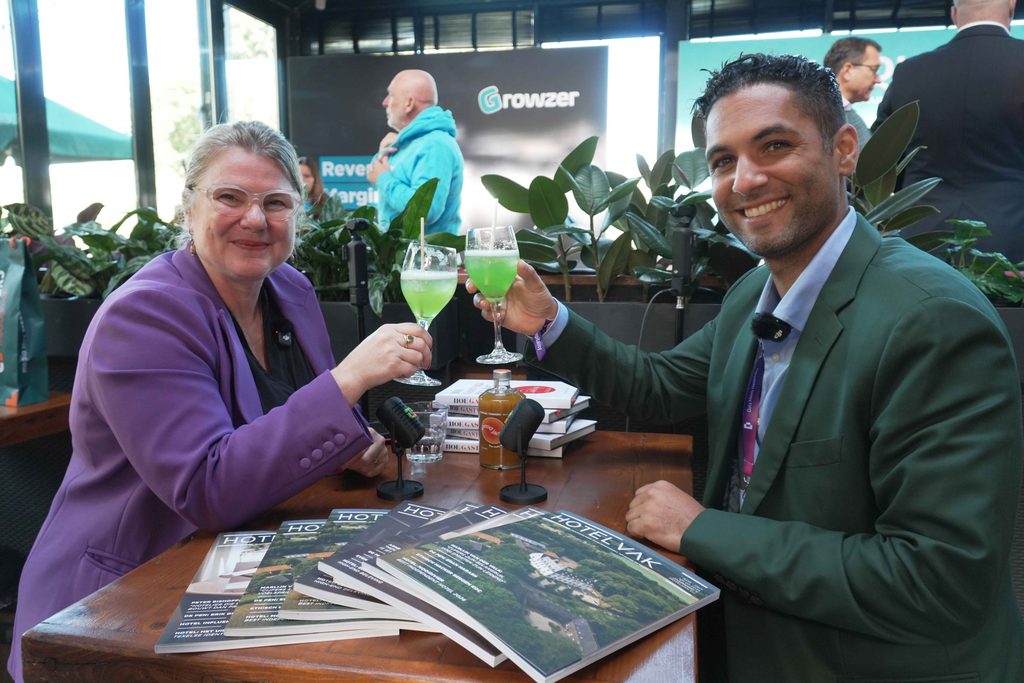
[01:07]Yes, and then we’ll have a cocktail, won’t we? Let’s go for the cocktail. We’ll have a pandan mule. Just like the Moscow mule, this is the pandan mule. [01:18]Based on that wonderful jamu. Jamu. [unintelligible] your daily ritual. Here we go.
[01:29]Nice shots, too. Yeah. Well, cheers. Cheers. Oh, oh.
[01:40]That’s really good.
[01:41]That’s right.
[01:42]Yes, it’s lovely to be able to join you for this drink. It’s always fun and a bit of a surprise, as I’d never tried it before, of course. So thank you for introducing me to it. Who are you, actually, and what do you get up to in your day-to-day life?
[01:56]Just to go back to your previous comment: I’ve discovered something. That’s why we’re organising Data Meets Hospitality: to bring together people in the hospitality industry, ‘horecans’… [02:04]That’s a term I’ve been trying to popularise for a while now.
[02:07]People in the hospitality industry – you love that, don’t you? I’ll come back to that in a moment.
[02:11]…to take people somewhere where they can discover all sorts of new products. Whether it’s tech, food or drinks: to give them a chance to sample things and make new discoveries, all in half a day.
[02:23]In half a day, yes. And it’s absolutely lovely, so I’ll have another sip.
[02:29]I see.
[02:31]But OK, you said that before you said: ‘That’s why we’re organising this.’ Emine, isn’t it?
[02:40]That’s right.
[02:41]Am I saying it right? Emine. Yes, OK. ‘Horecaan’, you say. Yes, but what do you think that is? I think that’s absolutely lovely.
[02:49]That’s something we do with everyone who joins us: we try to find out if they’ve got what it takes to work in hospitality. I can best explain it with an example. If your kitchen is on fire and you’re serving customers, you still manage to keep a smile on your face and provide the best service, even though it’s stressful. [03:07]It’s a bit of a combination of those things. Always being customer-focused. Always making sure people feel at home and are keen to help. But at the same time, keeping the day-to-day running of the business in mind.
[03:18]Yes, brilliant. ‘Horecaan’. Yes, so actually… I’ve got ‘gastoloog’ – the psychology of the guest – but it basically amounts to the same thing. And ‘horecaan’ – well, we need to introduce that. [03:31]Well, here we go, brilliant. So everyone who works for you has to be a ‘horecaan’. That’s a prerequisite.
[03:41]100%.
[03:42]Anyone in the hospitality industry loves good food and drink, good company and interesting conversations. Well, I reckon you can have all that at the bar too. And then you discover a new drink. It’s absolutely delicious. [03:54]Yes.
[03:55]It’s quite chilly.
[03:56]Yes.
[03:57]And even a bit healthy.
[03:59]Very good. Yes. Normally, my favourite drink is champagne, but I also love cocktails. So this one’s really good. Yes, delicious. [04:11]Right, Data Meets Hospitality – that’s where we are now. How did you come up with the idea of organising this?
[04:24]That’s something we’d been doing at Lightspeed for a while. We stopped doing it because of the pandemic. And we want to give something back to the hospitality sector again. Because ultimately, when our customers grow, we grow with them. [04:37]The more they know, the better they perform. The more they grow, the more we grow alongside them. And this is a way of bringing everyone together here: all the suppliers of interest to our partners and our customers. [04:52]To provide as much information as possible in just a few hours, because we know how busy people in the hospitality sector are these days. To teach them as much as possible and help them make connections. [05:05]We organise an event like this every year. Once in Antwerp, once in Amsterdam. So this time it’s in Amsterdam. And there were even people who came here specifically to arrange meetings with others attending the event. [05:20]So people who’d already held all their meetings with us.
[05:23]Oh, brilliant. Yes, that’s actually what you want: for those in the hospitality industry to meet up at this event.
[05:29]And support one another. Help one another. Because, at the end of the day, there are plenty of customers. They may be competitors, but you share your experience to support one another.
[05:41]Yes, that’s great. You can’t do it just in the hospitality industry – that’s not how it works.
[05:46]Not any more. It used to be easier; now it has to be more efficient.
[05:51]Yes, but that’s the beauty of that data. I’m convinced that people – those in the hospitality industry – will, of course, always be needed. But they can be hugely supported by the data that’s available. [06:02]So that they can respond even better to guests’ needs.
[06:08]That’s really the point, isn’t it? The personal touch, the hospitality industry, the contact with people: that’s why you go into the hospitality industry. To have genuine contact. And to be perfectly honest: you’re actually less keen on all the data and everything behind it. [06:22]That’s why you have accountants and operational staff. You want to spend as little time as possible on it. What we’re trying to do, particularly with AI – and the word’s already come up at the start of the podcast – is that with AI [06:36]the data can be understood. It’s not just about data – because that’s one thing – but you also need to be able to understand it and draw the right conclusions. And with today’s AI technology, that’s something which [06:48]represents a huge opportunity for many of our clients.
[06:51]Yes, exactly. Because whatever you say, data is obviously important. But if you don’t use it or don’t know how to apply it, then that data is of no use to you.
[07:03]No.
[07:03]Yes, exactly. Well, I actually thought this was rather nice. There was once a hotel that had only just opened. And they’d gathered a great deal of information about every well-known local – I won’t name names. [07:20]So they could provide the best possible hospitality. They knew not only someone’s favourite drink, but also who his wife was and, even worse, who his… [07:35]…who his mistress was. Good friend. Yes, good friend. But that’s part of the hospitality trade, of course: hear, see and keep quiet. But that data can certainly support that. [07:48]So that, if that gentleman has been here in the afternoon with, say, that lovely friend and comes back in the evening with his wife, you don’t say: ’Ah, weren’t you here this afternoon?’ You’re aware of those things.
[07:59]Certainly, yes. A less delicate example I have involving data: as a student, I worked in a nightclub called Culture Club. I was on the VIP floor and we worked on commission. Some really top-class DJs came through: [08:16]Moby, Bob Sinclar, [unintelligible], 2manydjs – they were resident DJs. But with so many people, it was almost impossible to recognise everyone by name. You could recognise them by their drink, though. [08:29]When they came in, you knew what their two favourite drinks were when they ordered. I couldn’t remember their names, but I knew: this is [unintelligible]. And they felt so at home. [08:42]Because you knew what they were drinking, they actually spent even more.
[08:47]Yes, that’s the strength of a really good barman – they know that. And they bring people together. There was once an entrepreneur, a hospitality entrepreneur, who said to me: ‘People sit at the bar because they want to have a chat.’ [09:02]Because when you’re sitting at a table, you have a good conversation there, but at the bar people are simply seeking the attention of the bartender, the barman – whatever you want to call them. Whatever the word is. No, exactly. [09:14]And he said: ‘The key is to bring people together. To find a common topic. Then they’ll start chatting amongst themselves and you can focus your attention on all the other tables.’ I actually thought that was such a good point. [09:27]That’s quite a laugh, isn’t it?
[09:29]I was standing at the bar once. It was really busy, and there was someone who came there often and demanded a lot of attention. And there was another person sitting on their own, whom I knew and who was a truly wise person. So I bought a drink [09:45] for the woman sitting there, on his behalf. ‘Oh, yes, that’s from that gentleman over there.’ She went over to thank him. And they’re still together to this day.
[09:53]Oh, brilliant. So you’re just sort of dating, then.
[09:57]That’s part of the hospitality industry too.
[09:58]Yes, definitely. Nice. Brilliant! And are you still in touch with those people?
[10:04]From a distance – it’s been more than 15 years now, after all.
[10:10]But how do you actually see the future of the hospitality industry?
[10:15]Yes, that’s a question people often ask. You could also look at it on a much larger scale: how do you see the future of friendship between people, of social interaction? It’s a difficult question, I think. [10:27]Not that there’s one right answer. But I tend to look mainly at myself and my circle of friends. And when I look at my children, there’s one thing we always [10:39]need: lovely fresh produce. And being out and about whilst still feeling at home. Yes, I think that makes sense: just not being at home for a change. [10:51]That’s the way things are heading. And still feeling at home and being made to feel welcome.
[10:54]I can really let myself go here. Here, I don’t have to worry about a thing. Everything’s going to be fine here.
[10:59]They know you here too. You don’t have to prove yourself. You get a table, you’re treated kindly. There are restaurants I go to where they simply put the tablet for taking orders right on my table. [11:13]Because they know us there. They know we order ourselves. If we were sitting here and fancied another drink, I’d just order it. Because they know: this is one of us. It’s something unique.
[11:25]That’s a lovely way of putting it. Yes, I agree. Just having that feeling as a guest: everything’s going to be alright here; I can let go of everything here.
[11:38]And there are few places where you can always go with so many different friends and acquaintances. With hobbies and sport, you have to do the same sport. [11:50]And travelling isn’t for everyone either. But everyone wants to enjoy themselves: good food, a nice drink, and feeling at home. That’s how you can make all generations – all sorts of people, really – happy.
[12:00]Yes, and I also really like what you said: that just by giving something away for a moment… That’s the power of influence, too. So when you give something away, [12:12] eventually love grows from that, and you’re the magic factor in it. Isn’t that brilliant?
[12:20] I wonder if they still realise it was me. It took them ages to realise I’d offered them that drink. They were always a bit tipsy.
[12:30]Yes, yes, yes.
[12:30] ‘Marinated’ is when you’re a bit tipsy.
[12:32]Yes, yes, yes. I get that. Yes, not everyone understands that, of course. But that’s nice, because it means you’re open to making more connections.
[12:43]And that’s also what has really helped me in the job I do now. I’m now the director for Western Europe at Lightspeed. Spotting connections, bringing people together and thinking in terms of solutions: these are all things you take with you if you’ve ever worked in the hospitality industry. [12:59]You’ve had responsibilities; at some point, you’ve had to find solutions. If the champagne ran out: how are we going to sort that out? Most people say: oh, there’s no more champagne.
[13:10]No, that’s a bit of a shame.
[13:12]That’s a real shame, isn’t it?
[13:13]I’d say: a pandan mule.
[13:16]That’s right.
[13:17] Very festive.
[13:18]Or a really good Prosecco that you just happen to have in stock. Thinking in terms of solutions is something I’ve continued to do a great deal of up to now.
[13:26]Offering an alternative rather than just saying no – that’s the key.
[13:29]Thinking in terms of solutions, really.
[13:31]Exactly, yes. Thinking in terms of solutions. You sometimes hear people say: ‘Oh yes, then people serve water, you know, just free tap water.’ [13:44]Well, there are whole debates about this in the Netherlands. I don’t know if you’re aware of that.
[13:47] I can hear it, can’t I?
[13:48]Right? And how can you possibly… you can tempt people, or you can serve tap water, of course.
[13:59]On the one hand: they do it in Paris too, in France. I think tap water in the Netherlands is some of the best in the world. That’s been proven, too. Yes, I still think tap water in the Netherlands is a top-quality product. But giving something away – and the same goes for snacks. [14:16]Many Michelin-starred restaurants do this: serving tasty little bites, amuse-bouches. What I’ve noticed is that the fact you’re given really tasty things for free at the start means that far more is ordered: snacks, starters, appetisers. [14:31]And that people drink and consume much more, because they’ve actually realised: ‘Wow, this little bite I’ve just had is simply marvellous; I want to try everything.’ Then they drink more too, and you generate much more turnover. [14:42]And I think the same applies to water: if you offer a complimentary aperitif or a tasty treat at the start, it can make people feel more at home, and encourage them to try and drink even more. [14:55]In the long run – and perhaps the data can back this up – you’ll see higher turnover.
[15:00]Yes, of course. I’m convinced that works. Because that’s one of the persuasion techniques too, but I’m sure you know that. One of Cialdini’s persuasion techniques: reciprocity. [15:12]Consciously influencing unconscious behaviour. And that, of course, is the psychology of the guest. Guests don’t want to be in anyone’s debt. And it really does happen: if you’re given something tasty, [15:25]it whets your appetite. Then you fancy even more, just as you describe.
[15:28]And you feel special. And you want to give something back, too.
[15:32]Yes, that’s the give and take of reciprocity.
[15:35] So you’ve created something.
[15:36]Yes. And then you think: oh wow.
[15:39]I’m not just going to have a pasta carbonara and call it a day. No, I’m going to try some more dishes, I’m going to have a few more drinks, and I’ll have a little dessert too. That way, you automatically sell more drinks as well. And I get it too: if costs are a problem, if costs are rising, if turnover is down, if there’s more competition and more challenges, [15:57]then you think: let’s cut costs a bit by giving away less.
[16:02]Yes, but that’s…
[16:03] It won’t pay off in the long run.
[16:04]No, exactly, then you’re doing it wrong. And what you’re saying – I love the way you put it: ‘tap water’ – that’s brilliant. I live in Belgium myself and I think… Just like in Belgium, where they simply say ‘groentjes’ instead of ‘groenten’. [16:18]Isn’t that much friendlier? Much friendlier language, I think. Anyway.
[16:21]We use a lot of diminutives.
[16:23]Yes, but I do like that. Apart from ‘a glass of wine’, you mustn’t say that, because then you’re doing the winemakers a disservice. Yes, right. OK, I’ve got that.
[16:34]And it’s usually a large glass, too, and not cheap wine.
[16:37]Yes, really lovely wine. But what was I going to say? Oh yes, about tap water: of course that’s an option, if you present it really well. But you could also go for a different product. [16:49]That way, you make sure you recoup the cost, and you’ll also earn appreciation – people will genuinely think: ‘Oh wow!’ I did that, for example, at a fine-dining restaurant where we served a different sort of water. [17:00]The proceeds from that water went to countries where clean drinking water isn’t a given. Just by telling people that, you ended up selling only bottled water instead of carafes. [17:12]So that turnover increased just by saying one little thing: storytelling at the table. Plus: if people have water, they’ve already got something to drink. And then you can very easily sell a welcome cocktail like this one. [17:25]A lovely one like that. And of course, you can prepare it beautifully at the table. I introduced that at a fine-dining restaurant back then. Because whether you make it behind the bar or at the table – especially if you don’t have that many guests – it’s easy to do at the table. [17:40]And how lovely, with Erlenmeyer flasks and everything: what more could you want? And then there’s that atmosphere, that experience: it’ll be fantastic. Plus, your job in the hospitality industry naturally becomes more rewarding and interesting. [17:53]And you’ll definitely sell a lot more with a welcome cocktail like that. People’ll have a drink straight away, because you want that first drink on the table within five minutes. Well, that’ll be water. And then you carry on.
[18:04]That takes a lot of patience, doesn’t it? Even when it’s busy. I’ve often sat in a restaurant run by someone who’d been in the business for forty years. If there was no room, he’d never say: ‘Right, go on then, [18:16]we’re full.’ He’d seat them all at the bar.
[18:19]Yeah, sure. A nice drink to go with it.
[18:21] Hang on a moment. And at some point, people said: ‘It’s cosy enough here; just bring my meal over to the bar, and we’ll eat together here.’.
[18:30]Yes, I suppose that might well be the start of the gastrobar. The start of the gastrobar. When you eat at the bar, it’s more informal. [18:41]Then you’re really more approachable and more open to interacting with others.
[18:46]One of my favourite restaurants in Ghent is Bar Bask. I always ask to sit at the bar there. It’s not really a bar; it’s actually where they prepare everything. The chef stands right opposite me. And he can see how we’re enjoying everything. [18:58]Every now and then, because they know us so well, they’ll give us an extra bite: ‘Would you like to try this?’ We tried that out yesterday. So I had a really special experience.
[19:06]And that gives you something to talk about straight away. How do you see that? Because sometimes with the younger generation: ‘Oh, how are you?’ ‘Yeah, fine.’ And then silence. Then I think: [19:18] how can I get you to talk? Well, bring something like that up.
[19:21] My 12-year-old son is exactly the same. He’s now at secondary school.
[19:25] At school.
[19:25] It’s the first time he’s cycled further to school. He cycles 7 kilometres there and back. I ask: ‘How was school?’ ‘Fine.’ ‘It’s always fine.’.
[19:36]So it’s not just me. Because we’ve got teenagers at home too. Then I ask: ‘So how was it?’ ‘Fine.’ Yes, and I’ve learnt that open-ended questions get you a more detailed answer. [19:50]No.
[19:50] So I’m trying something different now. I ask: ‘What was the best thing you did today?’ Then I can see every now and then that he’s making an effort and starting to think about it.
[19:57]Yes, but not always.
[19:59]And sometimes: wow.
[20:00] Yes, lovely. [unintelligible]
[20:04][unintelligible]
[20:05]Yes. Yes, that’s obviously… Yes, we could talk about the trade for ages. This is fun too, I think. And I can see from the bar that my next guest is already [20:20]on their way. But would you like to give a ‘golden tip’? Satisfied guests leave a tip, and I ask for a ‘golden tip’ to go into the tip jar. Do you have one? [20:32]For the hospitality industry, just…
[20:34]Perhaps less for the hospitality industry itself and more for the people who go to bars and restaurants. The no-shows. They don’t realise… we’ve talked about this a lot already. It’s something I keep repeating. [20:45]Every time I get a chance to speak out, I’ll say it again. Please, stop with the no-shows. It costs us money, it costs us staff, it costs us in terms of production. That’s why prices are going up. That’s why we ask for a deposit when you book. [21:00]Pass this on to everyone; make sure everyone knows. Because I assume people don’t realise what it costs us when they make a booking and then don’t turn up. So it’s better for everyone if they simply don’t do that. [21:12]That’s my message to everyone.
[21:14]So, dear guests: please stop turning up at the last minute. I really appreciate that. Thank you very much – let’s raise a glass to that. Thank you very much.
hotelvak.eu
EN

Platform on hotelmanagement, interiordesign and design in the Netherlands


 Nederlands
 English (UK)