
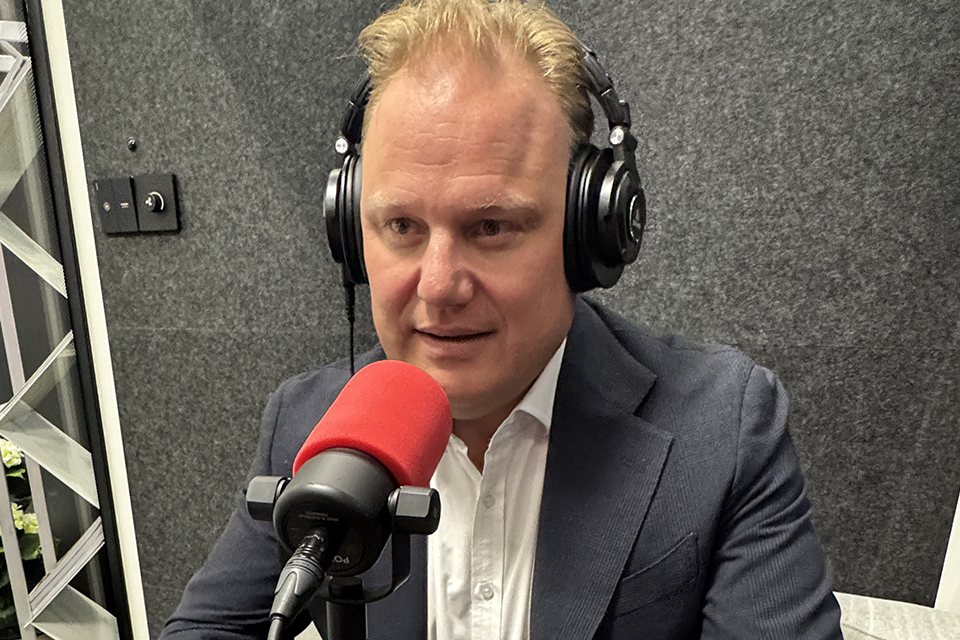
[00:10] Introduction to the podcast series
Jerry Helmers: Thank you for listening to Hotelvak, the podcast. Produced by Louwers Mediagroep in Weert. This episode is part of a series in which we speak to industry experts and examine a current hotel dilemma. It’s certainly a dilemma or issue that every hotel owner, general manager or entrepreneur in the sector will recognise. Such dilemmas can, incidentally, take many different forms. For example, guest safety versus guest or customer friendliness. Or the increasing digitalisation and the convenience it brings versus the complexity of all the steps a hotel must take in this regard. As a listener, you’re sure to be inspired, as the approach to each conversation is substantive and practical.
[00:54] Structure of the episode
Jerry Helmers: In each episode, we also present the guest with a few statements, which they can then choose to agree or disagree with. That certainly provides plenty of opportunities to explore the topics further, with all the interesting and thought-provoking tangents that go with it. This episode of Hotelvak, the podcast, is presented by Jerry Helmers. Each episode in this series lasts around 30 minutes. We hope you find plenty of inspiration, thought-provoking information and enjoy listening.
[01:28] Introduction to Martijn Dekker
Jerry Helmers: How lovely! Who’s here with me in the studio? That’s Martijn Dekker from Van Hessen in Ridderkerk, isn’t it?
Martijn Dekker: That’s correct.
Jerry Helmers: I’ve done my homework properly. I’ve got to, haven’t I? If I’m going to be talking to an expert like you, I’ve obviously got to do a bit of preparation, haven’t I?
Martijn Dekker: I don’t know if I’m an expert. Only time will tell.
Jerry Helmers: We’ll be looking at that over the next half hour. You’re Martijn Dekker. We’ll, of course, be introducing you in a bit more detail later on. Why do you think people should keep listening? And who, in particular, should keep listening?
[02:00] Why this episode is relevant
Martijn Dekker: It’s great to be here with you, Jerry. To get straight to the point: everything is changing so fast. Back in the day, as a hotelier or restaurant owner, I used to think you still had time to say: ‘Before this blows over or before it affects me, I’ve still got a bit of time.’ These days, everything’s moving at breakneck speed, and the pace at which things are changing is now so fast that adapting has become absolutely crucial.
Jerry Helmers: So you’re talking about technological changes, then?
Martijn Dekker: Absolutely. Technology is changing at breakneck speed. The advent of AI, the cloud and all the various integration options available now. That’s what makes it all so complex.
[02:45] Pressure on margins and automation
Jerry Helmers: But would you say: the people who’ve just tuned in to listen to this podcast – why should they keep listening? Because I think they’ll recognise what you’re saying. Why should they keep listening?
Martijn Dekker: I think so too. If you’re a hotelier, or you run a restaurant, a café or any other hospitality business, and you’re facing significant pressure on your margins as well as staff shortages, then there’s automatically immense pressure to automate and digitise.
Jerry Helmers: And how do you go about doing that?
Martijn Dekker: And how do you go about doing that?
Jerry Helmers: I have a feeling Van Hessen knows the answer to that. Or am I making this too commercial now?
[03:20] International experience and adapting to change
Martijn Dekker: No, but personally I think: I’ve had to adapt a great deal in my life. I lived abroad for a very long time after finishing hotel school. In the Caribbean, the Middle East, Dubai, Asia, Indonesia and Singapore. There’s a real difference between the way I had to adapt back then and the way I have to adapt now, with all the changes happening in the world.
Jerry Helmers: Right, does a man of the world dare to take on a number of statements to which you can only respond by agreeing or disagreeing?
Martijn Dekker: So I’m not allowed to remain neutral when faced with a statement like that?
Jerry Helmers: No, it’s certainly fun, even on a podcast. And I think it’s a bit exciting for the listener too. And of course it’s even more fun when you’re not quite sure whether you’re going to agree or disagree. No, I don’t want neutrality. I really do want some honest answers.
Martijn Dekker: Well, I couldn’t agree more. And I was already hoping this would be an interesting conversation. Because the listeners don’t have time to listen to a boring story either.
Jerry Helmers: That’s right. Are you ready for the propositions?
Martijn Dekker: Yes.
[04:18] Statements about technology in hotels
Jerry Helmers: Here’s the first one. A hotel without a proper link between its PMS and POS system is unknowingly missing out on revenue.
Martijn Dekker: I agree.
Jerry Helmers: One more thing. These days, customers expect not only good service, but also smart and seamless technology.
Martijn Dekker: I agree.
Jerry Helmers: In a hotel, technology should never be noticeable to the guest – only the convenience it brings.
Martijn Dekker: I disagree.
Jerry Helmers: We might well come back to that as well, of course, in the next 30 minutes. One final point for you. The biggest challenge for hotels is not digitalisation, but having the courage to change old ways of working.
Martijn Dekker: I agree.
Jerry Helmers: A slight doubt?
Martijn Dekker: Because it was a long move. I had to think about it for a moment.
Jerry Helmers: I’m making this far too difficult for you. My apologies in advance. Right, in this podcast we’re going to be talking to you about digitalisation and just how complex it all is. But very briefly, Martijn, what do you do at Van Hessen?
[05:32] Martijn Dekker’s role at Van Hessen
Martijn Dekker: I am the CEO of Van Hessen.
Jerry Helmers: And why did you become CEO at Van Hessen?
Martijn Dekker: Because I bought the company last year.
Jerry Helmers: So that’s how it works. But could you give us a little insight? When did you discover Van Hessen, and why did you think: ‘I’m going to invest in that’?
Martijn Dekker: That’s a good question. I come from the hospitality industry myself. I worked for Marriott and Accor for 25 years. After that, I returned to Europe and started working for the Borealis Hotel Group. I’ve gained a wide range of experience with various brands and hotel groups. That’s when I thought: how can we help these hotels to remain relevant to our guests in a really smart and sustainable way, using technology?
[06:11] Sustainable technology and staying relevant
Martijn Dekker: Sustainability means choosing solutions that adapt to your needs. Because at the moment, everything is changing so quickly that if you don’t have the right set-up, you won’t be able to take advantage of the opportunities that arise in the future.
Jerry Helmers: You’re already getting quite technical. You’ve mentioned the word ‘configuration’. I’d like to know a bit more about that in a moment. But you’ve also mentioned ‘sustainable’. From this perspective, that doesn’t directly relate to sustainability in terms of climate measures you can take within your own organisation or environmental awareness. In this context, ‘sustainable’ has more to do with consistency and profitability.
Martijn Dekker: Exactly, that last bit.
[07:00] The importance of correct configuration
Jerry Helmers: What do you mean by ‘configuration’ in this context?
Martijn Dekker: In any hotel operation, you have to deal with your systems. That’s partly down to your legacy. What did you start out with? Which network provider do you use? What sort of PMS and POS do you have? PMS is the hotel check-in software. The POS is the restaurant point-of-sale software. What systems did you choose back then, and what suits your needs best now? That’s different for everyone. That’s what I mean by configuration. You do need to know what best suits your unique situation.
Jerry Helmers: But how do you find that out? Because you’re a hotel manager or general manager. You know all about hospitality and welcoming guests. You know how to pamper your guests. But then, all of a sudden, you’re also expected to understand these kinds of processes.
[08:03] Digitalisation driven by market pressures
Martijn Dekker: You’re forced to think about it. That’s because of the change. That’s because of the pressure on margins. That’s because you can no longer find staff. But you’re still expected to deliver the very best guest experience. So that forces you to look at your own processes and how you can organise them in a smart way so that you have more time for the important things in your business. So that guest experience is key. It’s important that both the front office and the back office have the time to optimise the guest experience.
Jerry Helmers: Is there a big difference in how this is handled between the large hotel chains and the small, family-run boutique hotels?
[08:47] Differences between chain hotels and independent hotels
Martijn Dekker: Absolutely. Major chains such as Marriott, Hilton, Accor and IHG naturally all have a great many guidelines. They have a whole host of frameworks that you have to comply with. That makes it very difficult to think outside the box.
Jerry Helmers: But they’ve also got the euros and dollars to invest in those, haven’t they?
Martijn Dekker: That’s right, they do. But then there are also the independent hotels. They have much more control over their own tech stack.
Jerry Helmers: What do you mean by that?
Martijn Dekker: By that I actually mean everything to do with the network, PMS and POS. But it actually goes much further than that, with all the integrations. In the past, you had what we call ‘property interfaces’. Back then, you only had a connection to your keycard system and perhaps your POS. But now it goes much further. Integration with your revenue management system, integration with booking tools, sales and proposal tools, your loyalty scheme, your upselling tools, your HR tools, as well as accounting and back-office integrations. And all of this needs to be reported via clear, user-friendly dashboards.
[10:13] The complexity of technological choices
Jerry Helmers: That tangle of different possibilities is what general managers, restaurant owners and hotel operators are now facing. Suppose a hotel manager, general manager or hotel operator of an independent hotel is listening to this and thinks: ‘Oh, whatever. I’ll just be friendly and kind to my guests.’ Let Dekker carry on rambling. I’ll just click away from this podcast.’ Will a hotel like that still be around in a few years’ time?
Martijn Dekker: I think we really need to look at the impact AI is currently having on this market – on our hotels and restaurants.
Jerry Helmers: But does that independent hotel owner really have the time to get to grips with what AI actually is? Artificial intelligence. Let alone what he can do with it himself. After all, you’d need to devote half a degree course to it, wouldn’t you?
[11:11] AI as a tool to support hospitality
Martijn Dekker: I think a great many people are currently trying to figure that out. I also think many people feel a certain fear about it – fear of something they don’t know and what it will mean for them. I don’t so much think that adopting AI will create winners, but that there could well be losers if people pay no attention to it at all. AI is something we need to embrace and adopt. Because it’s actually going to save you a great deal of time. It’s going to help you enormously in freeing up time to focus on that guest experience. Many people think that AI means there will no longer be any personal contact with guests. I believe the exact opposite. I think that because so many administrative and manual tasks are supported by AI, you’ll actually have more time for your guests.
Jerry Helmers: Could you give a very specific example of that? Because I’m still thinking about that independent hotel owner who’s listening to this and thinking: ‘Here’s another person telling me I need to do something with AI.’ Why not make it really clear for him or her? For example, what’s a process where AI could help him or her?
[12:17] Specific applications of AI in hotels
Martijn Dekker: At the moment, there’s a lot of focus on how AI can facilitate integrations with your PMS. This means that bookings in your PMS system are processed automatically, and that emails sent by customers are automatically routed to the correct place within your PMS. We’re even looking at scenarios where a guest sends an email asking: ‘Can you change my booking by one day?’ The idea is that this action is carried out automatically within the system without the need for a front-desk agent or reservations agent to intervene. These are just a few examples, but you can imagine that if you spend less time staring at a screen and doing things manually, you’ll have more time for that eye contact, that smile and that chat with the guest themselves.
[13:19] Booking platforms and automation
Jerry Helmers: Do you think that, as a hotel, you really do need to get in touch with the major booking platforms – the ones where you can list or display your available rooms? Because, as a hotel, you can hardly do without those major booking platforms these days.
Martijn Dekker: No, but that’s all being automated as well.
Jerry Helmers: So there’s hardly any manual work involved anymore. But is that something you, as a company – Van Hessen – are also involved with? Because ultimately, you want to ensure that everything remains compatible, don’t you?
[13:56] Independence and integration
Martijn Dekker: We believe that agnosticism is very important. We want all the different integration options to be possible. We don’t want our customers to be under any obligation to work with specific parties. We don’t want them to be obliged to use a payment system that costs them a certain amount of money. We really want to operate on a white-label basis. You need to be able to stay in control and decide for yourself who and what you want to integrate with. That’s really a fundamental point that listeners need to consider. It’s not just about how I’ll be supported today; tomorrow there’ll be another change, another integration and another tool you’ll want to use to improve your productivity, enhance your guest experience, make things easier for yourself or save money. So if you don’t start thinking about how to organise that now, you’ll soon miss the boat when it comes to being able to do so.
Jerry Helmers: Because the competition is doing it.
Martijn Dekker: The competition certainly is. That’s the great thing about the cloud, of course – that you have that flexibility too.
Jerry Helmers: By ‘cloud’, do you also mean the AI programme? Or do you mean ‘in the cloud’?
Martijn Dekker: In the cloud.
Jerry Helmers: So there’s also an AI programme called Cloud. Just to avoid any misunderstanding. You’re talking about working in the cloud.
[15:30] Benefits of cloud software
Martijn Dekker: All software is now in the cloud. Whereas you used to run your systems on your own servers – what we call ‘on-premise’ – they now run in the cloud. The great thing about that, of course, is that updates can simply happen behind the scenes. You no longer have any interruptions. Another benefit is that other parties can link up with you more easily, because it’s all online. At Oracle, they call it OHIP. It’s a platform that anyone can connect to. That also means it’s becoming increasingly easier for the next generation of technology to integrate into your own operations.
Jerry Helmers: But how do you keep on top of it all yourselves? You bought this company a few months ago. But surely you need to keep refreshing your own knowledge constantly. Where do you get your own knowledge from? And how do you ensure you’re always up to date with all this expertise in ICT and AI?
[16:37] Expertise and experience at Van Hessen
Martijn Dekker: That’s a very good question. Van Hessen is 107 years old. We started out in 1919 with the very first NCR cash registers from the United States. When Oracle acquired Micros Fidelio in 2013, we became Oracle’s exclusive partner for the Benelux region. But we have a wealth of expertise within Van Hessen. We have people who have been working here for 40 or 35 years.
Jerry Helmers: But surely even those people must realise that, especially in the last two or three years since AI has been embraced by society?
Martijn Dekker: Yes, but they combine the knowledge of the past with the relevance of the present. That’s what they bring to the table. At Van Hessen, we have a huge number of people who come from the hotel and hospitality industry. So we’re actually bringing those two worlds together: the world of technology and the practical side. Because hoteliers really are a breed of their own. I went to hotel school in The Hague myself. We’re very resilient. We’ve been through a lot. We love to roll up our sleeves and get things done. We’re unrivalled when it comes to putting theory into practice. We can take a knock. Just look at what happens when the economy takes a dip or during the pandemic. The impact that’s had on the hospitality industry. But we’re a resilient lot and we can adapt.
[18:25] Combining a passion for hospitality and technology
Jerry Helmers: Just a quick aside. Why didn’t you just go and run a hotel yourself? Now you’re suddenly in IT and AI. You have to explain quite a technical concept to people who might not be all that open to it yet. Whereas it’s much more fun just to welcome guests and pamper them a bit. Why not start Hotel Dekker yourself?
Martijn Dekker: I still think hospitality is fantastic. It’s my passion. I particularly like the fact that I can combine my background in hotels with this. I love it immensely. We in the hotel industry can do all the things I’ve just mentioned, but we always do so with a smile and a real sense of conviviality. Hotel staff are bon vivants par excellence. This is precisely the way I can really bring that to the fore.
[19:19] Guests’ changing expectations
Jerry Helmers: Is there such a thing as a professional bias? Like, when you check into a hotel yourself, do you find yourself thinking: ‘I’d do that differently’ or ‘that could be improved’?
Martijn Dekker: You’re always looking at it. That’s also a bit what we were talking about: customers’ needs are changing. Nowadays, when I walk into a shop, I simply don’t have time to stand in a queue. I don’t want to either. I don’t have time to wait. I want everything to happen quickly. It’s hard enough just keeping up with everything. The last thing you want is to be distracted. I just want to get into the room quickly, order something straight away and get to the point.
Jerry Helmers: Hang on a moment. Have you turned into one of those impatient consumers too?
Martijn Dekker: Yes, but perhaps that is precisely what motivates us to look for solutions that can resolve the issue.
[20:18] The digital guest journey
Jerry Helmers: So you see, I’m just painting a picture of what it’s like for you when you walk into a hotel; I can picture it all, and to be honest, I recognise myself in it a bit too. But is that a widespread view? That people literally can’t be bothered to wait at reception for long any more? Surely that’s part of your holiday experience too?
Martijn Dekker: At the moment, the topic of conversation in hotels is the digital guest journey. Not so much the physical one. The physical aspect has always been important and always will be. But how can we make things as easy as possible whilst still retaining that personal touch? We don’t want it to feel transactional, but we do want to make it efficient. So you look at the digital guest journey from the moment of booking, through the communications you receive, right up to check-in or walking into the restaurant. You also look at the check-in process. Is it entirely via a mobile key and online check-in? Or is there still a kiosk involved? You can make all sorts of different choices. That’s also the difference between hotels and restaurants. Everyone makes their own choices in this regard. Sometimes it’s dictated by the brand you’re part of. Otherwise, it’s simply something that suits your operation. You also want to remain true to your own product and service. So whatever you choose to do is a choice. And those choices are what make it so complicated. That brings us back to the complexity of digitalisation. You have so many choices – which one should you make? In your own best interests and in the interests of your guests.
Jerry Helmers: Of course. And in the interests of your business, naturally, because you want to ensure continuity there.
[21:57] Education and technological developments
Jerry Helmers: You studied at the Hotel School in The Hague. There are also hotel schools in Maastricht and Leeuwarden. Do these courses pay sufficient attention to these current, rapid, new developments? After all, this does require a different way of thinking as a manager and hotel operator.
Martijn Dekker: I don’t know. As it happens, I’ve got a meeting with the Hotel School in The Hague next week, because I’d been wondering the same thing. So you’ve read my mind, Jerry. But I’m also very curious about that. I’ve yet to find out.
Jerry Helmers: Yes, because it’s quite exciting. Also because you said earlier that things are moving so fast. Can you still keep up with it all? You do need a certain amount of flexibility if you’re running a hotel these days. You have to be able to keep on top of things.
Martijn Dekker: I agree. At Van Hessen, we try to provide that overview. We often say: Guide, Deliver, Care. Under ‘Guide’, we support our clients in their search for the best solutions to suit their needs.
[23:11] How conversations with customers go
Jerry Helmers: What’s that sort of meeting like? I don’t know if you actually went out and about yourself during your first five or six months as CEO of the company. Did you visit clients?
Martijn Dekker: Absolutely.
Jerry Helmers: Does that apply to potential customers as well?
Martijn Dekker: That too.
Jerry Helmers: So how does a conversation like that go? You’ve got the appointment, you sit down there – and then do you just let the customer or hotel manager explain their problems?
Martijn Dekker: Listening is, of course, very important. That’s where it all starts. We already have certain ideas in mind, but it’s much more important to hear what challenges the hotel or restaurant is facing. We want to really understand the full configuration and the entire tech stack so that we can then come up with the right solutions. But when you ask this, I immediately think of something else as well. We often think straight away of PMS and POS, but it’s much broader than that. It also has to do with your network. The role of the network and the strength of the network are becoming increasingly important. You’re connecting more and more devices to it. How do you ensure redundant connections in case your internet goes down? Do you want to put everything on a single network? Because that’s also risky. You’ve also got all those smart devices and IoT devices these days. They’re all connected to your network. Do you really want your security cameras on that network? Because if it gets compromised, you could end up with a security breach.
[25:00] Security, privacy and network management
Martijn Dekker: Security is now becoming increasingly important too.
Jerry Helmers: It’s probably linked to privacy.
Martijn Dekker: Security and privacy. Linked to privacy and linked to the GDPR. Take a look, too, at the data breaches that have been reported in recent months. At the moment, you need to think not only about your optimal configuration, but also about how you set it up. How you set up your network and which providers you use for that.
Jerry Helmers: When you’re having a conversation like that and you’re visiting a potential client for the first time, isn’t that a bit overwhelming for a hotel manager? You turn up with all your expertise and some pretty tough questions. Surely that must be overwhelming?
Martijn Dekker: Not at all, actually. They’ve often already given it a great deal of thought themselves. They know their systems. They know what their processes are and understand how things work. Back in the day in hotels, twenty or twenty-five years ago, the IT department was a separate division under finance. If you needed to reset your username or password, you had to ring someone. It really was a secondary department. Now it’s a main department. Everything is managed by IT, based on processes and digital solutions, and supports your entire operation. So it’s a different way of thinking, a different way of organising things and a different way of dealing with them.
[26:44] Proud of Van Hessen and international support
Jerry Helmers: Anyway, I’m sure you know how to get people on board with that.
Martijn Dekker: Yes, certainly.
Jerry Helmers: That’s the least we can expect, isn’t it?
Martijn Dekker: I am incredibly proud of the nearly one hundred colleagues at Van Hessen in the Netherlands, Belgium and West Africa. We also operate in West Africa.
Jerry Helmers: I didn’t know that.
Martijn Dekker: We provide support in Dutch, French and English to more than three thousand customers in the Benelux and Africa. They do this with such passion and such expertise. That is what drew me to Van Hessen and the reason why I love this role so much.
[27:24] Van Hessen’s ambitions and areas of specialisation
Jerry Helmers: This is an audio podcast, but dear listeners: I can see a man sitting opposite me, smiling broadly and full of passion, who’s really giving it his all. What are your ambitions for the coming years?
Martijn Dekker: We’re very keen to grow. We’re really specialising. Because, at the same time, the cloud and integrations offer a great many opportunities if you approach them in a highly specialised way. So we have a team that does nothing but look at integrations. A team that focuses heavily on reporting and analytics. Data is so important. We also have people who specialise in sales and event management. The specialisms we’re currently developing will, hopefully, continue to support our clients for a very long time to come.
[28:14] A look back at the history of Van Hessen
Jerry Helmers: It would be nice if we could go back 107 years in time, to when those first cash registers were imported from the United States. Back then, you really couldn’t have imagined what things would look like in 2026. Perhaps it’s even the case that, back in 2020, you still couldn’t have imagined what things would be like in 2026.
Martijn Dekker: We don’t know what things will look like in 2046 either. It’s great fun to think about, though. But I think Van Hessen has always adapted and evolved alongside its customers and its systems, so I’m fully confident that they’ll continue to do so in the years to come.
Jerry Helmers: You’ve got to. A hundred people have to eat as well.
[29:02] Three tips for hoteliers
Jerry Helmers: Listeners are always keen to get some tips. They’ll finish listening to the podcast shortly and might still be thinking about it. But what can the listener – whether they’re a hotel owner, manager, general manager or CEO – actually do tomorrow, on their next working day? Do you have three tips for them?
Martijn Dekker: Yes, absolutely. Number one: identify the specific needs of your business. Work out what’s important to you, write it down and make that your first priority. Number two: choose a cloud-based system that will adapt to your needs. One that’s not just relevant now, but also for the future. And three: look beyond the purchase price. Also consider the hidden costs, any obligations to work with specific providers, and the requirements surrounding payment transactions. Look at the whole picture and try to remain agnostic so that you can stay in control.
Jerry Helmers: So the bottom line is: it doesn’t all have to be at the expense of entrepreneurship. You can still remain in control, but you do need to ask yourself a number of important questions.
Martijn Dekker: Yes.
[30:28] Van Hessen’s commercial pitch
Jerry Helmers: Let’s see what people have to say in the comments. There’s something else I’m really curious about – and you knew this was coming, and I reckon you’ve prepared for it – but you’ve got another sixty seconds of airtime. In this podcast series, we also refer to this as a bit of a ‘Loeki de Leeuw’ moment. You can say whatever you like. It’s entirely up to you. I won’t say another word. I’ll be listening intently. So I’m now announcing to the listeners a short advert, or an advert break – whatever you want to call it. Are you ready for your sixty seconds of fame?
Martijn Dekker: Van Hessen is the full-service IT partner for the hospitality and catering sectors, specialising in PMS, POS and IT management. We offer full-stack IT solutions and personalised support from A to Z. Our ethos is Guide, Deliver, Care. Guide: we guide you through the maze of IT solutions. Deliver: we ensure everything runs smoothly. And Care: we take the pressure off you with our reliable support. Whilst you look after your guests, Van Hessen ensures your IT works. No two hospitality businesses are the same, which is why you need a partner who takes your specific situation into account. Van Hessen is also the exclusive partner in the Benelux and West Africa for Oracle Hospitality Solutions. This means you can rely on robust, trusted Oracle products, combined with the flexibility and service levels of a local partner like Van Hessen, in Dutch, English or French. For more information about Van Hessen, visit vanhessen.nl and get in touch with us to see how we can help you.
[32:14] A look back at the propositions
Jerry Helmers: Martijn, I saw you were four seconds over time. I thought: I’m not going to interrupt that just for the sake of it. You ended up taking 64 seconds, but I thought it was a brilliant pitch. What was really clever, of course, was mentioning the website right at the end. You obviously want people to have a look at it. At the start of the podcast, we went through a few statements. There was one statement you disagreed with. That was the statement: ‘In a hotel, technology should never be noticeable to the guest – only the convenience it brings.’ You disagreed with that. I’d like to ask you to explain that briefly.
Martijn Dekker: Thank you for the question. I think they’re both very important. The convenience, of course, but I also think it’s fine to be able to see the technology at work. Take Wundermart, for example. It’s an unmanned shop in hotels. You get all the convenience, but you can also see the technology in action right in front of you. I think that’s brilliant. I love that.
Jerry Helmers: Yes. Did you enjoy this podcast? This might well have been your global podcast debut.
Martijn Dekker: I’ve appeared in front of cameras, on TV and on the radio before, but yes, this was my first experience doing a podcast.
Jerry Helmers: That’s much more fun than national television, of course.
[33:24] Concluding the conversation
Jerry Helmers: Martijn, it was lovely having you as a guest. I’ve got to know you better as a person, but I’ve also learnt more about your company. I also listened carefully to your closing pitch, so I’m going to have another look at your website. I’d like to thank you very much for coming to the studio. Who knows, maybe we’ll see each other again sometime. Let’s just agree that we’ll arrange another podcast session in a year or a year and a half. Then we’ll see what’s happened in that year and a half in terms of developments, AI and technological advances that may have been made. And whether the message you have for the listeners will still be just as relevant by then. Thank you very much.
Martijn Dekker: Thank you, Jerry. And thank you to all our listeners for taking the time to listen.
[34:14] End of the podcast
Jerry Helmers: Right, I agree with that too. Thank you to all our listeners for tuning in. I think this was another really enjoyable episode from the ‘Hotelvak met Van Hessen’ podcast series. You’ve just been listening to an episode of ‘Hotelvak’, the podcast. We hope this conversation has inspired and stimulated you, and that you’ve gained some practical insights for your day-to-day work in the industry. The programme was presented by Jerry Helmers. The project manager is Daniël Bundel. Mark Schouten and Daan Halters were responsible for the technical aspects. ‘Hotelvak, the podcast’ is produced by Louwers Mediagroep in Weert. Do you have any questions about this or other podcasts we produce? Please send an email to info@louwersmediagroep.nl or call 0495 – 45 00 95 during office hours.


 Nederlands
  English (UK)