[00:00]Lightspeed Restaurant, the leading platform for the world’s top hospitality entrepreneurs.
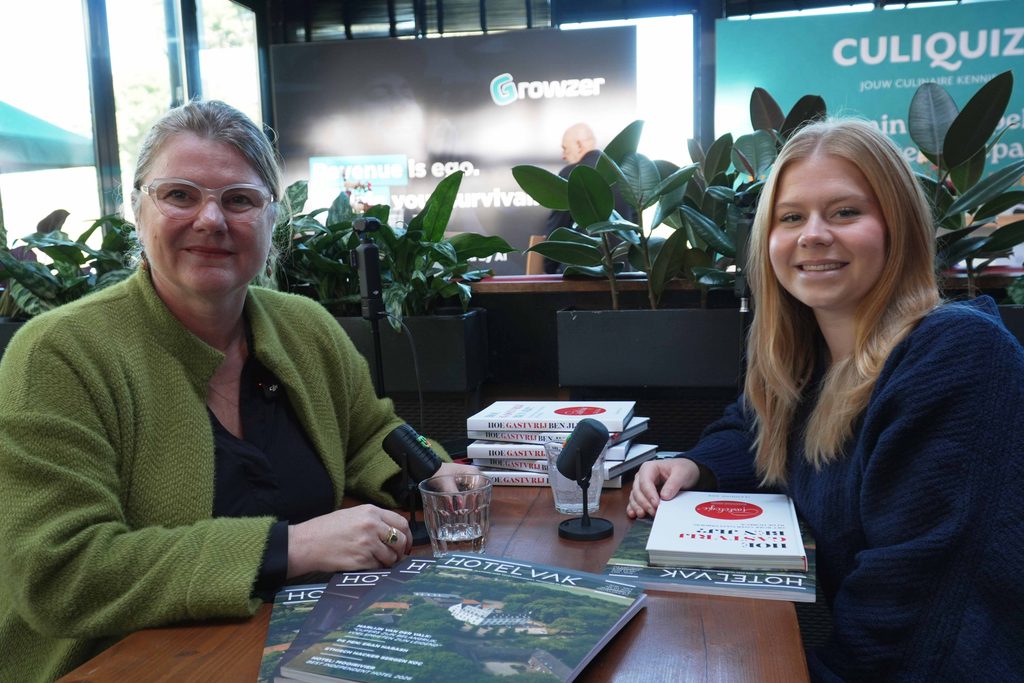
[00:11]Dear listeners, my name is Jeannine Sok, the Netherlands’ first ‘guestologist’. Welcome to the bar – the place where the best conversations take place.
[00:23]At the bar with… Well, what would you like to drink?
[00:27]A glass of water.
[00:28]A glass of water – well, that’s just the ticket. Who are you and what do you get up to?
[00:34]My name is Manouk Uidam, I’m 20 years old. I’m studying hospitality in Purmerend. I’ve also been working at Land en Zeezicht on Marken for 7 years. [00:45]I’m really enjoying myself there.
[00:47]Yes, I didn’t quite catch that.
[00:49]Views of the countryside and the sea on Marken.
[00:50]Oh, on Marken. Yes. Land and Sea View?
[00:53]Yes.
[00:54]Oh, brilliant.
[00:55]Land and Sea Views.
[00:55]Land en Zeezicht, right. Very good. And you’ve been working there for seven years?
[01:00]Yes, I started when I was thirteen. Oh, really?
[01:05]You weren’t actually allowed to work at all back then. But you went ahead and did it anyway, didn’t you?
[01:10]Yes, at the start it was mainly just a bit of a helping hand, so to speak. I actually always used to ask my parents for money for school. At one point, my parents said: everything costs money. [01:25]‘Learn the value of money and get yourself a job.’ And my niece had been working there for a while. She’d just left. So she said: ‘Well, I’ve got a brilliant job for you.’ [01:38]A really nice place. A lovely owner. A really great team. And then we went there together and sort of sorted it all out. [01:49]And then I started helping out there a bit.
[01:52]Yes, brilliant. So from the age of thirteen, you really learnt the trade there?
[01:57]Yes, I really did grow up there a bit. I came into my own, actually. When I first arrived there, I was still a very quiet girl and found everything quite exciting.
[02:07]Yeah, of course.
[02:08]And in the kitchen, with so many lads. At some point, you do end up toughening up a bit.
[02:13]Yes, I understand.
[02:15]In the end, I think I spent two years washing up there. And then I asked if I could do something else. Because washing up was great fun,
[02:26]Yes, but you’ll be done with that at some point, won’t you?
[02:29]Every time I walked up to the front, I’d see the bar there. And I’d been really keen to do that for ages.
[02:33]Yes, I see.
[02:35]So I asked if I could go behind the bar, but I wasn’t allowed to serve drinks just yet.
[02:39]No, because of the laws and regulations: it wasn’t allowed back then.
[02:44]No, I just wasn’t allowed to do that yet. And then she said: ‘I can always teach you things behind the bar.’ And then one of my colleagues at the time told me all about the bar. And then I absolutely loved the bar.
[02:56]Yes, I understand.
[02:56]I didn’t really want to leave there. But at some point, I made way for other people. So then I said: I reckon serving would be great fun too. [03:09]So I started doing that, and it actually turned out to be the best thing ever. That’s what I enjoyed the most.
[03:15] Brilliant. How do you deal with guests?
[03:19]Yes, dealing with guests. Just making guests happy with food and having a chat with them.
[03:28]Yes.
[03:28]I’m always getting questions about Marken, about how things work there. I do get some rather odd questions from time to time.
[03:34]Yes. But of course, you do need to know all that.
[03:38]My father is from there. My family on my father’s side are from there. So I actually knew everything about Marken. And I already know everyone there. So for me, that was a huge advantage.
[03:50]Yes, exactly. So you don’t need to learn that before you start working there; you can talk about it from your own experience. And that works really well, of course, because people really appreciate that. [04:01]Yes, doesn’t it?
[04:01]Yes, people really appreciate it when you just know certain things, rather than having to look them up on the internet.
[04:08]No, yes, exactly. A personal story is always better. So you were working as a waiter. You were still at school and were going to do the course. [04:20]And eventually, after secondary school, you chose to…
[04:26]International Management of Hospitality, Food and Beverage. That’s quite a long name. It’s a course at Horizon College in Purmerend. And I have to be honest: when I left secondary school, [04:39]I actually wanted to do something else. I realised I’d been working in the hospitality industry for so long that I felt I could only do things related to hospitality. So I ended up doing a two-month nursing course. [04:55]And I very quickly realised that it just wasn’t for me.
[05:00]No, although of course you do interact with people there as well.
[05:03]Yes, that too. But I just found myself rushing straight back into the hospitality industry. I immediately felt right at home again. And I’ve now almost finished the course.
[05:16]Oh, that’s fine. Yes.
[05:17]And then I’ll have to see what I want to do next.
[05:21]Right, yes. So you’re now in your final six months?
[05:26]I’ve added an extra year to the course, because that’s better for me. I find it quite a challenging course. And I want to do my absolute best to pass it with good marks.
[05:38]Yeah, of course. So you’re still managing to fit that in alongside your work?
[05:43]Yes, at the moment I go to school one day a week. Apart from that, I work full-time at Land en Zeezicht on Marken. That’s how I manage to juggle it all. And my manager, the daughter of Vicky [surname inaudible], the owner, [06:01] did more or less the same course. So she helps me out a lot.
[06:06]That’s lovely.
[06:07]Yes, and there are also more girls who’ve done the same course as us.
[06:12]And what do you have to produce? Do you have to write a sort of dissertation? What is your assignment?
[06:19] I’m drawing up a business plan from start to finish.
[06:23]From A to Z. And there you are, right in the middle of it all.
[06:26]Well, I’m actually almost finished. It just needs a thorough read-through and then, hopefully, approval. Just the finishing touches.
[06:33]And what’s your business plan? What have you decided on?
[06:39]It’s a wine bar on the Roode Steen in Hoorn. I came up with that idea myself.
[06:43]Yes, that’s great.
[06:44]He specialises mainly in wines, including biodynamic, organic and vegan wines. Yes, it’s just a really extensive wine list.
[06:56]Oh, how lovely!
[06:57]Wines are brilliant too, and there’s so much to learn about them.
[07:00]Yes, you never stop learning about wine.
[07:02]No, I could go on and on about it. And I’m actually learning a great deal about it at work too.
[07:08]I’m happy to believe that.
[07:09]Yes.
[07:09]And that wine bar in Hoorn is, of course, part of your course, so you can submit that business plan. But could that also be a dream of yours?
[07:19]I don’t know. It’s really hard to get an idea of what you want to do later on, because there are so many things that are really fun. I did an internship in Italy myself.
[07:32]Oh, how lovely!
[07:33]Yes, three months.
[07:35]Oh, and where in Italy?
[07:37]On Lake Garda, near Verona.
[07:40]Yes, I know Verona.
[07:42]That’s right. That was at a campsite. I worked at reception, ran the entertainment programme and helped out in the restaurant. And I actually enjoyed it all. I enjoy loads of things, but it’s so hard to decide exactly what you want to do later on.
[08:01]I see. To book you in now. Well, perhaps that wine bar.
[08:06]Yes, perhaps. You never know.
[08:08]Yes, because you really like wine too.
[08:10]Yes, certainly.
[08:12]And how do you see the future of the hospitality industry?
[08:19]The hospitality industry in general? Yes. I hope it stays as it is now. That as many staff as possible stay on and that it isn’t taken over by robots. [08:33]You do see that sometimes in certain restaurants. I hope everyone just enjoys the job as much as I do. You can learn so much from it. I’ve gone from being a 13-year-old girl to being 20 now, and I’m so open, and loud, and super sociable.
[08:50]Yes.
[08:51]And you realise…
[08:52]Your personal development: you’ve made considerable progress in that area.
[08:56]You just develop a lot. You also learn body language, so you can actually tell how people are feeling.
[09:05]Yes, you can tell that about some people.
[09:08]You can just tell that. I think it’s really very good, including when it comes to getting on with other people.
[09:13]Yes, that social aspect. I always call it social skills, rather than etiquette, because that sounds so patronising. It’s simply about making interactions with others run smoothly. [09:25]And I think that’s what you’re aiming for too. So you think that’s important as well. And I reckon that will always be the case.
[09:33]And I really do think that everyone should have worked in the hospitality industry at least once.
[09:38]Oh, that’s great. Yes, I agree with you. But why?
[09:42]You learn so much. As I said about socialising: you go and meet other people and you learn to read their body language. You learn that some people aren’t actually that nice at all. [09:54]And then how you…
[09:55]…takes a knock. Like: how do you deal with dissatisfied guests?
[10:00]Yes, definitely. You just learn so much about yourself – something you don’t get in a supermarket, for example. Here in the hospitality industry, you just learn so much about yourself. [10:13]I just think that’s brilliant.
[10:15]Yes, it gives you a great deal of self-insight. Yes, exactly. Self-confidence too – that’s put very well. So the finest profession there is will always be around. [10:28]Yes, certainly. And I think there’ll still be a need for it in the future. But I do think that data can provide very powerful support. Let’s say you’re really interested in wine. [10:42]You’d know what guests drank last time, because that’s recorded somewhere in a CRM system. So you’d know: ‘Oh, this is what that guest drank.’ And then you could surprise your guest even more.
[10:54]Yes, definitely. It’s the same with regulars. With some people, you just know. They don’t even need to come over to you; you already know: right, you want a cup of coffee.
[11:03]Yes, exactly.
[11:04]You specifically want a glass of water with it. Or you want a particular wine that we always have in stock. I think you really do build a connection with guests.
[11:14]Yes, exactly. And why do you think a thirteen-year-old should choose this profession? It really is the younger generation. [11:25]Generation Alpha is on its way. How can we motivate this generation to choose this wonderful profession?
[11:35] The 13-year-olds and those a bit older are mostly just glued to their phones.
[11:42]Right?
[11:43]They don’t even learn how to communicate with people anymore. They only learn to communicate via their phones. My little sister, for example, never rings anyone – she always sends text messages. [11:59]Whereas when you ring someone, you can tell how they’re feeling.
[12:02]Yes, exactly.
[12:02]That person might be angry or really happy. But you can’t tell from a text message. No, you can’t hear anything. If there’s a laughing smiley face, you know they’re happy. If there’s an angry smiley face, you know they’re angry.
[12:16]No.
[12:16] There’s no sign of anyone.
[12:18]No.
[12:19]What I really like is that you can find things for yourself on social media – certain lovely little shops. They promote themselves really well on social media. [12:33]We do that too, with fun TikToks, videos and photos. So that’s just really great. I do think, though, that you need to realise there’s a life outside your phone. [12:46]You can also meet people just by bumping into each other by chance.
[12:50]Yes, exactly. And those chance encounters often happen in bars and restaurants, at the bar.
[12:57]And that’s simply the best way to meet someone. You just get to know people much better, rather than just looking at a profile and seeing where someone’s from [13:09]and what they do. That’s why, when it comes to job applications, I think it’s important that you aren’t hired based on your CV alone. Of course, your CV counts for a lot, because you need to know what someone’s qualities are. [13:21]But it’s only when you get to know someone that you really know what they’re capable of.
[13:27]Yes, exactly. So showing genuine, sincere interest in the other person. And then you’re like: their eyes start to sparkle. I’ve got to have that person; they’ve got to come and work here.
[13:38]Yes, there are also people who find it really difficult, but the profession is great fun and they can go from 0 to 100. They might be working in a café now and in a Michelin-starred restaurant later on. [13:50]Anything is possible; you can grow so much. And that also gives you self-confidence, which you eventually gain. That’s absolutely vital for yourself, but also for the people around you. Because people will want to follow your lead afterwards, yes, exactly. [14:03]Because if you can do it, so can I.
[14:05]Yes, lovely, lovely, lovely the way you put that. You’re very interested in wine. You’re currently finishing this course. But what do you envisage for your own future? [14:19]What else would you like to do?
[14:21]Yes, I find that really difficult, because there are so many possibilities.
[14:26]Yes, I know. It’s almost impossible to choose.
[14:28]Yes, there are so many different directions you can go in, depending on the sort of customers you have and the concept you’re aiming for. It can all be on a larger scale, or it can all be a bit smaller. [14:40]It can have a different atmosphere.
[14:42]Yes.
[14:42]It’s just really…
[14:44] There’s a wide choice.
[14:45]It’s really big. But that’s exactly why I’m so happy that it’s so big. It’s like: OK, I’ll be finishing my course soon. What do I want to do then? Will I stay there? [14:56]Do I want to learn absolutely everything that Vicky and Sharon can teach me?
[15:02]Yes, exactly – making the perfect coffee, the perfect cocktails.
[15:07]Or am I actually heading down a completely different path, where I’ll suddenly be thrown in at the deep end because I’ve never worked in that role before?
[15:14]No, exactly.
[15:15]There are so many ways to go about it. You can make things really difficult for yourself and then achieve great things. Or you can make things easy for yourself and still achieve great things. So there are different approaches.
[15:26]To map out your career. And you did an internship in Italy. That’s great; experience abroad is always a good thing.
[15:36]Certainly.
[15:36]I think you could recommend that to anyone.
[15:38]Yes, definitely. I was there with my best friend, who’s doing the same course as me. I went to that campsite with her. So you’re not on your own then.
[15:48]Yes, you’re not on your own then. That’s nice.
[15:49]But some of my colleagues did go there on their own back then. They say: ‘Yes, I learnt so much.’ Because suddenly you’re in a different country. You don’t know the language. You just have to hope that they [16:03]can speak English where you’re based, because Italians… No, it is a beautiful language, though. Yes, it really is a beautiful language. And you’re better off learning Italian than always speaking English. [16:15]And if you speak a bit of Italian, they really love that too. Then they’re genuinely very happy. Yes, because then they appreciate it.
[16:21]Yes, exactly. It doesn’t have to be perfect. No. If you give it a go, if you do your best to speak their language, you’re already 10–0 ahead.
[16:29]Yes, and they’re very grateful for that.
[16:33]It’s a lovely language, isn’t it?
[16:35]And you just learn… No, I was staying in a flat. And there I was. Lovely. Yes, but I was sharing that little flat with five girls.
[16:48]Oh yes.
[16:50]Two of whom are Italian and three Dutch. Including me. Yes. And you just learn: I have to do my own washing, make sure everything’s clean. [17:02]You’re just living with five girls, who can be quite fussy.
[17:06]Yeah, some girls, yeah. It’s awful.
[17:08]You have to clean up, make arrangements, and discuss how we’re going to do the shopping. So you really do learn to live on your own a bit. And you simply learn that [17:20]the Netherlands is a familiar place for you. That was very much the case for me. You see, speaking Dutch feels very familiar. But how lovely is it when you’re in Italy and learn so much about a different culture. [17:32]Italy really does have a culture all of its own.
[17:35]Yes, exactly.
[17:36]Everything they do is simply magnificent. Everything they present. That’s something I learnt there too: they’re simply proud of the dishes they present and serve to their guests.
[17:46]Yeah, of course. So it’s quite different from the Netherlands, then.
[17:51]Yes, things just work a bit differently in the Netherlands. You see, I work somewhere where people come for the fish.
[18:01]Yes.
[18:01]For the eel, for the salmon.
[18:03]Yes.
[18:04]That sort of thing. But there are also things you need to develop to attract other guests as well. [18:16]Not everyone likes this.
[18:17]No.
[18:18]People also like burgers. Or some people are vegetarians.
[18:21]Yes, exactly. And in Italy?
[18:23]Yes, in Italy it really doesn’t matter.
[18:25]No.
[18:26]You should eat whatever you fancy. But you mustn’t take any of it away.
[18:33]No.
[18:34]You shouldn’t put cheese on fish either – that’s a real no-go. She’ll just take your plate away and make it again, without the cheese. You know, that’s just how it is.
[18:42]Those are some wise lessons for everyone, aren’t they? Yes. Gosh, that’s lovely. And where else did you do an internship apart from Italy?
[18:53] I also worked as a stage hand at the Moon restaurant in the A’DAM Tower, on the 19th floor. I have to say, I learnt a great deal there too.
[19:02]Yes, I think so.
[19:03]Just a bit more upmarket. Yes. And I learnt a great deal there. Especially the English language.
[19:12]Yes.
[19:12]Very much so.
[19:13] Oh, that’s not bad, is it?
[19:14]Yes, because you have to explain the dishes. It’s a set menu, and you explain the dishes as you go along.
[19:20]Yes.
[19:20]And then, at a moment like that, you have to do it in English, even though you can do it in Dutch. Yes. But you also learn to explain different products that way. It’s like: right, how did that go again in English? And then you remember and you can just do it. [19:34]Yes, that’s just how it is. Yes.
[19:38]So the language is important after all. You’ve learnt a few words of Italian too, and given it a go, of course. Yes, but that doesn’t matter. You don’t speak perfect Italian, and you don’t need to.
[19:48]No.
[19:48]And English is, of course, an important language too. But we’re sitting at the bar now, and a satisfied customer leaves a tip. [20:00]What’s your top tip for the tip jar?
[20:05]My top tip for the tip jar is: always be yourself. Because everyone is hospitable. Everyone has a spirit of hospitality within them. And be friendly with people too. [20:19]Yes. Ask them how their day is going. People appreciate that.
[20:24]Yes, that’s what I think too. It’s the little things, then.
[20:26]It’s the little things that count. Even when you ask: ‘Did you enjoy it? Is there anything else? Will you come back sometime?’ People give really honest answers.
[20:37]Yes.
[20:38]And especially when you ask them about their day: it really helps some people when you ask that question. It’s just absolutely vital.
[20:47]Well, that was lovely. I can see my next guest is already on their way. So I’d like to thank you ever so much for this lovely chat. It was lovely. Thank you very much. I’d love to have another chat with you sometime.
[20:59]Certainly.
[21:01] OK.
hotelvak.eu
EN

Platform on hotelmanagement, interiordesign and design in the Netherlands

 Nederlands
 English (UK)