hotelvak.eu
EN

Platform on hotelmanagement, interiordesign and design in the Netherlands
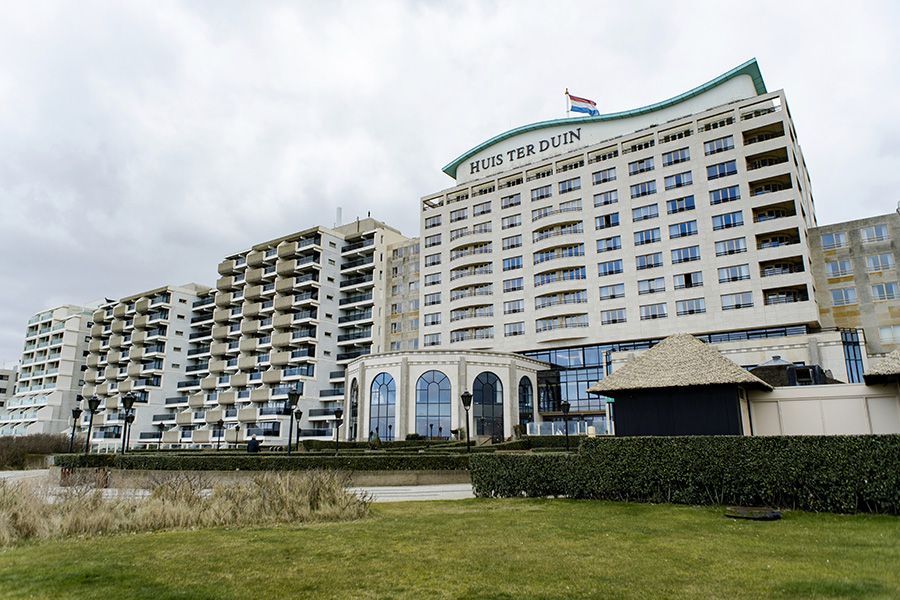
For more than 130 years, Grand Hotel Huis ter Duin has been a landmark on the Dutch coast. The iconic hotel overlooks the North Sea and exudes history, hospitality and grandeur. Its origins date back to 1883, when mayor Pické gave the go-ahead for the construction of an exceptional hotel on the highest dune. A completely renovated version was opened in 1985, after which Heinrich Tappenbeck took over in 1987. He saw potential on both the national and international markets and managed to attract an audience of businessmen, noble families and even members of the House of Orange and the Belgian royal family through targeted advertisements in exclusive magazines.
In the 1960s, the hotel changed hands several times and even demolition seemed inevitable. However, the Noordwijk municipal council put a stop to this. Eventually, the hotel came into the hands of Noorlander Vastgoed, which had the complex reopened by Princess Margriet in 1984 after a thorough renovation. The year 1990 marked a dramatic turn of events: a major fire destroyed a significant part of the building. This event became the starting point for a new chapter, in which safety, comfort and cutting-edge technology took centre stage.
The current Grand Hotel Huis ter Duin consists of two clearly recognisable parts. On one side, there is The Historic: the part that survived the 1990 fire and thus preserves the hotel's oldest soul. On the
other side is the Grand Hotel, the renovated part built in the 1990s and regularly modernised since then.
Warmerdam Installatietechniek has managed the hotel's complete climate system since 2007. Director Richard van Kesteren emphasises that the maintenance goes a step further each time: “We monitor and modernise annually. In recent years, the focus has been increasingly on sustainability.” This is visible in previous optimisations in the boiler room and building management system, but especially in the transformation of The Historic: there, Mitsubishi Electric's City Multi HVRF system was installed in 2025.
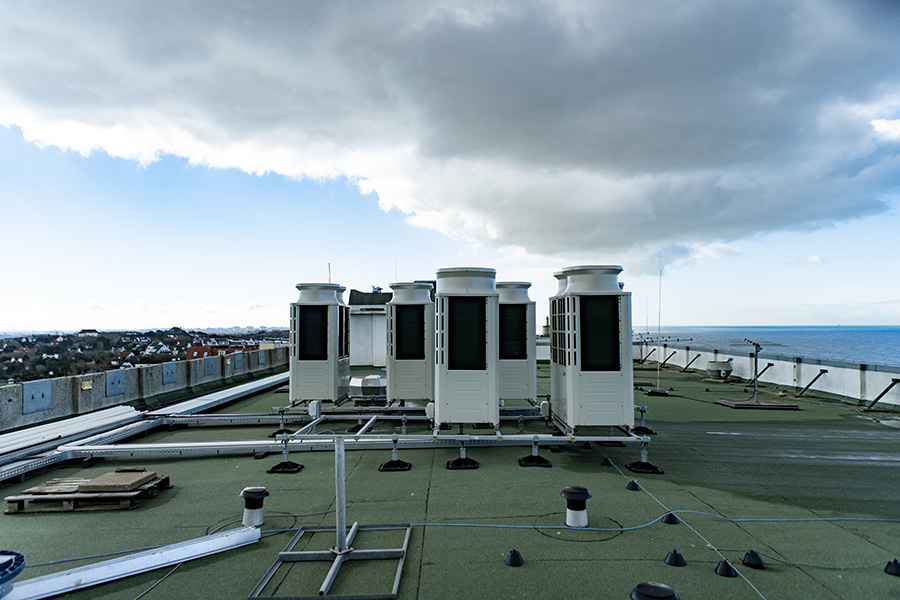
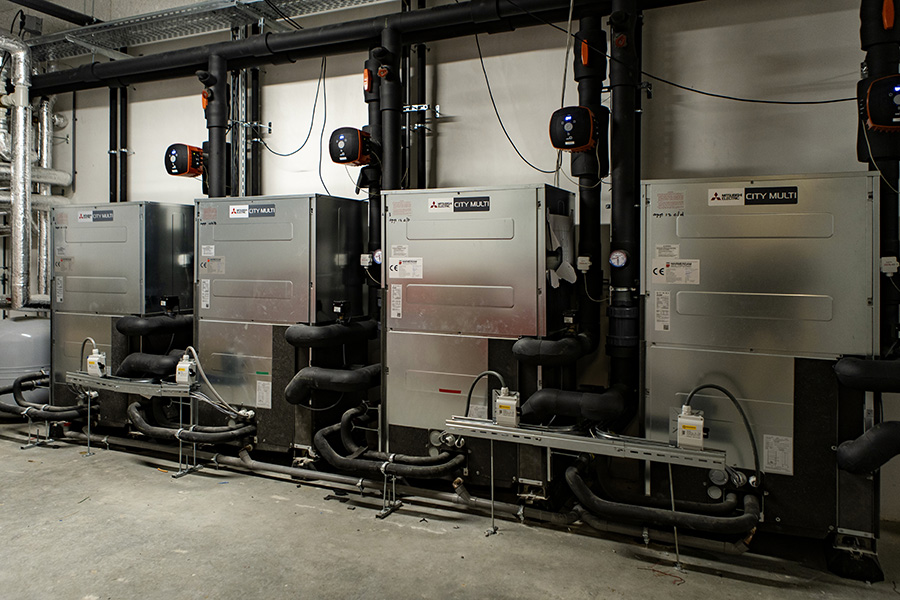
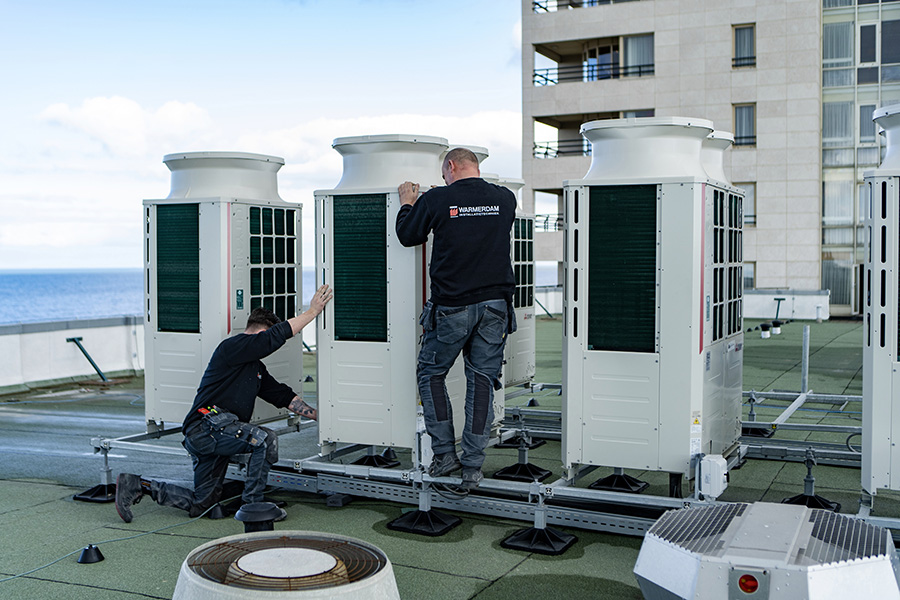
This hybrid heat pump concept, in which water acts as an energy carrier, is the hub of the new, sustainable hotel technology. On the roof are seven outdoor units connected to eight hybrid distribution boxes (HBC controllers) and over a hundred satellite indoor units in rooms, suites, lounge areas, meeting rooms and offices.
Until recently, The Historic was cooled and heated via temporary split units. A practical interim solution, necessary to ensure the hotel's comfort standards during the preparations for the final sustainability plan.
The new installation now represents the first solid step towards a fully all-electric hotel environment.
Van Kesteren explains: “This is the foundation of a broader transition. Together with Alklima, we have now developed a roadmap for the entire hotel complex, including tap water solutions. The end goal: a completely gas-free operation.”
It not only means a big CO2 reduction, but also enhances safety and comfort for both guests and employees.
Environmentally conscious and safe thanks to water as an energy carrier
More and more hotels and office buildings want to reduce the amount of refrigerant in their installations. This fits in with contemporary sustainability goals, but also with increasingly stringent regulations. Hybrid VRF (HVRF) technology is a perfect match. Marco van der Haven, account manager at Alklima: “Our City Multi HVRF system stands out because only water is used in the pipes between the HBC controllers and indoor units. No refrigerant enters the hotel rooms or halls, and this significantly reduces both the environmental impact and the risk of leaks.”
The system combines the efficiency of traditional VRF heat pumps with the advantages of water. Higher inlet temperatures are thus possible, directly contributing to a more comfortable indoor climate. The smart positioning of gas and fluid distribution in the HBC controllers also reduces pipework and welding joints - making the installation not only safer, but also more maintenance-friendly.
The City Multi HVRF system has become a technological standard for hotels looking to achieve sustainability at a high comfort level. The two-pipe configuration with which Mitsubishi Electric enables a full WTW concept is unique in this respect. Whereas other manufacturers still require three pipes for this, Mitsubishi has managed to reduce this to two. This means a less invasive installation, lower failure rate and easier long-term maintenance. For a hotel that operates 24/7, these are crucial advantages.
The installation was complex: the hotel remained fully operational during the work. This meant that noise, dust production and disruption to guests had to be kept to an absolute minimum. For example, there was a set rule: no drilling or sawing was allowed before 9am.
Warmerdam Installatietechniek therefore developed detailed planning and routing. The HBC controllers on the ground floor were placed in the basement, while the units on the upper floors were housed in the entrance to the emergency stairwell. In this way, the pipework remained limited and maintenance could easily be carried out without disturbing guests.
Van Kesteren: “By choosing this location, technicians do not have to go into hotel rooms. Service and maintenance can take place completely invisibly. That's exactly what you want in a five-star hotel.”
With the installation of the HVRF system in The Historic, Grand Hotel Huis ter Duin is another big step closer to becoming a future-proof, safe and sustainable hotel environment. The combination of innovative heat pump technology, water as an energy carrier and sophisticated engineering creates a unique climate concept that matches the allure of the hotel.
In the coming years, this sustainability drive will be extended to the rest of the complex. Eventually, the entire hotel will function gas-free, without making concessions to luxury, comfort or appearance. In this way, Grand Hotel Huis ter Duin will not only remain an icon of the Dutch coastline, but also an example of how historical buildings can be given a sustainable future.
 Nederlands Nederlands
  English (UK)