hotelvak.eu
EN

Platform on hotelmanagement, interiordesign and design in the Netherlands
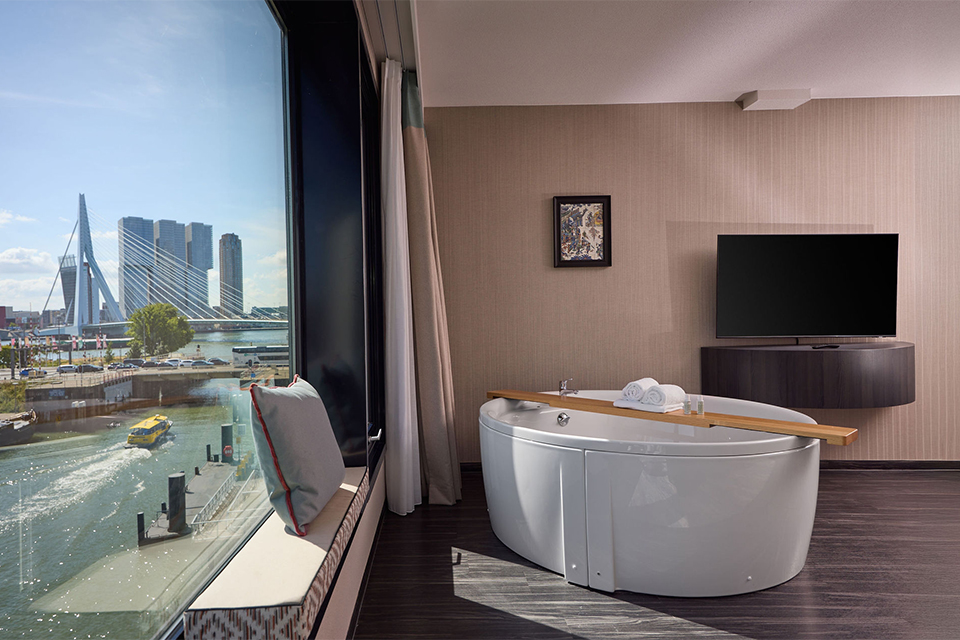
With ‘A Night at the Gallery’, Haven Hotel Rotterdam aims to be more than just a hotel on the Leuvehaven. The hotel uses art, heritage, gastronomy and local partnerships to bring Rotterdam to life for its guests. Not as a one-off package, but as part of its brand positioning.
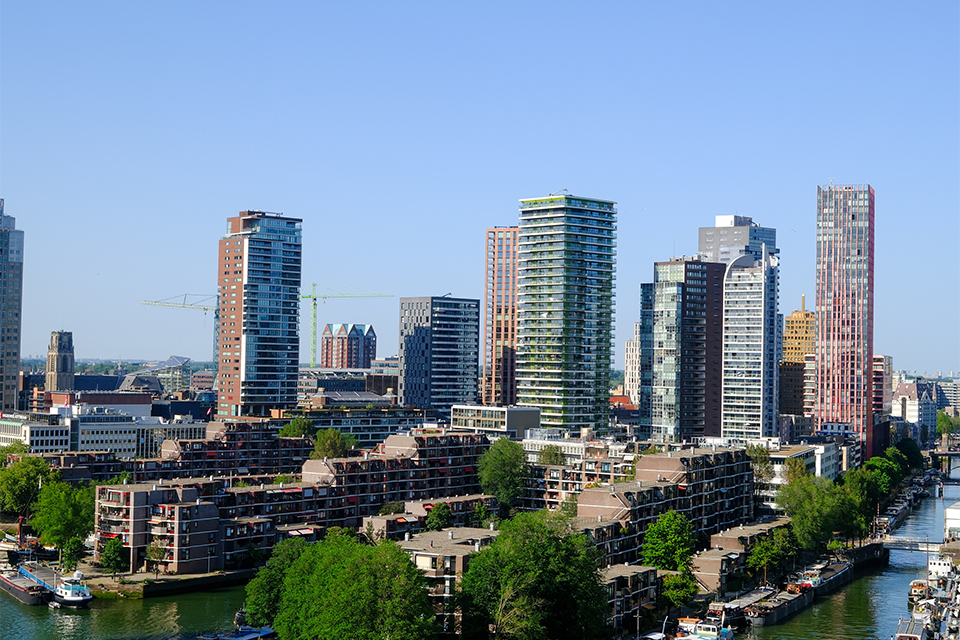
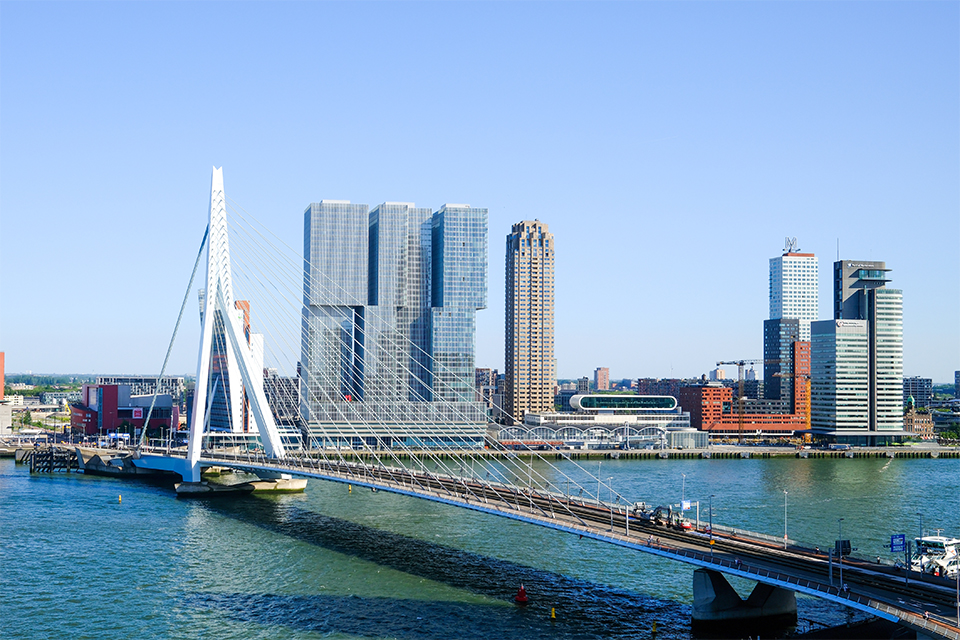
Rotterdam doesn’t sell itself by being beautiful in the traditional sense of the word. Rotterdam works differently. You have to walk into the city, sail through it, listen to it and, every now and then, let it wash over you a little. From the quay at Leuvehaven, you can see why. On one side, the boats of the Maritime Museum; on the other, high-rise buildings, bridges, terraces, water taxis and the promise of a city that never quite seems finished. That’s exactly where the Haven Hotel Rotterdam, Curio Collection by Hilton, is located.
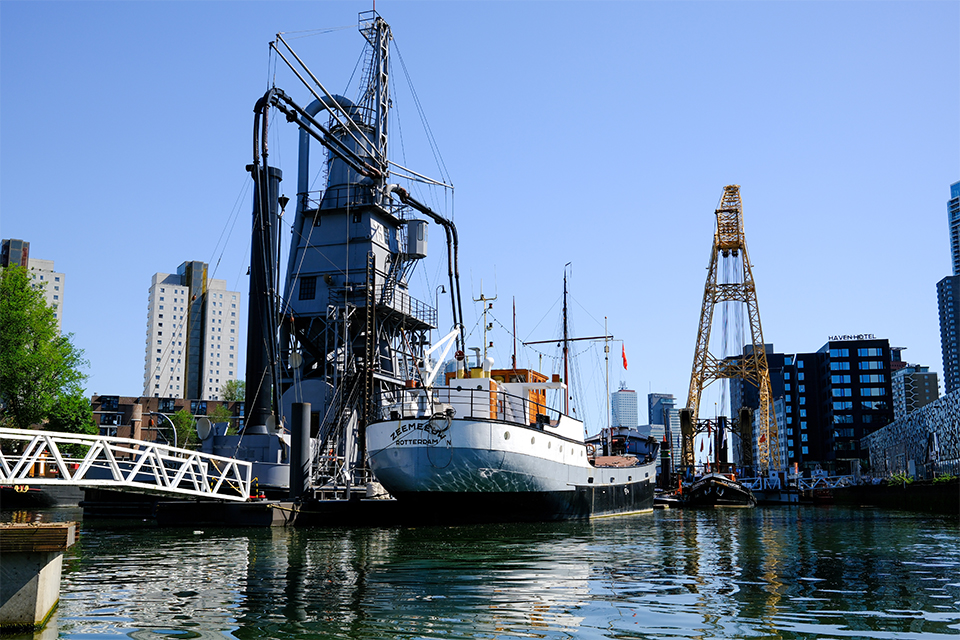
It’s a location that any hotelier would envy, but it’s also one that demands a lot from you. Anyone who merely sells rooms here is missing out on a large part of its value. That is the idea behind ‘A Night at the Gallery’, the cultural programme through which Haven Hotel Rotterdam is forging a stronger connection with the city. Not by coming up with yet another package deal with museum tickets, but by literally bringing the city into the hotel.
General Manager Melle van Uden (number 51 in the Hotel Influencers 100) says this is no coincidence, but a strategic positioning choice. When he became involved with the new hotel two years ago, he says there was a clear question on the table. How do you position a hotel locally, nationally and internationally? “A hotel is a hotel, a bed is a bed and a room is a room,” he says. “Ultimately, you always try to position yourself based on the city’s appeal.”
That is the crux of the matter for hoteliers. Certainly within an international brand such as Hilton, local distinctiveness can quickly become nothing more than a marketing slogan. Van Uden turns this on its head. Precisely because Haven Hotel Rotterdam is part of the Curio Collection by Hilton, the hotel must have a strong character of its own. The international distribution network helps with sales and visibility, but what sets it apart is found right here at Leuvehaven itself. In the story of the place. In the art on the walls. In the names of the outlets. In the way staff talk about Rotterdam.
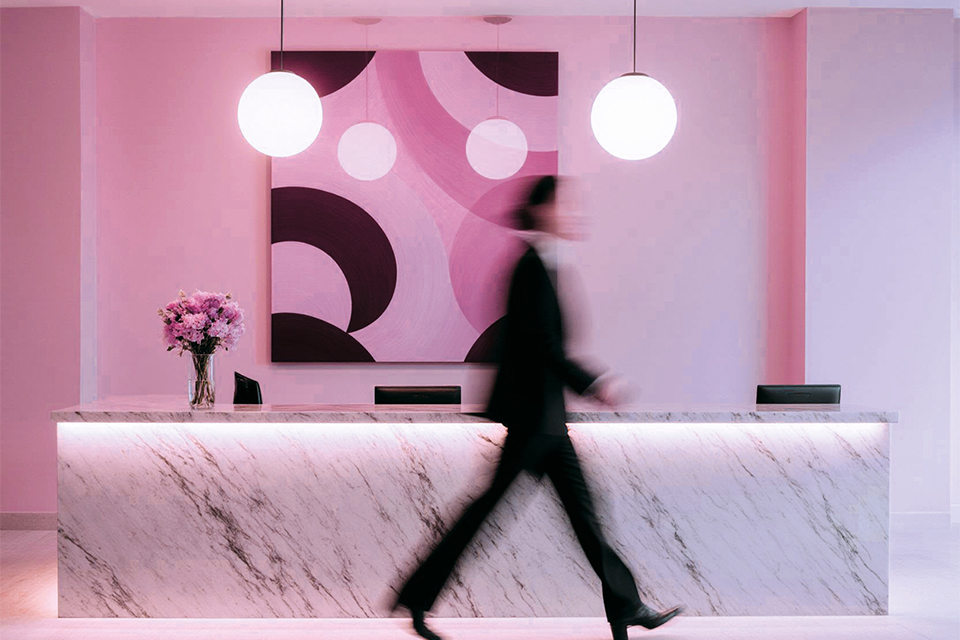
Anyone walking into the hotel will see that this concept doesn’t just begin at reception. The lobby is not a neutral waiting area with designer furniture and a random piece of art on the wall. The hotel aims to function as a living canvas. The public spaces feature works by artists from Rotterdam and those with links to the city. The collection changes, the lobby evolves with it, and guests thus gain an impression not only of the hotel, but also of the city.
That requires more than just good taste. It calls for careful selection, collaboration and, above all, a willingness not to view a hotel merely as a commercial machine. For Van Uden, the Kunsthal, the Maritime Museum and Fenix are not simply names to be used for a package deal on the website. They are substantive anchors in the story the hotel wishes to tell.
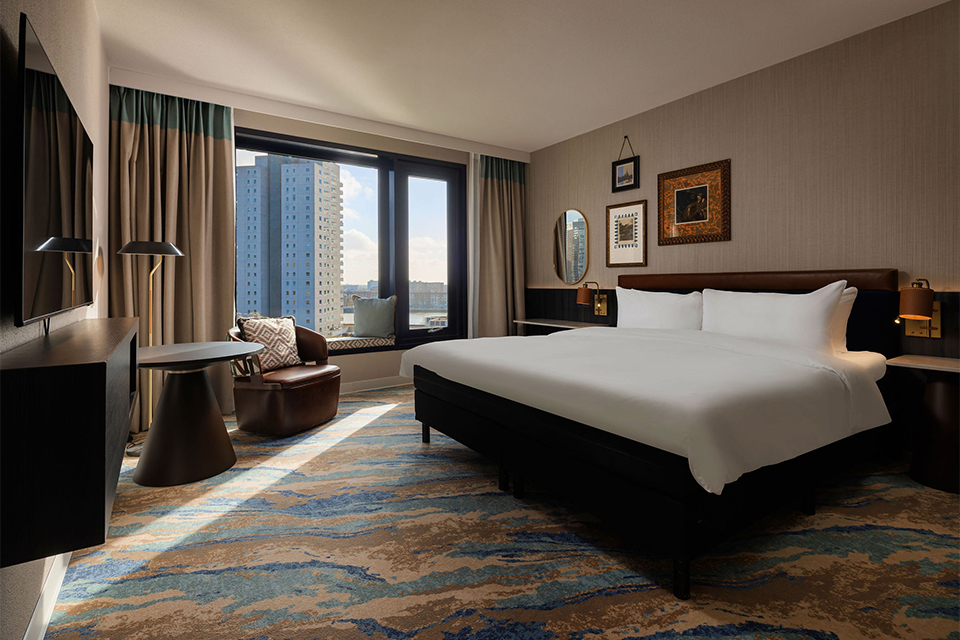
This theme is carried through into the guest rooms as well. Old photographs of ships and the location pay homage to the maritime history. The book *Highlights of the Maritime Museum* is on display as a subtle nod to the neighbouring museum, which literally stretches right up to the hotel’s back door. At LOEF Living Room & Café, the harbour is reflected in the name and the wine selection, featuring wineries along the River Maas and further afield towards Germany. Bar Calan pays homage to Pieter Caland, the man behind the Nieuwe Waterweg. It is there that the bridge to Rotterdam as a global city lies. Without that connection to the sea, Rotterdam could never have become the city it is today, with its many communities, cuisines, languages and stories.
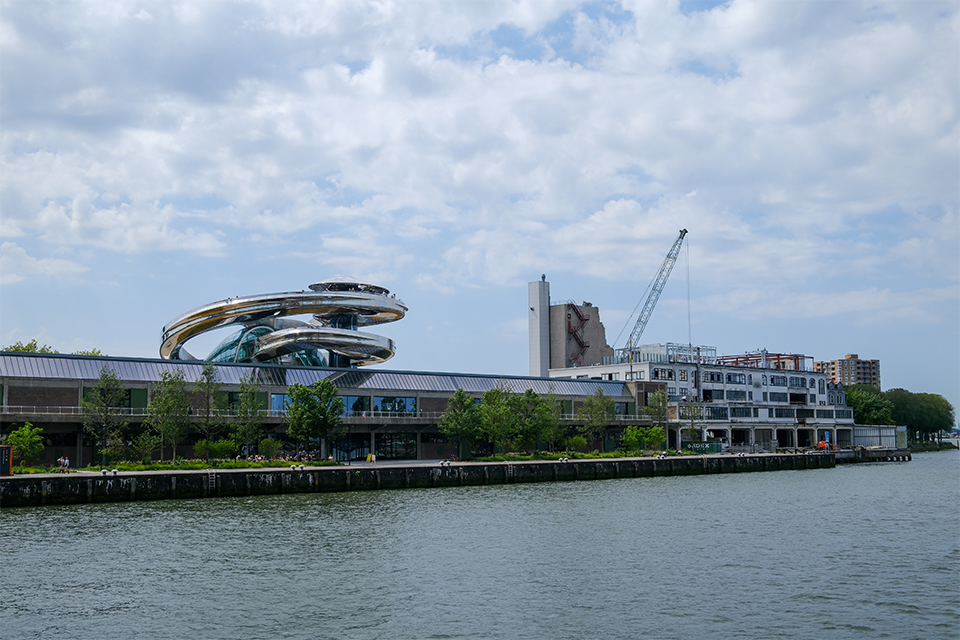
Van Uden also recognises the value this brings to less established artists. The hotel has, as he puts it, plenty of walls and plenty of passers-by. With 480 rooms and a mix of national and international guests, lots of people pass by the art every day. “I’d just think it was brilliant if a traveller said: ”I want that piece of art“,” he says. “Then we’d make that happen.”.
”I don’t need anything in return, but I do enjoy being able to give young artists a platform."
The art changes several times a year. Artists receive a fee, and the hotel organises openings to which they can invite their own networks. This gives the programme a dual purpose: it enriches guests’ stay, whilst providing creators with a platform outside the traditional museum context. For the hotel, this fosters a community that goes beyond booking channels and loyalty programmes.
During our visit, it becomes clear that ‘A Night at the Gallery’ works so well precisely because the programme doesn’t stop at the hotel door. For two days, the city, as it were, flows right through the hotel. Or, to put it another way: the hotel acts as the director of a compact cultural trail through Rotterdam.
Dennis van der Maarel, sales manager at Haven Hotel Rotterdam, is acting as host alongside Van Uden during the visit. Whilst Van Uden outlines the positioning, Van der Maarel demonstrates along the way how that positioning is put into practice. He moves seamlessly between hospitality, sales and the city’s story.
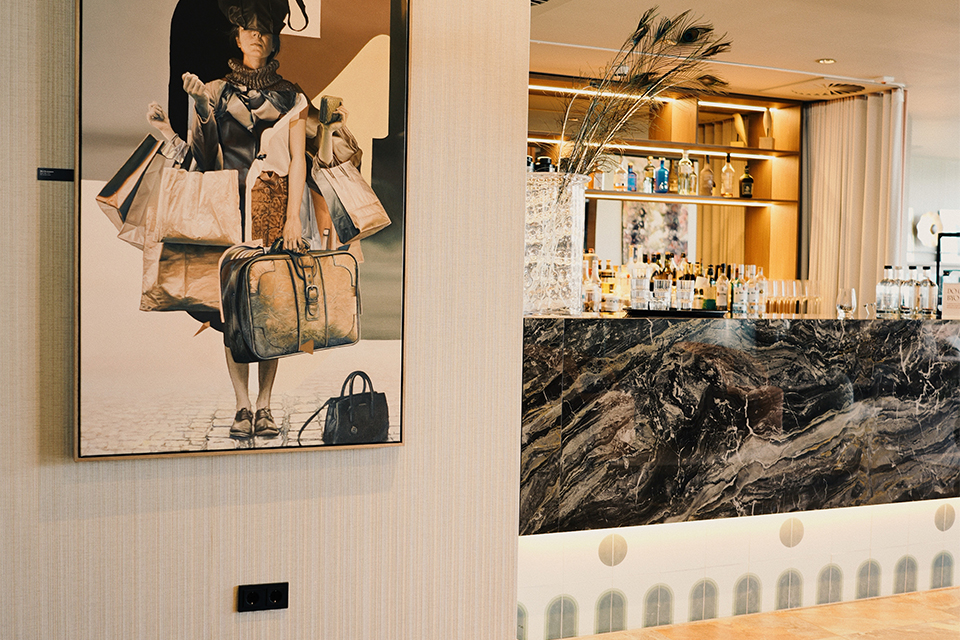
It all begins in the hotel itself, during a guided tour of the art. The works have not been chosen at random. The lobby features, amongst other things, paintings by Miel Krutzmann, known for the TelmoMiel duo with Telmo Pieper. Their work has its roots in Rotterdam, an international appeal and just the right amount of playfulness to work in a hotel setting without becoming trite. A piece such as *Empty Bags* takes on extra significance in this context. Luggage, travel, arrival, departure, shopping, migration – in Rotterdam, everything is closely intertwined.
Further along, works by Melissa Moria are on display, in which flowers are not merely decorative, but conveyors of time, fragility and attention. In the main corridor, the collaboration with the Kunsthal becomes tangible. Demonfuzz Records has created a temporary installation there featuring album covers and floral motifs, inspired by ‘Flowers Forever’ at the Kunsthal. It is not a traditional museum display, but rather an unexpected encounter between music, art, the city and the hotel.
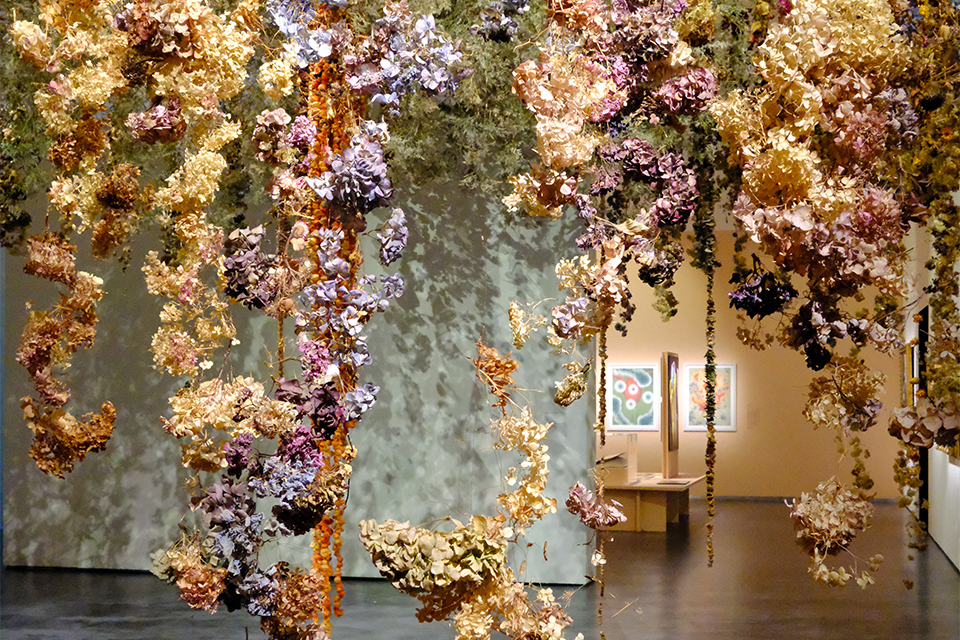
At the Kunsthal, ‘Flowers Forever’ demonstrates just how broadly an accessible theme can be explored. Here, flowers are not merely beautiful. They are religious symbols, commodities, political statements, scientific objects, design motifs and sources of technological inspiration. The exhibition gets off to a stunning start with Rebecca Louise Law’s *Calyx*, an installation comprising over a hundred thousand dried flowers strung together. You don’t just walk past it; you step right into it.
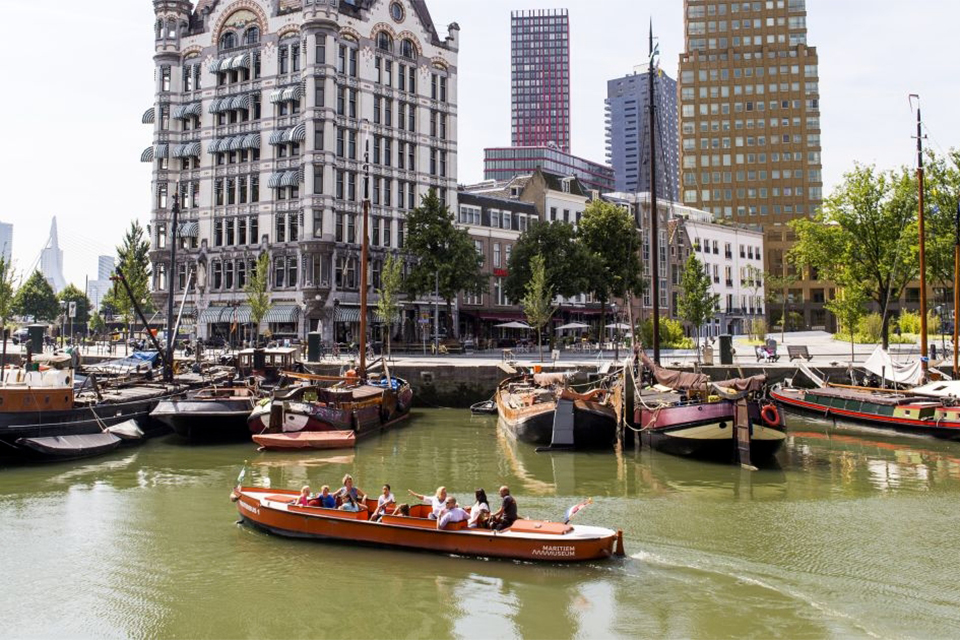
’In the afternoon, we board the Maritime Museum’s electric boat. From the water, our perspective shifts. What looks like a set from the quay becomes history as we travel along. The guide tells us about wine merchants in the Wijnhaven, eel and salmon smokehouses on the water, an old light vessel on the North Sea and a floating hotel made from old LASH barges, the forerunners of the container. A little later, the Witte Huis comes into view; completed in 1898, it was long known as one of Europe’s first skyscrapers.
The next day, the route continues across the water, by water taxi to Katendrecht. That in itself is typical of Rotterdam. Whilst other cities tend to organise their cultural programmes mainly around walking distances, here you can link the different parts of the city together via the water. The crossing to Fenix therefore doesn’t feel like a mere journey, but like part of the programme itself.
Fenix is the new art museum in Rotterdam dedicated to migration. The theme ties in almost naturally with the story of the Haven Hotel Rotterdam. The port has always been a place of departure and arrival. People came, passed through, stayed on, built a life for themselves or took stories with them. At Fenix, this universal concept is brought to life through the use of space.
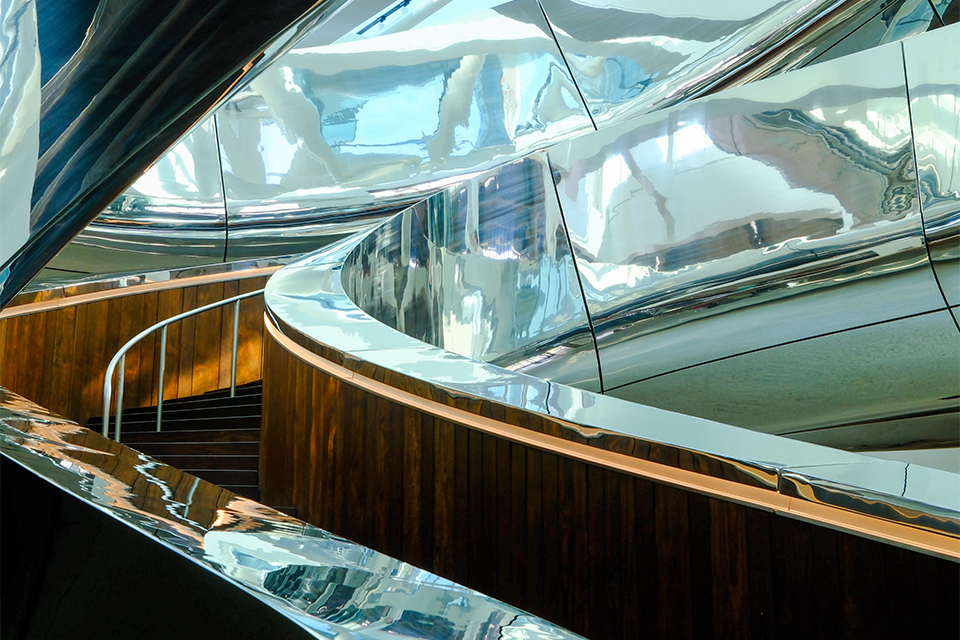
The Tornado, designed by Ma Yansong of MAD Architects, is more than just a spectacular staircase. It is a work of art, a route and a viewing point all in one. The stainless-steel structure spirals upwards through the building, connecting the ground floor with the first floor and the viewing point. From the top, you can look out over the departure and arrival quays.
What makes ‘A Night at the Gallery’ interesting for the hotel industry is that the initiative goes beyond the guest experience alone. It touches on the changing role of hotels in cities. In popular cities in particular, hotels are being scrutinised. What do they add to the local area? Who are they there for? Do they merely benefit from the city, or do they also contribute something?
Van Uden seems aware of that question. He talks not only about guests, but also about the local community. The hotel is large, centrally located and highly visible. In his view, it is not enough simply to offer a good room and a decent breakfast. “What can we, as a major employer but also as a major meeting place in the city centre, offer the local community?”, he says, summarising the underlying question.
The answer lies in several layers. The hotel provides a platform for Rotterdam-based artists, collaborates with cultural institutions, offers a space for music and creative communities, and involves staff in the city’s story, including through gastronomy and their personal backgrounds.
Along the way, Van der Maarel consistently translates that relevance back to the guest’s journey. The cultural partners are not simply listed side by side as logos in a brochure, but form a coherent itinerary. The hotel, the Kunsthal, the Maritime Museum, Fenix, the electric boat, the water taxi, the bar, the lobby and the room each tell different chapters of the same story. This is important for sales. A corporate guest, an international leisure guest or a meeting organiser rarely chooses a place to stay based on a bed alone. They choose based on accessibility, comfort, ambience and, increasingly, context. Why here? Why this city? Why this hotel?
After two days in Rotterdam, one thing is particularly clear: the hotel doesn’t use the city as a backdrop, but as its very essence. Not every hotel is next to a Maritime Museum. Not every city has a Fenix or a Kunsthal just round the corner. But every hotel is situated somewhere. And every place has stories, creators, institutions, memories, flavours and people. That is precisely where A Night at the Gallery finds its strength. It doesn’t just sell a night in a gallery. It shows that a hotel itself can be a gallery, a starting point, a meeting place and a storyteller of the city. Provided you dare to choose a story that’s bigger than the bed.
 Nederlands Nederlands
  English (UK)