hotelvak.eu
EN

Platform on hotelmanagement, interiordesign and design in the Netherlands

Receipts in an apron pocket, invoices left lying around after a busy weekend, and till systems where nobody knows exactly what the settings are. According to Jan Vedder, national project leader for the hospitality sector at the Tax and Customs Administration, this happens more often than business owners realise. Not out of a lack of willingness, he emphasises, but mainly due to being busy, a lack of knowledge and the growing complexity of digital systems. With the new Administration Check for hospitality business owners, the Tax and Customs Administration is seeking to change this.

Since the launch of the online tool, more than 900 hospitality business owners have already completed the checklist. In doing so, the Tax and Customs Administration aims not only to help business owners avoid problems during inspections, but above all to help them gain a better grasp of their own business operations.
“Better record-keeping generally leads to better tax returns and less hassle,” says Vedder. “We often hear during audits: ”If only I’d known’ or ‘If only I’d been given that tip sooner’. Many business owners really don’t set out to do things wrong. Often, it’s simply because they’re so busy.”
According to Vedder, the traditional shoebox full of receipts still exists, although in the hospitality industry it has largely been replaced by digital systems. And it is precisely there that new issues are arising.
“Those old till machines with a flip-top drawer are almost a thing of the past,” he says. “A modern till system is really just a sophisticated computer. That offers advantages, but business owners need to realise that it also comes with responsibilities.”

According to Vedder, it is still too often assumed that digitisation automatically means that everything is properly organised. In practice, for example, it turns out that data is automatically overwritten or deleted, even though it should actually be retained for years. Back-ups are also frequently missing.
“Many business owners leave the settings entirely to a supplier,” says Vedder. “But ultimately, the business owner remains responsible for the administration. So you need to know how your systems are set up.”
The Tax and Customs Administration has noticed that many misunderstandings are arising, particularly regarding the retention obligation. Businesses are permitted to digitise documents, but only under strict conditions. For example, a scanned invoice must correspond exactly with the original.
“Many business owners think: ”I’ll just scan it in and then throw the original away.’ That’s possible, but there are certain requirements that apply. People aren’t always aware of this. And if in doubt, you can contact the Tax and Customs Administration.”
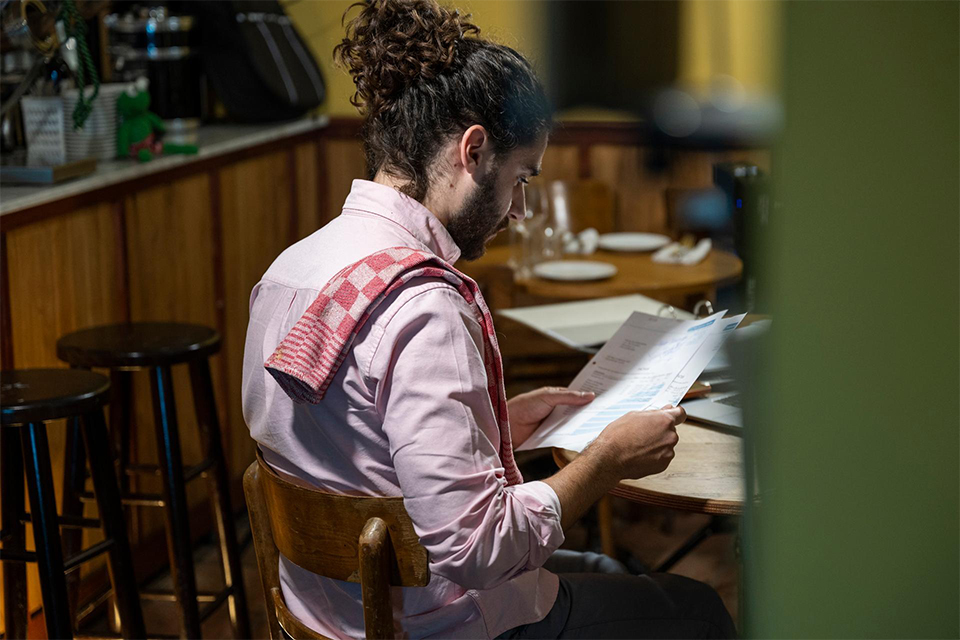
According to Vedder, the AdministratieCheck is explicitly not just about tax audits. A well-organised set of accounts is particularly beneficial for business owners themselves.
“Record-keeping isn’t just for the tax authorities,” he says. “As a hotelier, you also want to know how your occupancy rates are developing, how many bookings you’ve had, or how your margins are performing. That’s what you use to manage your staff, procurement and investments.”
This insight is becoming increasingly important now that hospitality business owners are working with booking platforms, online orders, different VAT rates and multiple digital systems at the same time. It is precisely for this reason that personal and business matters are becoming more easily intertwined.
Vedder cites calendars and WhatsApp as examples. “If business and personal data are intermingled, you basically have to keep everything. Many business owners don’t realise that.”
Furthermore, accessibility plays a greater role than many business owners realise. By law, records must not only be complete, but also verifiable.
“If any questions arise, you need to be able to explain what happened within a reasonable timeframe,” says Vedder. “If it takes you months to do so, you need to ask yourself whether you’re actually still in control.”
The Administration Check consists of nine practical questions about invoicing, record-keeping and document retention. Business owners receive immediate feedback and can save action points in an overview.
According to Vedder, the tool’s strength lies primarily in the relatability of the questions. It has been deliberately designed to be practical and has been extensively tested with hospitality business owners and consultants.
This yielded some striking insights. “Many business owners initially gave their accounts a ”nine“,” says Vedder. “After the review, we asked them to give a mark again. It was almost always lower. Not because their accounts were poor, but because they suddenly became aware of things they hadn’t thought about before.”
The check is completely anonymous. The Tax and Customs Administration cannot see who is using the tool or what answers are given. According to Vedder, this lowers the threshold for taking an honest look at one’s own records.
It is striking that the AdministratieCheck has been explicitly designed with a focus on support. To this end, the Tax and Customs Administration is collaborating with organisations including Koninklijke Horeca Nederland, the Chamber of Commerce and tax advisers.
According to Vedder, the tool is also actively promoted during company visits and start-up programmes. “We sometimes ask start-ups to fill in the checklist in advance before we visit. That way, we can go through it together and see what questions they still have. It’s not just about checking things, but above all about helping entrepreneurs.”
The positive feedback has now led to discussions about possible applications in other sectors, although there are no concrete plans for this as yet.
For now, the focus is entirely on the hospitality sector. And according to Vedder, there’s a good reason for that. “It’s precisely in this sector that we saw business owners frequently coming up against the same administrative issues. That’s why we wanted to develop something that really ties in with their day-to-day operations.”
His main piece of advice to hospitality business owners? Don’t view administration as a necessary evil, but as part of good business practice.
“Good record-keeping doesn’t just prevent disputes later on,” says Vedder. “Above all, it helps you keep a firm grip on your business.”
Want to carry out the Administration Check yourself?
 Nederlands Nederlands
  English (UK)