
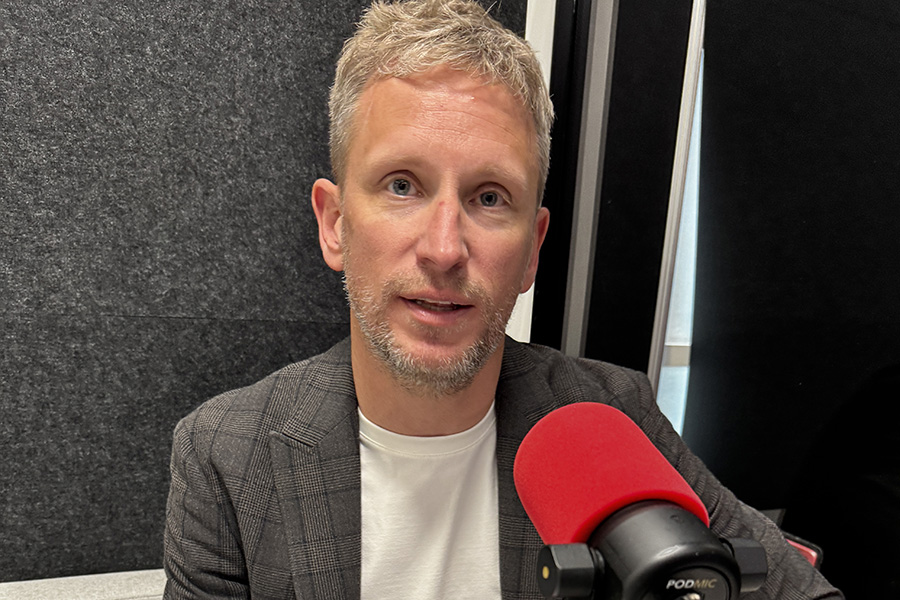
Host: Jerry Helmers
Guests: Jan Akkermans – owner of Garde Hotels
[00:05] Introduction to Jan Akkermans
Jerry Helmers: A very warm welcome to yet another new episode of Hotelvak, the podcast. And sitting next to me is someone I’m meeting in person for the first time today. And I’m really delighted about it. Jan Akkermans from Groningen, representing Garde Hotels, is here with us. I’m almost tempted to call him ‘Mister Groningen’.
Jan Akkermans: Yes, I left early this morning.
Jerry Helmers: What did you say? Left early? Yes, that’s right, because we’re recording this podcast in Amsterdam. It’s always the case, of course, that we Amsterdammers find the journey to Groningen a right long way. But you Groningeners – surely you wouldn’t think twice about popping over to Amsterdam for a bit?
Jan Akkermans: No, that might well be the case. Both my parents are from The Hague. So I actually used to drive back then. We’d just pop over for the weekend – well, not even a weekend, but on Sundays we’d drive back and forth. And if we had to go to Groningen as a family, you always had to stay for three weeks. That was always the difference, really.
Jerry Helmers: Yes, exactly. Well then. ‘Welcome to Amsterdam,’ I’d say.
Jan Akkermans: Thank you very much.
[00:53] Why listen to this episode?
Jerry Helmers: Jan, before we get to know you a bit better, why should people keep listening to this podcast? And who, in particular, should keep listening?
Jan Akkermans: Well, as many people as possible, I’d say. And especially the enterprising hoteliers amongst us. Because that’s always been my approach; it’s something I try to stand out in. I really enjoy doing that. I really enjoy telling a story, building a brand. And I hope we can share some tips, tricks and stories along the way.
Jerry Helmers: Building a brand – you’ve done that yourself, haven’t you?.
Jan Akkermans: Yes, that’s what I enjoy doing most of all. And I hope we can draw some attention to that today.
[01:33] Who is Jan Akkermans?
Jerry Helmers: Before we do that, I’ve got a very long list of little things I’d like to ask you about. Why don’t you tell the listeners – perhaps the odd person who’s never heard of you before – who you are?
Jan Akkermans: My name is Jan Akkermans and I’m now 44 years young. I was born and brought up in Groningen. I live there with my wife Marloes and my two children, Sam and Liva, aged 8 and 12. And for about four years now – almost five – we have been the owners of Garde Hotels, and I am also chairman of the Groningen branch of Koninklijke Horeca Nederland.
Jerry Helmers: So you still have time to do a bit of lobbying, take part in debates and discussions, and put forward proposals?
Jan Akkermans: Yes, I’m trying… No, I really do see it as a single entity. I don’t really see it as a side note, KHN. I genuinely see it as part of my work. And that’s how I try to approach it. That’s how I explained it at home, too. So I hope they see it that way at home as well.
Jerry Helmers: Then you shouldn’t let it slip here either.
Jan Akkermans: No, I shouldn’t reveal that here. It wouldn’t be a good idea. But that’s really how I see it. It’s an all-encompassing job, work, part of my life. And that’s exactly how it is. So in that sense, it does make things easier.
[02:52] Mr Groningen?
Jerry Helmers: And I introduced you as Mister Groningen. I did, of course, have a quick look here and there on the internet. I did find a few things. Is ‘Mister Groningen’ the right description?
Jan Akkermans: No, not for me. I’d be more likely to give that description to my father at the time. But no, I… Well, you know, we’re doing our best. And I don’t shy away from the limelight – let’s make that clear from the outset. So I do try to represent Groningen wherever I can.
Jerry Helmers: Is there nothing quite like Groningen?
Jan Akkermans: No, nothing. But very few things can beat Groningen.
Jerry Helmers: Very little, OK. We want to paint a nice picture of you. So that the listener can get to know you. I’d just like to go right back to your childhood for a moment. What sort of little boy were you? And was there already something in you back then that suggested or hinted that, as a little boy, you wanted to make people happy later on? Perhaps you wanted to work in the hospitality industry. You wanted to make people happy. You wanted to welcome guests.
[03:52] Childhood and early ambitions
Jan Akkermans: No, not really.
Jerry Helmers: Never?
Jan Akkermans: No, never. Strange, isn’t it? Because you’ve had a completely different career as well. I’ve done something quite different. I do sometimes draw on it, and sometimes on my training too. I’m a physical education teacher by training. So I do have some connections with that. But for me, it’s something that’s always been part of who I am: taking the lead, wanting to be the one at the front of the pack, telling stories. Ever since I was a child, I’d hand out the presents whilst giving a little speech. That’s just part of who I am.
Jerry Helmers: And then perhaps you’re talking about entrepreneurship.
Jan Akkermans: Well, perhaps entrepreneurship, or perhaps also… A lack of self-confidence, perhaps.
Jerry Helmers: Were you also the sort of boy at primary school who used to be elected class representative?
Jan Akkermans: No, not that either. No, not at all, in fact. No, but I was there, I think. It wasn’t until later in life – not right from the very start, anyway. I still hear stories from my childhood about me sitting in the sandpit, with everyone playing with my toys, and how I was perfectly happy with that. That’s quite strange, really. But later, after secondary school, I got more involved in sport and found I enjoyed… I became a coach very early on.
Jerry Helmers: In which sport?
Jan Akkermans: In the world of football. I always really enjoyed doing that. And telling stories, being there for people – that’s always been part of me. But I’d never – before I started at The Student Hotel, now known as The Social Hub – worked a single day in the hospitality industry. And then I became general manager of a hotel with 365 rooms.
[05:30] School years and education
Jerry Helmers: Yes, exactly – we’ll come back to that later, of course. Secondary school. You love telling stories, but what sort of stories did you tell?
Jan Akkermans: I tried to do as little as possible. And whilst I managed the oral exams, it was really a struggle – I only just scraped through to complete my MAVO.
Jerry Helmers: Did you get there all right?
Jan Akkermans: Well, I did carry on in the end. Thanks to my mum, actually. She did put a bit of pressure on me.
Jerry Helmers: So how did that go? Was she on top of it? Have you done your homework?
Jan Akkermans: No, not really. But there was a time when they actually said at my school: ‘This lad – even MAVO is too difficult for him. He’s only ever up to other things.’ Playing football, doing sports, joking around, that sort of thing. I was never really a nuisance either. But I just had other interests. And when, at one point, they even wanted to send me away from MAVO, my mum said: ‘Well, it’s about time.’ That’s when I was helped by ending up at a homework centre. And thanks to that, I did eventually complete my studies – albeit at D-level, I should add, so MAVO D-level.
Jerry Helmers: You say: ‘I just wasn’t interested in school.’ Didn’t you ever realise, even just a little bit, that you’d have to get a qualification at some point, because you wanted to have a decent job later on? Or didn’t you give that any thought?
Jan Akkermans: I can’t imagine I was doing that at the time. No.
Jerry Helmers: And you said you were interested in sport. At some point, you made that choice too. Because, after all, you ended up becoming a PE teacher. I completed my higher professional education. So, in that respect, things did turn out quite well in the end, indeed. How did you feel when you started that course? Because you knew then that you’d be standing in front of a class.
Jan Akkermans: Yes, but I could do that. I could teach. I could stand in front of groups of people. I could tell my story. It just came very naturally to me.
[07:23] Physical Education Teacher
Jerry Helmers: Yes, you can tell your story, but as a teacher, surely you also want to help your pupils make a bit of progress?
Jan Akkermans: Yes, definitely. But I really enjoyed that. And I still really enjoy doing it. The ALO was actually very… Well, I wouldn’t say easy, but what I was able to do was: I’m quite naturally athletic. Apart from gymnastics and swimming, I’m quite capable when it comes to ball sports, fitness and sport in general. And I found it quite easy to stand in front of groups and teach. And to explain why we do things and what’s important about them. And what it’s like to get on with one another. And what sort of behaviour you want to see. And how to look out for one another a bit. And I think I’m quite sociable by nature. I really enjoyed doing that. I got a lot of pleasure out of it. So I really did have a great time at the ALO. In the end, I was quite good at it.
Jerry Helmers: And then you actually started working at a school.
Jan Akkermans: Well, I did a teaching placement at the Van Liefland School in Groningen. It was my LIO placement in my final year. And that was a school for children with behavioural difficulties. I did do a day’s supply teaching there on the odd occasion. But that was about it, really.
[08:35] Why he didn’t go into teaching
Jerry Helmers: So, in the end, you did ALO, but you didn’t go any further in education at all. Why not?
Jan Akkermans: Well, I don’t always make myself very popular with that sort of thing.
Jerry Helmers: Well, go on then.
Jan Akkermans: Look, I found few places more depressing than a staff room.
Jerry Helmers: I think I know what you mean.
Jan Akkermans: And that’s exactly how I experienced it. It was break time in the staff room. Then that box of sandwiches would be opened. And right from the start, what was on them was rubbish. I always found that really fascinating. I mean, you can make your own sandwiches, can’t you? But that was already quite something. And then the moaning would start. And I’m quite the sort of person who… I actually quite enjoy a bit of moaning now and then, don’t I? We moan about all sorts of things on a regular basis anyway. But it was always there. Pietje hadn’t done well. Klaas was late again. Marietje…
Jerry Helmers: You mean that the teachers…
Jan Akkermans: It was nothing but negative. And then I thought: surely you’re in the team to help those children, to help people get ahead? Isn’t that right? That must be the idea.
[09:39] Why he left teaching
Jan Akkermans: Well, back then… Yes, I don’t know. Looking back, I think I should have said something about it. But I was doing a work placement there. I’d only just started. I thought: what am I going to do here? I did enjoy teaching, though. And I’d found that to be the case at several different schools. The last school was an exception, though. But at all those secondary schools where you’re supposed to do your teaching placement, I just never really found it enjoyable. And I do think – I can talk about it like this now, but at the time I really did make a subconscious decision: I’m definitely not going to do this. I need to do something else. And for me, that quite quickly led me towards the business world.
[10:18] The first step at Red Bull
Jerry Helmers: So how did you end up working in the hospitality industry?
Jan Akkermans: I ended up joining Red Bull. At the time, the only requirement there was a completed higher professional education (HBO) degree. Well, luckily I was able to provide proof of that.
Jerry Helmers: Your mum’s proud too.
Jan Akkermans: My mum’s proud too, yes. It’s partly thanks to mums. No, but I was able to sort that out. And then I eventually started at Red Bull. It was called ‘Account Market Striker’ back then. As an account manager.
Jerry Helmers: A sort of sales representative.
Jan Akkermans: Yes, a sales representative. Selling a can.
[10:50] Learning from brand perception
Jerry Helmers: So what sort of companies did you visit?
Jan Akkermans: The hospitality industry. So it was really all about pubs, restaurants, nightclubs and event venues – anywhere where Red Bull was sold. And that’s where my fascination with marketing and brand promotion first began. Because, of course, it’s a massive brand.
Jerry Helmers: So you head off to visit that customer. You say you love telling stories. Then you pop into those pubs and restaurants. That’s when you can tell your story. But you’ve got to sell as well.
Jan Akkermans: Yes, certainly. But that was also the time when… Look, back then, selling basically meant making sure that… Because a catering establishment would sell Red Bull. Generally speaking. There was still a bit of competition here and there, at other times. But let’s just say that 80 per cent of the hospitality business owners I visited did sell Red Bull. The question is simply: how do they sell Red Bull? And is it visible? And when a customer walks into a bar or restaurant, what do they see? And how are they prompted to buy? And what’s the moment when they decide to buy a can or something else? Well, I really enjoyed doing that.
[11:52] Competition and self-confidence
Jerry Helmers: But did you also feel like you were in a sort of battle against the competition? Because, of course, you weren’t the only sales representative walking into that sort of shop at the time. Because the very next day, representatives from another brand – brand B, brand C or brand D – would walk in. Is that a battle you faced? Because you’re also very competitive, so that means you want to win. So was it in your nature to do everything you could to convince that hospitality business owner to choose your brand and start telling that story?
Jan Akkermans: Yes, certainly. But that’s… Look, it doesn’t necessarily have to be a struggle… It could simply be that you’re very self-assured and that you have confidence in what you’re doing. And that you think, simply as a group – whether as a brand or as an individual – that at that moment, we’re the best. That’s a phrase I often find myself repeating, inspired by Louis van Gaal. Because Louis van Gaal once said in Munich: ‘We’re the best.’ Well, that’s certainly something I try to convey.
[12:45] Modesty and entrepreneurship
Jerry Helmers: But as a top player, do you also need a bit of that arrogance to dare to say that out loud? We’re the best.
Jan Akkermans: Absolutely. My team don’t often dare to say that out loud. And that’s always a bit nerve-wracking. But I do just want to… That’s what I try to do. With a bit of self-deprecating humour too. So I try… I’m also very aware that it doesn’t always work out that way. And there are loads of competitors who do things differently. But when you have confidence in yourself and simply radiate that, that’s what I try to do.
Jerry Helmers: But are you saying that modesty is a virtue in a person, but not in an entrepreneur?
Jan Akkermans: Well, no, I suppose I’m also an entrepreneur. Yes, I’d say I’m consciously an entrepreneur too. I think I just try to go through life with a healthy dose of self-deprecating humour. And that does help me. I take myself… Here I go again. Here we go again. I did MAVO. And when people ask, I just say so. What’s more, my mum did MAVO too. That’s basically what it boils down to. But that’s something I just keep saying all the time. Even though I’m quite aware of the fact that I’m capable of much more. And that I’ve definitely developed at certain points.
[13:47] A career without a fixed plan
Jerry Helmers: Anyway, of course, you only realise that as you get older.
Jan Akkermans: You realise that later on, as things go along. And I’ve never really had any specific career plans. It’s just sort of happened to me at certain times.
Jerry Helmers: So things just turn out the way they do?
Jan Akkermans: Yes, things really are just the way they are.
Jerry Helmers: Have you been lucky?
Jan Akkermans: Always.
Jerry Helmers: Can you force yourself to be happy?
Jan Akkermans: As well. As well. As well. Not only, but also.
[14:06] The story behind a brand
Jerry Helmers: I’m just thinking about this for a moment, because you said you really enjoyed going to those hospitality venues to sell Red Bull there. Shall we do a bit of role-play for a minute? I’ll be the hospitality business owner who actually already has another good brand. And you’re now going to try and sell me Red Bull.
Jan Akkermans: Yes, well, do you know what we used to do? What I always used to do was…
Jerry Helmers: Well, go on then. Hello, sir, what brings you here?
Jan Akkermans: Well, I’ve got something brilliant for you, sir.
Jerry Helmers: Yes, that’s what they all say.
Jan Akkermans: No, but the point is, first and foremost: the experience behind the brand. Because that’s exactly what we’re doing now. What feeling do you get the moment you’re handed a can of Red Bull? These days, you associate that with Max Verstappen. Or you associate it with the Red Bull Air Race that used to take place. In Groningen, they arrive on bikes. You associate that with sport, with strength. You associate that with experiencing thrilling moments.
Jerry Helmers: But why do I have to sell that, sir?
Jan Akkermans: Because the guest who comes in experiences that too. And that’s a different experience.
Jerry Helmers: But how on earth do you know which guests are coming in here?
Jan Akkermans: Well, but I can see that, can’t I? I was here on Monday evening as well. I saw it then too. It’s Saturday afternoon now, but I see it on Monday evenings as well. I see it on Sunday mornings too. Because you feel and experience what’s going on in a business.
Jerry Helmers: But you know, Mr Akkermans, I realise you naturally want to sell to me. But your colleague, the sales representative for the other brand, said exactly the same thing yesterday.
Jan Akkermans: No, that’s not possible.
Jerry Helmers: No, that’s not possible. But he did it anyway.
Jan Akkermans: No, that’s not right. No, that’s not possible. No, that’s not true. No, but of course it is. And I’m applying that to Red Bull now, but we also apply it to… It’s what we’re doing right now, of course. So it’s the same in the hospitality industry too. Because ultimately, it’s all about conveying the feeling people have the moment they walk in, or have a drink, or experience something, or do something. People have a certain association with that. And you have to manage to convey that association. That’s what it’s all about. Not so much about the can itself, or what it does, or what happens, or how the story came about, or where it comes from. You can tell all sorts of things about that. You can put that on display.
[16:06] The most important lesson from Red Bull
Jerry Helmers: Right, let’s step out of the café for a moment and get back to this conversation. But what’s the most important thing you learnt during your time at Red Bull? Is it really about creating a brand? Could you give one tip to listeners who are now thinking: ‘Yes, I want to position or create my own brand more effectively too.’.
Jan Akkermans: Understanding why you do things. Truly knowing, from within, what your strength is and what your brand is. That’s really where it all starts. And it’s very simple: why do I get up in the morning, and why are we here in this world? The ’why’, the ‘how’, the ‘what’ – things we come across all the time. If you truly know them, and can really bring them to life, that’s where it all begins. And once you know that and translate it into a brand, everything you do becomes easier.
[16:57] From Red Bull to Regus
Jerry Helmers: How did that go at The Student Hotel? Was that the next step straight after Red Bull?
Jan Akkermans: No, mate. I worked at Red Bull. After Red Bull, I joined Groupon. They took on a lot of former Red Bull staff, because they had a network in the hospitality industry.
Jerry Helmers: Are you working in sales there as well?
Jan Akkermans: I also worked in sales. After that, I went on to work at Manpower.
Jerry Helmers: By that, do you mean the employment agency?
Jan Akkermans: Human trafficking – I’m not really supposed to say that. Human trafficking. Manpower didn’t like that, but that was Manpower. And eventually, a while after that, when I wasn’t quite sure what to do, I went it alone for a short while. That’s when I offered my services as a sales consultant, so to speak.
Jerry Helmers: A sort of self-employed person.
Jan Akkermans: I was sort of a freelancer. I did a bit of everything – from designing football goals to writing job adverts and working on job sites, that sort of thing. And eventually I joined Regus.
Jerry Helmers: The letting of flexible office spaces.
Jan Akkermans: Exactly. And that’s where the seed was sown, in a way.
[17:59] The first steps towards a career in the hotel industry
Jerry Helmers: So what was the seed?
Jan Akkermans: That I had a place which I could make more beautiful and better together with a community and with other people. That’s what we did.
Jerry Helmers: But how did you realise that it had suddenly become a passion?
Jan Akkermans: I really enjoyed doing it. And what I did there was: I went out and about. I’d actually been a sales account manager for my entire working life before this. And I was always on the go… I’d get in my car in the morning and go and visit clients, with a few things in the boot. Or I’d go to an office. At Manpower, we had temporary employment agencies. I was based in the north-east of the Netherlands. So it was either off to Apeldoorn, or to Heerenveen, or to Groningen. But here, I simply went to my business centre in Groningen. That’s where my clients were – my ’guests’, as we called them even back then – who were working there.
Jerry Helmers: The tenants?
Jan Akkermans: The tenants of a flexible office space. And there we tried to organise networking events, help each other out, connect people, and keep improving things bit by bit. I really enjoyed that. And it gave me a real boost. And then I thought: I want to become a hotel manager.
[19:24] From Regus to the hotel industry
Jerry Helmers: But I still think the move from flexible office spaces or workspaces to a hotel is quite a big step.
Jan Akkermans: It’s a huge step. And I don’t think it’s an obvious one either. As luck would have it – or perhaps unfortunately – at that very moment, after two years, there was a reorganisation at Regus. Whereas we’d previously had one centre manager covering three cities, the roles were clustered. So more people were brought in. Or rather, people had to go. I didn’t have a permanent contract at the time. So my job came to an end.
Jerry Helmers: You suddenly found yourself out of work again.
Jan Akkermans: I was suddenly out of work again, so to speak. Properly out of work. I thought: right, what am I going to do now? Because I actually really enjoyed what I was doing. That’s exactly what I thought: oh, what a shame.
[19:56] Dealing with setbacks
Jerry Helmers: Right, but that makes me wonder. Suddenly, your employment comes to an end. How does that affect you? Are you disappointed in society? Are you down in the dumps? Or do you have the sort of attitude where you think: this is…
Jan Akkermans: I’m lucky in that, by nature, I don’t get flustered very easily. That can be an advantage, but it can also be a disadvantage. From a business perspective, it can sometimes be a disadvantage. In this case, on a personal level – because this is a bit of a private matter, so to speak – it’s actually quite an advantage. So I did see some opportunities there too. And that always sounds so romantic, doesn’t it? But that’s just the way I am.
Jerry Helmers: But didn’t you – I don’t know if you were already living in your own home at the time, for example – find yourself thinking: right, I’m about to lose my job, but the mortgage still has to be paid. Were you still with your wife back then? Or perhaps your girlfriend at the time?
Jan Akkermans: Yes, my girlfriend was with me at the time, that’s right. And we did indeed own our own home. But no, I can honestly say: there are jobs out there. My girlfriend simply had a good job at the time. And there are jobs out there.
Jerry Helmers: Then it’s easy to say: I’m a bit less worried. I’m with my girlfriend, and she might be taking some of the strain off me as well.
Jan Akkermans: Well, in any case, he made sure I felt confident that we didn’t necessarily have to sell our house. And I think that sort of thing always happens at some point, when you think: this is complicated, or I’ve got to sort this out. But I’ve never… I’ve done so many things. I’ve gone from cans to people, to deals, to agencies. I was confident enough to think: ‘I’ll find a way out of this.’.
[22:01] The phone call that changed everything
Jerry Helmers: It always works out in the end, doesn’t it? That’s what people say, of course.
Jan Akkermans: Everything always works out in the end. It really does. And I come from… That does make things a bit easier. Both my parents are still alive. They’ve done well for themselves. My girlfriend just happened to have a good job at the time. Of course, there’s also a safety net if you lose your job. No, don’t dwell on it for too long. Just carry on and look for something new.
Jerry Helmers: But then you did make the move into the hotel industry.
Jan Akkermans: And I actually think that’s one of my favourite stories too, one I always really enjoy telling. I was sitting there with a client at one point and he said to me: ‘Gosh, so what now?’ Then I said: ‘Well, I was sitting at home last night and I thought: I want to become a hotel manager.’ And that was really because I thought: if I like a desk, a bed must be even better. Because you get food as well, and breakfast too. So a hotel had to be even better. I’d never worked in a hotel before. I had no idea. But my gut told me: this could be even more fun. Then he said to me: ‘Why don’t you have a chat with Herman van der Poel?’ He was the manager at the Apollo Hotel at the time. So I rang him. I said: ‘I’m Jan, and I’d like to become a hotel manager.’ ‘Could I pop round for a cup of coffee sometime?’ He said: ‘Well, that’s quite a story, but do come round.’ That cup of coffee turned into lunch. And it was a really lovely chat. He advised me to look for a job in sales within the hotel industry. ‘Look for a job like that.’ So I went home and started looking. And the next morning, he got a call from a recruiter in Amsterdam. The recruiter said: ‘I’m looking for someone for the new The Student Hotel opening in Groningen. It needs to be someone with a network in Groningen, but not a traditional hotelier. Do you know anyone? Or would you like to do it? He said: ‘I spoke to Jan yesterday. It’s really bizarre. You should give him a call. It might be something.’.
[23:49] The application process at The Student Hotel
Jan Akkermans: She rang me. And she said: ‘Can you come to Amsterdam now? Because we’d like to meet you.’ I jumped in the car. I had three meetings there at the Hotelprofessionals office at the time. They said: ‘Yes, we’re keen.’ But, well, it was a bit mad. I’d never worked a single day in a hotel. ‘Just drive over to The Student Hotel.’ So I drove over to The Student Hotel. Had three or four interviews there as well. The next morning, I got a call from the CEO at the time. He said: ‘Jan, everyone’s absolutely raving about you. But I don’t quite understand, because you’ve never worked a single day in a hotel. How are we going to do this? He said: ‘Can you pop round? Just one thing – it’s only possible on Sunday morning; that’s when I’ve got time for you.’ But you know what? Why don’t you come on Saturday evening instead? Bring your wife – or my girlfriend at the time. We only had our little daughter back then. Bring her along, come to Amsterdam. Stay over with us. I’ll see you at breakfast the next morning.’ I said: ‘All right.’.
[24:41] A decisive breakfast
Jerry Helmers: That really is a unique recruitment process.
Jan Akkermans: Brilliant. But it’s going to be lovely, isn’t it? So we’ll be sitting there the next morning. You’re a bit nervous, aren’t you? What’s going to happen now? And you’re a bit on edge, aren’t you?.
Jerry Helmers: Surely?
Jan Akkermans: Yes. There have been a few times in my life when I’ve been nervous.
Jerry Helmers: So apparently, you weren’t the sort to think ‘it’ll all be fine’.
Jan Akkermans: No, that was this moment.
Jerry Helmers: Why?
Jan Akkermans: Because I felt: this is my chance. This is what I want. I’ve always done things where I thought: OK, fine, go on then. But I thought: this is what I want. And there have been two times in my life when I’ve been really nervous. Apart from my driving test. It took me three attempts. I just couldn’t get my legs to cooperate. And this moment. And I was really nervous. So I sat down there. We were having breakfast. And my little daughter… That CEO walked in. Of course, you only know him from photos. So he walks in. He sits down. Just then, my little daughter knocks the bottle of orange juice over the table.
Jerry Helmers: So you thought: bloody hell.
Jan Akkermans: And he sits down. And he says to Marloes, my wife: ‘Do you think this is possible?’
Jerry Helmers: What did you think? Now she’s the one who’ll decide.
Jan Akkermans: I thought: ‘Here we go again.’ But luckily, it seems she gave the right answer. And I have to be completely honest with you…
Jerry Helmers: So what did she say?
Jan Akkermans: I get asked that question too, because I tell the story quite often. I can’t quite remember. But I think it was something along the lines of: I’m sure of it. He’s enthusiastic and it’s… Well, what do I know? I can’t remember. Strange. But it must have been something like that.
[26:00] The job of hotel manager
Jerry Helmers: But isn’t it bloody interesting that an employer would ask a potential employee’s wife or girlfriend: ‘Do you think this is possible?’
Jan Akkermans: Wow. Unbelievable. And he looked me straight in the eye. And he said: ‘You’ve both got to realise that something needs to happen. Because you’ve got no experience in the hotel industry.’ So we really need to teach you that. That means you’ll be doing a two-month in-house placement at our hotel in The Hague. He won’t be at home during that time. I also expect you to give it your all for those two months, so you can learn everything there is to learn. If you’re all right with that, he can start tomorrow.’ So we said yes. And that’s how I became the hotel manager of The Student Hotel in Groningen.
Jerry Helmers: And your wife?
Jan Akkermans: He thought it was brilliant.
[26:52] Falling in love with the profession
Jan Akkermans: It all happened so quickly that I wasn’t even out of work for a moment. I heard about it at Regus and three weeks later I was hotel manager at The Student Hotel. But we really did… Especially that early phase at The Student Hotel. That’s where the seed was sown. And it was just a really lovely time. That’s where I fell in love with the profession – with the hospitality industry, with the hotel trade. And that’s where it really all began.
[27:40] What sort of data would he like to collect?
Jerry Helmers: What other data would you like to collect from your guests, apart from the data you already have?
Jan Akkermans: I think we’re able to capture a great deal of data at the moment. But if it were possible to capture it in data, I’d really love to capture the feeling people have immediately after their visit or stay. Not through a review form afterwards, but really what the visit, the surroundings, the food and the night itself did for people at that very moment. That’s what I’m curious about.
[28:14] In love with hospitality
Jerry Helmers: Can you imagine ever doing something else?
Jan Akkermans: No.
Jerry Helmers: Are you in love for life?
Jan Akkermans: Yes. I’ll carry on… I now see myself as an entrepreneurial hotelier. And I think that’s quite different from being a manager-hotelier or a hotelier in paid employment.
[28:34] From hotelier to entrepreneur
Jerry Helmers: At some point, of course, you do take that step.
Jan Akkermans: So I do see myself now as a truly entrepreneurial hotelier. I do more than just… But I can’t really see myself doing anything else. No, I’ll definitely keep going down this path.
Jerry Helmers: So what was the trigger that eventually led you to take the plunge into entrepreneurship?
Jan Akkermans: Coincidence.
Jerry Helmers: It’s happened to you again.
Jan Akkermans: Yes, it’s happened to me again. Well, look, to cut a long story short, after The Student Hotel I spent three years in Groningen. After that, we were given the chance to develop things a bit further. So I was going to grow the business a bit more with The Student Hotel. So I was going to be more involved in the launches of the international hotels. That was the romantic idea. So that meant heading there three months before opening, sorting things out, trying to get things up and running, and promoting and implementing The Student Hotel’s DNA there. The first step, however, was Rotterdam – as general manager of the Rotterdam branch – because there was no manager there at the time. I started there, and two weeks later, the coronavirus outbreak hit. And that simply meant I was effectively stuck in Rotterdam for two years. Not the best of times. It was also difficult with the situation at home. And then, eventually, I decided – in close consultation with The Student Hotel, of course – as the world had come to a standstill, what was going to happen now? – to leave The Student Hotel, albeit with a heavy heart. And to go back to Groningen. And to prioritise my family, my children and Groningen once again.
[30:11] Back to Groningen
Jerry Helmers: Didn’t you have a mindset along the lines of: ‘Despite all this COVID mess, things will turn out all right in the end’? So you weren’t naturally that positive sort of bloke either?
Jan Akkermans: No, that wasn’t the best time of my life. Things just weren’t going well. On the one hand, I was really enjoying my work at the time. I wasn’t spending enough time at home. It just wasn’t the right path. So, in the end, I decided to go back to Groningen. I started at Plegt-Vos in the construction industry as a commercial manager.
Jerry Helmers: Something completely different.
Jan Akkermans: Something completely different. Because they’d built The Student Hotel. So I knew them.
[30:44] The opportunity at Corps de Garde
Jerry Helmers: So are you one of those classic examples of people who worked in the catering or hospitality industry, and when the COVID-19 crisis hit, you found yourself out of a job?
Jan Akkermans: No, this was a decision that had to be made at the time. It was a decision based on returning to Groningen. I couldn’t find a suitable job in the hotel industry at the time. And it was an ambition where I thought: this sounds like fun too. Because they’d actually built The Student Hotel in Groningen. And the idea was: we’re going to develop, create and build this sort of hospitality concept. And so, for a change, I’m on the other side of the coin.
Jerry Helmers: Yes, exactly. I see what you mean.
Jan Akkermans: So we did have a certain connection that made us think: this is what we’re going to do. That’s where I started. One of the first conversations I had in my current role was with Wim Bulten, a property developer from Groningen. And he said to me something along the lines of: ‘But do you actually have any idea what you’re talking about?’ To which I replied: ‘Well, not entirely, because I don’t really come from a construction background.’.
Jerry Helmers: But Mr Bulten, it’ll be all right.
Jan Akkermans: It’ll be fine. I’ll learn how to do it. And he says: ‘But what have you been up to then?’ I say: ‘Well, this and that and the other.’ And he says: ‘Did you know I’ve actually got a hotel standing empty as well?’ And that was the Hotel Corps de Garde in Groningen. I knew it, because a good friend of mine had been the manager there for years. We used to go there all the time. I’d often stayed there too when we couldn’t find our way home from Groningen. And I thought: that’s quite a nice idea, actually. So I went home. I said to my girlfriend: I’ve got a good idea. I’m going to set up my own business.
[32:42] Doing business with Marloes
Jerry Helmers: And didn’t Marloes say something like: ‘Are you sure everything’s going to be all right?’
Jan Akkermans: No, Marloes said to me: ‘Just pop back to your office for a moment. No, we’re not going to do this. You’re doing just fine at Plegt-Vos now.’ You’re going to have a look at your lease car in a moment. And that’s absolutely fine. And the next morning we woke up. Then she said to me: ‘But we could do it together, too.’.
Jerry Helmers: Fortunately.
Jan Akkermans: And then we thought: we’d just sold our house. We were going to buy a new one. That builder went bankrupt. So we had money in the bank but couldn’t really do much with it at the time. And we thought: you know what we’re going to do? From now on, we’re going to work together.
[33:25] A shared adventure
Jerry Helmers: Did you expect that – that your wife had apparently spent the whole night thinking about it and that, after a night’s sleep, she’d changed her mind?
Jan Akkermans: No, I hadn’t expected that. Looking back, I could have seen it coming. She’d always worked part-time in the hospitality industry. She’d done all sorts of jobs like that. I also thought there was a really lovely community there in the early days at The Student Hotel — my children were often there too. She was there a lot. We really enjoyed that experience – not just the hotel, where I was the hotel manager, but simply being there as a family. So I really did think: this could turn out to be a real winning formula. And she really enjoyed it too. And that’s when we got started.
[34:07] Uncertainty and risk
Jerry Helmers: But are you talking about money as well, then – about earnings? You have children; you want to give them a decent life too. Haven’t you ever had the slightest doubt about that?
Jan Akkermans: No, and then that sign seems to pop up in front of me again. Which makes me think: it’ll all work out in the end.
Jerry Helmers: It all worked out in the end. Or is that always just a snapshot in time?
Jan Akkermans: Well, that’s just a snapshot. You’re really only as good as you were yesterday.
Jerry Helmers: Like your last goal.
Jan Akkermans: Yes, exactly. There’s certainly a competitive streak in me. But we’re really building something special right now. And it’s all worked out well. But make no mistake, it was right in the middle of the pandemic. We actually went through the last lockdown.
Jerry Helmers: But you managed to get through that as well, didn’t you?
Jan Akkermans: We got through that as well.
[34:51] Working with his wife
Jerry Helmers: How’s it going, working with your wife?
Jan Akkermans: Yes, it’s going like a house on fire.
Jerry Helmers: And what’s not going well?
Jan Akkermans: Well, the fact that we don’t always see eye to eye.
Jerry Helmers: Yes, but how do you sort that out?
Jan Akkermans: Well, we’ve certainly had to learn that. Simply by trying very hard to discuss the right things at the right times. It sounds complicated, but of course you very quickly find yourself discussing things with each other at the dining table, where the children are present too. On the one hand, we’ve simply told ourselves that that’s perfectly fine. Children should be able to grow up with that too; they should know that they come from a family like this and that this is our life. It’s their life too. But on the other hand, we do make a conscious effort to create moments to talk about it properly. By going for a walk every now and then and having a chat about it. You do have to learn how to do that.
And internally, it can be a bit complicated, because we… I say A, Marloes says B. And then someone in the office says: ‘Oh, for goodness’ sake, just sort it out yourselves first.’ And that’s exactly what we’ve created. And that really does happen. Lads, why don’t you two sort it out amongst yourselves first? And once you’ve worked it out, come back to us. Then we’ll get on with it.
We base everything on time. I’m focusing on tomorrow and Marloes is focusing on today. And if you can come up with simple guidelines like that, it really does make things easier. Is it a policy issue that will affect us tomorrow? OK, then we’ll take our time, and the onus will largely be on me. Is it something that needs to be done right now, something that will benefit us immediately? Give an example: something’s happening in the operating theatre, this needs to be sorted out with a patient, there’s an urgent issue with a member of staff, or we want to rearrange this table. Then that’s Marloes’s role.
[36:38] Chair of KHN Groningen
Jerry Helmers: Eventually, you also became chairman of Koninklijke Horeca Nederland Groningen. As you said at the start of this podcast, you simply see that as part of your overall entrepreneurial activities or your public profile. But you do have to be a bit politically correct about it, don’t you? Because, after all, you’re essentially lobbying. Does that really suit you? Apparently it does, doesn’t it? I can see you frowning now.
Jan Akkermans: It does rub me the wrong way every now and then. I do think I’m quite socially minded, though. So I always try to think about what’s in the public interest. Is it purely a business matter, or does it also affect the local community?
Jerry Helmers: That takes time as well.
Jan Akkermans: That takes time, too. But it is part of my job. Look, I said when I started at KHN: there’s one thing I don’t want. I don’t want to become the face of a sector that’s in turmoil. Of course, back then it was nothing but trouble – and it still is from time to time – but there are also some really wonderful things happening right now. And that’s what I’m trying to draw attention to. I try to lobby where necessary.
The VAT issue. We’ve all got strong views on that. We’ve talked about it at great length. But I’m also trying to draw a line under it at some point. And then to focus solely on the things we can actually influence ourselves at that moment.
[37:55] Personal stories in the lobby
Jerry Helmers: Can you tell stories in that lobby just as you used to do as a teenage boy at secondary school?
Jan Akkermans: Certainly, but that’s what we’ve done too. Because then you try to explain: how does this affect me personally? So yes, I’m a different sort of entrepreneur to the large NH Hotel Group, so to speak. But that’s why an issue like VAT affects me personally. And so I try to tell the personal story as well.
Of course, we did the same with KHN. We produced a magazine in which we try to tell the personal stories behind such decisions. I enjoy doing that. And I’m involved in it.
[38:30] Successful lobbying in Groningen
Jerry Helmers: Is there a particular success in that lobby that you’re really proud of? One where you think: ‘Well, as an ordinary bloke, I’ve managed to pull that off again, haven’t I?’
Jan Akkermans: And what about VAT?
Jerry Helmers: Well, as for that VAT, nobody in the hospitality industry’s lobby has managed to sort that out.
Jan Akkermans: No, we did our best.
Jerry Helmers: At the Groningen level.
Jan Akkermans: Well, those are minor details. You see, lobbying is always complicated. You set your own objectives high, and you always end up somewhere in the middle. But we are very pleased with the collaboration we now have at local level in Groningen. People are really taking notice of us. Our opinion matters.
Single-use plastic – that’s what we’re talking about, that’s what we’re working on. Events we’d like to bring to the city centre. It’s a lovely circle: there’s going to be a huge Red Bull event in the city centre.
Jerry Helmers: Is that still from your old network?
Jan Akkermans: No, nothing. Pure coincidence. But it is on the Grote Markt. That’s nice, though. They haven’t phoned me yet, but I’m sure they will.
But we really do want to create a vibrant city centre right here on the Grote Markt that is accessible to everyone. A place that benefits not only hospitality businesses, but also retailers and other small and medium-sized enterprises. And we don’t want everything to end up taking place at the racecourse in Groningen or other venues again, but right in the heart of the city.
There’s a really lovely event on at the moment – ‘Groningen Winter City’ in the city centre. We didn’t organise it on our own. It really isn’t down to KHN. But it is one of the objectives we had: to create a vibrant city centre. And I think we’re succeeding in that.
[40:09] Mr Groningen
Jerry Helmers: So, ‘Mister Groningen’. I said that at the start of this podcast, perhaps with a slight wink, just for a laugh.
Jan Akkermans: But it…
Jerry Helmers: …is indeed an accurate description.
Jan Akkermans: Too much credit.
Jerry Helmers: How did that go again? Modesty?
Jan Akkermans: No, but I am well aware that we’re gradually starting to have a say in and around Groningen.
[40:33] City walks in Groningen
Jerry Helmers: It’s the same with city walks.
Jan Akkermans: Well, that’s my father’s business. It started out as a hobby that got a bit out of hand. We now have thirteen city guides walking the streets of Groningen, running all sorts of guided tours. That works out at about six hundred a year. The back-office side of things had grown so large that it was no longer possible to organise it all. So I thought: we need to set up a bookings department as well, which now includes two hotels and two restaurants. Then we might as well include the team of guides in that too.
[34:51] Working with his wife
Jerry Helmers: How’s it going, working with your wife?
Jan Akkermans: Yes, it’s going like a house on fire.
Jerry Helmers: And what’s not going well?
Jan Akkermans: Well, the fact that we don’t always see eye to eye.
Jerry Helmers: Yes, but how do you sort that out?
Jan Akkermans: Well, we’ve certainly had to learn that. Simply by trying very hard to discuss the right things at the right times. It sounds complicated, but of course you very quickly find yourself discussing things with each other at the dining table, where the children are present too. On the one hand, we’ve simply told ourselves that that’s perfectly fine. Children should be able to grow up with that too; they should know that they come from a family like this and that this is our life. It’s their life too. But on the other hand, we do make a conscious effort to create moments to talk about it properly. By going for a walk every now and then and having a chat about it. You do have to learn how to do that.
And internally, it can be a bit complicated, because we… I say A, Marloes says B. And then someone in the office says: ‘Oh, for goodness’ sake, just sort it out yourselves first.’ And that’s exactly what we’ve created. And that really does happen. Lads, why don’t you two sort it out amongst yourselves first? And once you’ve worked it out, come back to us. Then we’ll get on with it.
We base everything on time. I’m focusing on tomorrow and Marloes is focusing on today. And if you can come up with simple guidelines like that, it really does make things easier. Is it a policy issue that will affect us tomorrow? OK, then we’ll take our time, and the onus will largely be on me. Is it something that needs to be done right now, something that will benefit us immediately? Give an example: something’s happening in the operating theatre, this needs to be sorted out with a patient, there’s an urgent issue with a member of staff, or we want to rearrange this table. Then that’s Marloes’s role.
[36:38] Chair of KHN Groningen
Jerry Helmers: Eventually, you also became chairman of Koninklijke Horeca Nederland Groningen. As you said at the start of this podcast, you simply see that as part of your overall entrepreneurial activities or your public profile. But you do have to be a bit politically correct about it, don’t you? Because, after all, you’re essentially lobbying. Does that really suit you? Apparently it does, doesn’t it? I can see you frowning now.
Jan Akkermans: It does rub me the wrong way every now and then. I do think I’m quite socially minded, though. So I always try to think about what’s in the public interest. Is it purely a business matter, or does it also affect the local community?
Jerry Helmers: That takes time as well.
Jan Akkermans: That takes time, too. But it is part of my job. Look, I said when I started at KHN: there’s one thing I don’t want. I don’t want to become the face of a sector that’s in turmoil. Of course, back then it was nothing but trouble – and it still is from time to time – but there are also some really wonderful things happening right now. And that’s what I’m trying to draw attention to. I try to lobby where necessary.
The VAT issue. We’ve all got strong views on that. We’ve talked about it at great length. But I’m also trying to draw a line under it at some point. And then to focus solely on the things we can actually influence ourselves at that moment.
[37:55] Personal stories in the lobby
Jerry Helmers: Can you tell stories in that lobby just as you used to do as a teenage boy at secondary school?
Jan Akkermans: Certainly, but that’s what we’ve done too. Because then you try to explain: how does this affect me personally? So yes, I’m a different sort of entrepreneur to the large NH Hotel Group, so to speak. But that’s why an issue like VAT affects me personally. And so I try to tell the personal story as well.
Of course, we did the same with KHN. We produced a magazine in which we try to tell the personal stories behind such decisions. I enjoy doing that. And I’m involved in it.
[38:30] Successful lobbying in Groningen
Jerry Helmers: Is there a particular success in that lobby that you’re really proud of? One where you think: ‘Well, as an ordinary bloke, I’ve managed to pull that off again, haven’t I?’
Jan Akkermans: And what about VAT?
Jerry Helmers: Well, as for that VAT, nobody in the hospitality industry’s lobby has managed to sort that out.
Jan Akkermans: No, we did our best.
Jerry Helmers: At the Groningen level.
Jan Akkermans: Well, those are minor details. You see, lobbying is always complicated. You set your own objectives high, and you always end up somewhere in the middle. But we are very pleased with the collaboration we now have at local level in Groningen. People are really taking notice of us. Our opinion matters.
Single-use plastic – that’s what we’re talking about, that’s what we’re working on. Events we’d like to bring to the city centre. It’s a lovely circle: there’s going to be a huge Red Bull event in the city centre.
Jerry Helmers: Is that still from your old network?
Jan Akkermans: No, nothing. Pure coincidence. But it is on the Grote Markt. That’s nice, though. They haven’t phoned me yet, but I’m sure they will.
But we really do want to create a vibrant city centre right here on the Grote Markt that is accessible to everyone. A place that benefits not only hospitality businesses, but also retailers and other small and medium-sized enterprises. And we don’t want everything to end up taking place at the racecourse in Groningen or other venues again, but right in the heart of the city.
There’s a really lovely event on at the moment – ‘Groningen Winter City’ in the city centre. We didn’t organise it on our own. It really isn’t down to KHN. But it is one of the objectives we had: to create a vibrant city centre. And I think we’re succeeding in that.
[40:09] Mr Groningen
Jerry Helmers: So, ‘Mister Groningen’. I said that at the start of this podcast, perhaps with a slight wink, just for a laugh.
Jan Akkermans: But it…
Jerry Helmers: …is indeed an accurate description.
Jan Akkermans: Too much credit.
Jerry Helmers: How did that go again? Modesty?
Jan Akkermans: No, but I am well aware that we’re gradually starting to have a say in and around Groningen.
[40:33] City walks in Groningen
Jerry Helmers: It’s the same with city walks.
Jan Akkermans: Well, that’s my father’s business. It started out as a hobby that got a bit out of hand. We now have thirteen city guides walking the streets of Groningen, running all sorts of guided tours. That works out at about six hundred a year. The back-office side of things had grown so large that it was no longer possible to organise it all. So I thought: we need to set up a bookings department as well, which now includes two hotels and two restaurants. Then we might as well include the team of guides in that too.
[40:59] The ambition: ten hotels in ten years
Jerry Helmers: What are your ambitions for the future? I mean, suppose we were to do another podcast in five years’ time. I wanted to put it very bluntly: what can I count on? But I won’t do that. But if you were to make a promise to yourself right now, what would you like to have achieved in five years’ time?
Jan Akkermans: I’m very ambitious and see things in black and white. I once said: in ten years’ time, we must have ten hotels. That’s actually displayed prominently in our office. An interview with Marloes and me clearly sets out our ambition: ten hotels in ten years. That is our ambition.
Jerry Helmers: And that’s going to work?
Jan Akkermans: I think so, yes.
Jerry Helmers: Lots of discussions with Marloes.
Jan Akkermans: No, Marloes agrees, you know. Because that’s not about today.
[41:49] Growing in a challenging market
Jerry Helmers: But you’ll still have to take small steps and make decisions every time.
Jan Akkermans: It’s true, of course, that things are a bit more complicated these days. I have to be honest about that. Everything has become more expensive, of course. It’s more complicated. So we’re giving it a go. We’ve actually come very close to opening a third venue a few times now. We’re currently in talks again. I really do expect one or two to come through soon. We’ll then go for it full steam ahead, in our own way.
[42:17] Entrepreneurial stress is changing
Jerry Helmers: Does it ever keep you awake at night? Do you worry about it? The bigger the business, the greater the worry?
Jan Akkermans: Yes, I suppose so. What really kept me awake at first were financial worries. We still have them now and then – I really don’t want to say they’ve completely disappeared at the moment – but we’ve got them reasonably under control. That’s a different kind of stress. It’s a different sort of stress. Then, if people are doing well in their roles, we’ll need to take on more staff.
Real stress: I have to pay salaries tomorrow and I simply don’t have the money. At first, it was because we were in lockdown or because we’d signed a contract for a hotel, and then the trouble started. That’s real stress. As an entrepreneur, that’s the sort of thing that really keeps you awake at night.
Fortunately, I can now say that I no longer feel that way. But I can still wake up. That’s how I often put it these days.
Jerry Helmers: But is that because you’ve got a bit older in the meantime? Yes, you’re still much younger than me. But it’s because you’ve got a bit of a handle on your own quirks by now. So it doesn’t keep you awake at night in the sense that you start worrying about it?
Jan Akkermans: Well, it’s just… Look, I’m really relating this to my own situation. It’s not that surprising that it’s keeping you awake at night.
Jerry Helmers: No, exactly.
Jan Akkermans: And that’s how you’ve got to approach it. And of course I do still wake up sometimes. Early, too early. And then I can’t get back to sleep, because all sorts of ideas start popping into my head. And then I feel I have to do this or that. And that’s my problem. You know, I wake up and then there’s no going back. I start thinking things through and then I just have to get on with it. And of course, you just learn to trust that things will turn out all right in the end. Then you’ve got it sorted again.
Jerry Helmers: There he is again.
Jan Akkermans: It’ll all be alright in the end. It’ll all be alright in the end.
[44:04] A motto for life
Jerry Helmers: What a wonderful outlook on life you have.
Jan Akkermans: Well, yes, you know. And I do have that too – that’s one thing. And the other is, Wim Bulten said that… He said that to me when we were back in lockdown. He said to me: ‘Jan, if it were easy, everyone would have done it.’ And if you combine those two things, you’ve got quite a good formula.
[44:25] Propositions
Jerry Helmers: That’s actually quite a good formula. Just for a laugh, I’d like to put a few statements to you. You can say whether you agree or disagree with them. And after that, I’d like to hear three tips for entrepreneurs from you. We can’t quite wrap things up just yet, but these might inspire our listeners a little.
Jan Akkermans: A proposition.
Jerry Helmers: Every hotel manager should know every brand of champagne.
Jan Akkermans: Incorrect.
Jerry Helmers: I disagree, or that’s incorrect. Working in the hospitality industry is always too hard.
Jan Akkermans: Incorrect.
Jerry Helmers: That’s incorrect. Is this about the balance sheet?
Jan Akkermans: No, there’s no such thing as working too hard.
Jerry Helmers: There’s no such thing as working too hard. Right, one last question. Is entrepreneurship something you’re born with, or not?
Jan Akkermans: Exactly.
Jerry Helmers: Exactly, I agree. But you did eventually realise it. Not at a young age, anyway – let’s put it that way.
[45:17] Three entrepreneurial tips
Jerry Helmers: Right. Great. Three tips for the listeners. Three tips for entrepreneurs. What are you going to share with them?
Jan Akkermans: Well, they’re more or less in line with what I’m always trying to say.
One: don’t take yourself too seriously. There are loads of people who take themselves very seriously. You shouldn’t do that. Try to take life with a pinch of salt as much as possible.
That’s one.
Secondly – and this follows on from that, because it works – is: look after your network. Because without a network, you’re nowhere. And it also helps if you don’t take yourself too seriously.
And if you combine that with the right amount of guts – so go for it, get stuck in, seize the opportunities that come your way – then I think you can make your own luck and go a long way.
Jerry Helmers: Yes, because we’ve obviously talked about luck as well. Is luck something you have, something you’re given, or something you make happen?
Jan Akkermans: Then you’ve got a bit of a knack for it. Of course, you’ve got it too. Then you can force it a bit.
[46:14] 90 seconds of fame
Jerry Helmers: Great tips. We’re going to wrap up this podcast with your 90 seconds of fame. I’m going to keep quiet, and straight after the short jingle, you’ll have 90 seconds to tell your story. In that sense, it could be an incredibly commercial story – your ‘Loekie de Leeuw’ moment. You’re completely free to choose what you want to talk about, but I’ll definitely be keeping quiet. So I’d say: seize your chance. Are you ready?
Jan Akkermans: I think so.
Jerry Helmers: You reckon so?
Jan Akkermans: I think so.
[46:40] An ode to Groningen
Jan Akkermans: Right. In this case, I’m not so much concerned with our hotels. This is a tribute to Groningen. It’s the capital of the north. It’s a city you can easily get to grips with. It offers everything you could possibly want. It has culture; it has history. It’s a young, vibrant city. There’s an incredible amount to do. The bars and restaurants never close at the right times. Culture is everywhere. It has a fantastic football club.
I’d really like to invite people to come to Groningen – to spend a weekend or a day there. And if you do end up there, I’ve actually got somewhere for you to stay.
[47:32] Closing remarks
Jerry Helmers: Well, you’ve used up your 90 seconds of fame in 48 seconds.
Jan Akkermans: Surely that’s more than enough?
Jerry Helmers: More than enough. But let’s be clear: nothing beats Groningen.
Jan Akkermans: There’s nothing quite like Groningen.
Jerry Helmers: I’d like to thank you very much for coming to the studio. Did you enjoy sharing your story on this podcast?
Jan Akkermans: I always enjoy that.
Jerry Helmers: I’ve certainly noticed that. So I think we could have carried on for another hour or so.
Jan Akkermans: I do have a few other things to say. But no, it’s not a fact. I really enjoy doing this. So I’d be happy to. I hope people enjoyed it too. Of course, they did.
Jerry Helmers: I think so. You’re a lively speaker. You’ve shared some great tips. You’ve also revealed a bit about yourself. And, of course, we’ve talked about entrepreneurship in the hospitality industry. And that’s, of course, what our listeners are getting on with too.
So thank you very much for coming to the studio. I’d also like to thank all our listeners once again for tuning in to this episode of Hotelvak, the podcast. My name is Jerry Helmers. I was, and still am, the presenter. The project manager for Hotelvak, the podcast, is Daniël Bundel. And this series is made possible by the Louwers Mediagroep.
Thanks again for listening, and see you in the next episode.
Jerry Helmers: Thanks for listening. Do you like this podcast and don't want to miss an episode? Then click on the plus sign to follow us.


 Nederlands
  English (UK)